
Your app is live. The build is done. The screenshots look sharp. A few loyal customers in Baltimore, Towson, or Annapolis have downloaded it. Then momentum stalls.
That's the moment a lot of Maryland business owners realize app marketing isn't just “digital marketing, but on a phone.” A contractor with a scheduling app, a healthcare practice with a patient app, or a retailer with a loyalty app can all run into the same wall. Good product, weak distribution, unclear attribution, and no real plan for keeping users active after install.
An app marketing agency can help, but not every business should hire one immediately. Some teams need a full partner. Some need a focused consultant. Some need to tighten their offer and fix onboarding before paying for traffic. The right move depends on your app's readiness, your budget, and whether your internal team can execute.
Why Your Maryland App Needs a Marketing Partner
A common local scenario goes like this. A business owner in Federal Hill launches an app for repeat customers. A multi-location service brand in Columbia builds an app for bookings and reminders. A retailer near the Inner Harbor adds loyalty features and hopes downloads will follow. The app goes live, but visibility stays low because app stores and paid acquisition channels are crowded, technical, and expensive to learn through trial and error.
That difficulty is structural, not personal. The global in-app advertising market was valued at USD 182.06 billion in 2024 and is projected to reach USD 481.47 billion by 2033, with mobile app advertising accounting for 67% of the global digital ad market share, according to Grand View Research's in-app advertising market analysis. If your app competes for attention inside that environment, a generalist marketer usually won't be enough.
A useful way to think about it is this. Building the app was the first investment. Distribution is the second one. If the second investment is missing, the first one often underperforms.
For Maryland businesses, the issue gets even more practical. Your audience may be narrow and local. A family dental practice doesn't need broad national installs. A home service company serving Baltimore County needs the right users, in the right radius, with a clear reason to come back. That requires app store positioning, paid acquisition discipline, and retention planning that fit the business model.
Practical rule: If your team can't explain how the app gets discovered, installed, activated, and reused, you don't have a growth plan yet. You have a launch.
A strong partner should also understand how app growth connects to your broader local visibility. If your app supports bookings, loyalty, or repeat service, your organic presence still matters. Businesses that are tightening their local web footprint first should review these local SEO best practices for service businesses so the app doesn't operate in isolation.
For owners who want a broader strategic lens on how mobile growth systems fit together, the Ilias Ism SEO framework is a worthwhile read. It's useful because it pushes you to think beyond channels and into repeatable acquisition mechanics.
When a partner matters most
An app marketing agency usually becomes necessary when one or more of these are true:
- Your app is live but invisible: You've launched, but downloads rely on existing customers or word of mouth.
- Your team knows web marketing, not app marketing: Running Google Ads for a website is not the same as managing installs, store conversion, and post-install behavior.
- You need accountability: Someone has to own testing, reporting, creative iteration, and platform changes.
- You can't afford random spend: Smaller businesses don't have room for six months of unstructured experimentation.
Auditing Your App's Market Readiness
Before you call agencies, get clear on what you're asking them to grow. A weak app can burn through marketing budget fast. A clear app with a narrow audience can grow with far less waste.
Start with the real use case
Ask a blunt question. Why would someone in Maryland keep this app on their phone after the first week?
A student in Charles Village, a commuter in Columbia, and a parent in Howard County all behave differently. If the app only duplicates your website, the answer may be “they won't.” Agencies can improve visibility, but they can't manufacture product-market fit.
Use this short self-audit:
- Problem clarity: Does the app solve one repeat problem clearly? Booking, reminders, loyalty, tracking, support, or convenience tend to be easier to market than vague “all-in-one” concepts.
- Audience definition: Can you describe the exact user without broad labels? “Homeowners in Baltimore County who need recurring service” is stronger than “everyone who needs help.”
- Behavior trigger: What makes them open it again? If there's no recurring trigger, retention will be hard.
- Competitive difference: Why download your app instead of using your site, calling your office, or sticking with a larger competitor?
Check the product before the promotion
A lot of owners want traffic when they really need friction removal. If onboarding is confusing, if sign-up takes too long, or if the first screen doesn't guide a user to action, paid acquisition just amplifies the problem.
That's especially true for teams still deciding between product paths. If you're still sorting out platform trade-offs, Raven SEO's guide on native app vs web app decisions can help frame what the app should do best.
For founders thinking beyond promotion and into the underlying product stack, this jargon-free cloud development guide is useful because it explains infrastructure choices in plain language. That matters when your agency starts asking what can be tracked, personalized, or updated.
A good agency call goes better when you can say, “Here's the user, here's the habit we want, and here's where people currently drop off.”
Define success before you buy services
Many small businesses approach agencies with goals like “more downloads.” That's too shallow to manage against.
A better checklist looks like this:
- Primary business goal: More repeat bookings, more subscription starts, better customer retention, stronger loyalty usage, or reduced support friction.
- Key in-app events: Account creation, first booking, first purchase, profile completion, renewal, or repeat session.
- Monetization model: Subscription, in-app purchase, ad-supported, service retention, or customer convenience.
- Internal constraints: Who approves creative, who owns app updates, and who can act on agency recommendations.
If you can answer those cleanly, you'll get sharper proposals and better conversations.
Finding and Vetting Your Maryland App Agency
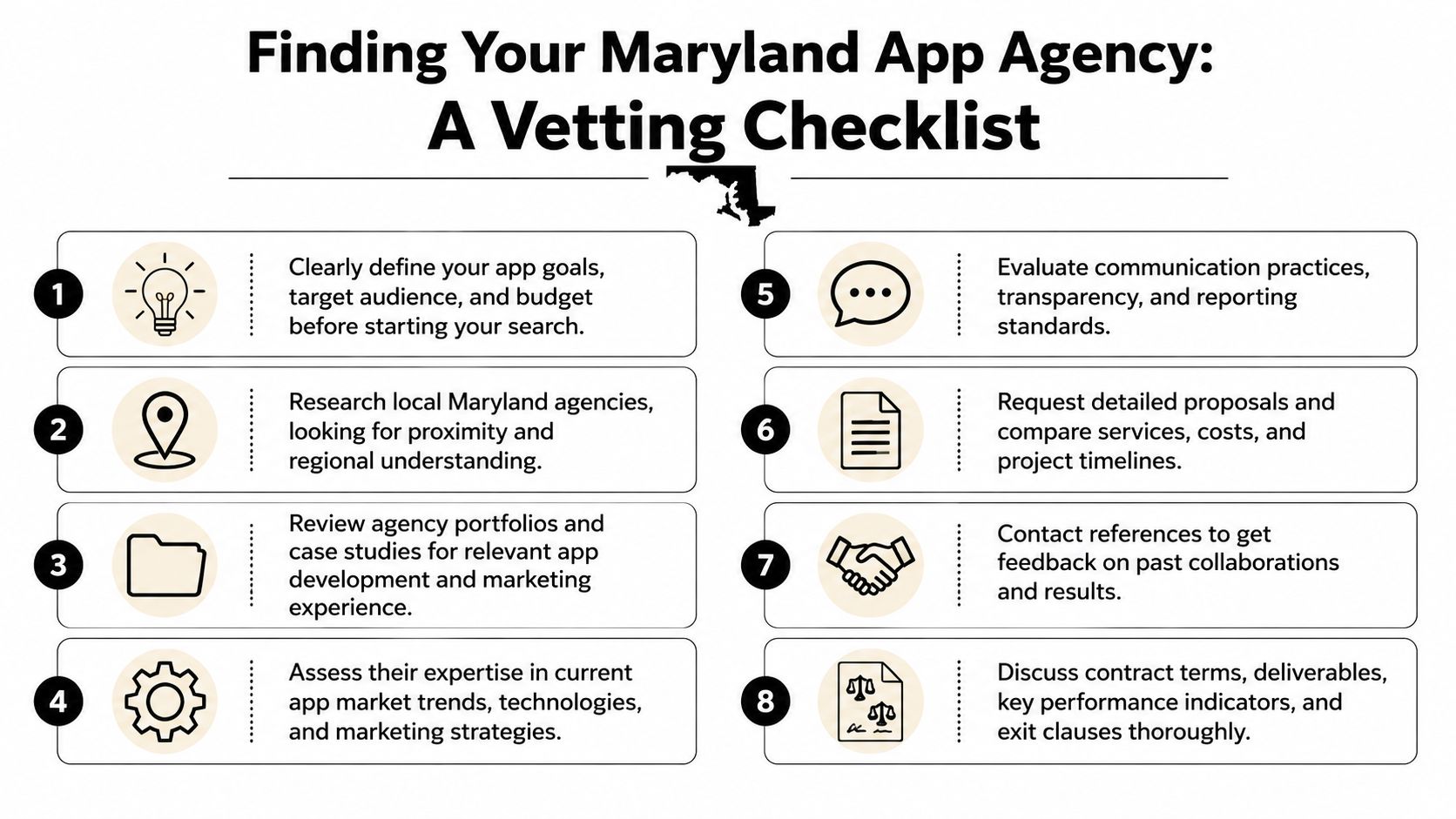
The easiest mistake is choosing the agency with the best pitch deck. The better move is choosing the one that can explain your app's growth mechanics in plain English.
Maryland businesses have an advantage here. You can often find firms or consultants through regional tech networks, founder circles, and communities connected to places like UMBC's bwtech corridor, Baltimore startup meetups, or digital marketing groups across the Baltimore-Washington area. A local conversation tends to reveal more than a polished proposal.
What to look for first
Start with fit, not scale. A smaller agency that understands service-area marketing, subscriptions, or repeat local usage may outperform a larger shop that mostly handles gaming apps or national consumer products.
Review these areas:
- Relevant category experience: Ask whether they've worked on service apps, healthcare apps, loyalty apps, or booking flows similar to yours.
- Operational depth: Who handles ASO, paid acquisition, reporting, and retention strategy? If every answer sounds outsourced or vague, keep looking.
- Communication style: You want clarity, not jargon. If they can't explain their process before the contract, reporting won't improve later.
- Local awareness: They don't need to be Baltimore-based, but they should understand local intent, service radius economics, and regional seasonality.
If you're comparing agencies more broadly, Raven SEO's guide on how to choose a digital marketing agency gives a good framework for separating polished sales from real capability.
The questions that expose real expertise
One issue matters more than most business owners realize. Attribution.
A credible agency should be able to explain how it reports ROI when user tracking is incomplete. As noted by Moburst's app marketing services overview, the attribution gap is a critical issue. Agencies need to explain how they reconcile iOS privacy changes under ATT and cross-device tracking limitations, because that's what separates experienced partners from teams relying on incomplete data.
Ask direct questions like these:
- How do you report performance on iOS when attribution is limited?
- What do you count as a successful install if a user never becomes active?
- How do you distinguish channel quality from channel volume?
- Which in-app events will you optimize toward?
- How often do you revisit creative, audience targeting, and onboarding assumptions?
- What will you need from our internal team every month?
- What happens if paid acquisition is working, but retention is weak?
If an agency can only talk about installs, they're not showing you the full picture.
Red flags in proposals
Some warning signs show up fast:
- They jump to media spend before learning your funnel
- They promise clean attribution across every platform
- They focus heavily on impressions and clicks
- They avoid discussing app store conversion
- They don't ask about onboarding, monetization, or repeat usage
- They have no opinion on what your team should handle internally
A serious app marketing agency should challenge assumptions. If your app isn't ready, the best partner will say so.
Decoding Core App Marketing Services
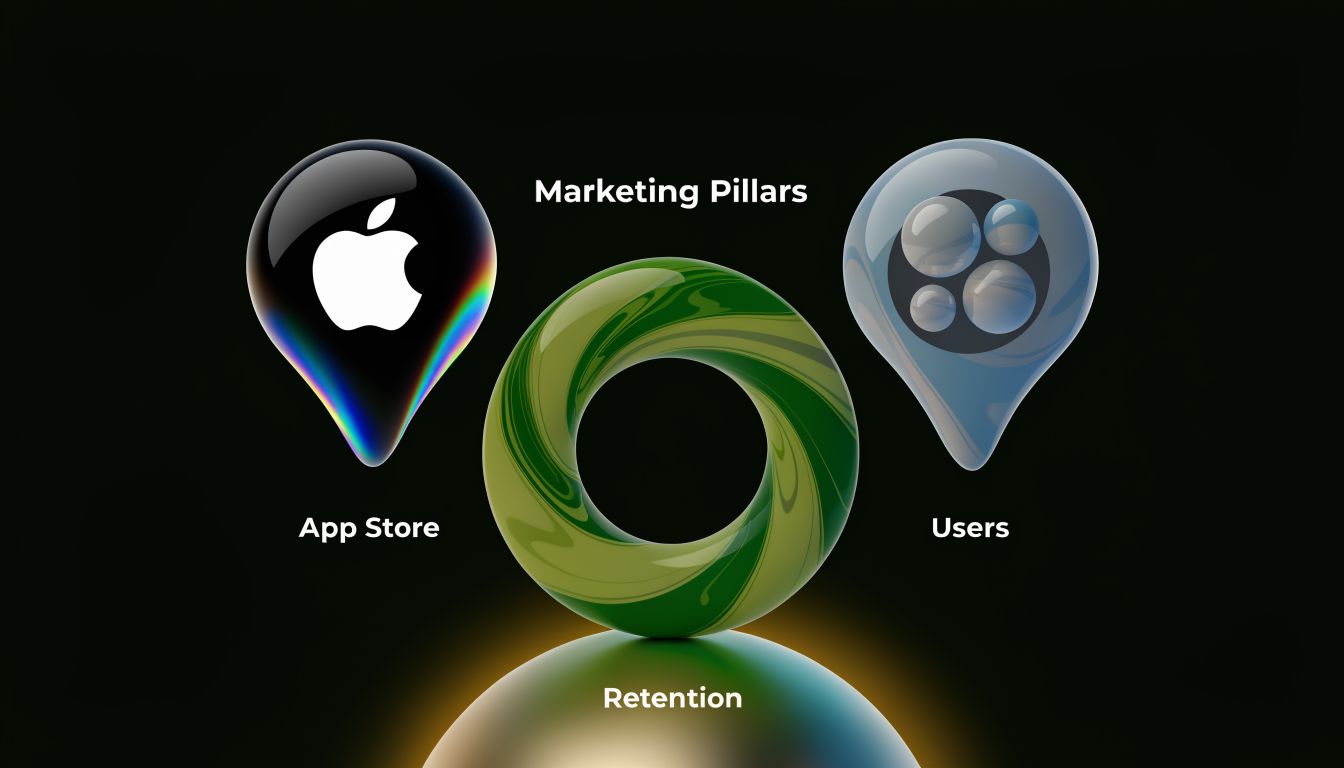
Most proposals revolve around three buckets. ASO, user acquisition, and retention. All three matter, but they don't matter equally at every stage.
ASO means store conversion, not just keywords
App Store Optimization is often sold like mobile SEO. That's incomplete.
Good ASO includes the app title and keyword targeting, but it also includes icon quality, screenshot order, review management, category fit, and the promise your listing makes. For a Maryland service business, that often means clarity beats cleverness. If a plumbing app helps users book emergency service fast, the listing should communicate speed, trust, and ease immediately.
A strong agency will test positioning questions such as:
- Is the value obvious in the first screenshot
- Do reviews reflect the actual user experience
- Does the listing promise the same experience the app delivers
- Are iOS and Android treated as separate conversion environments
For teams also running broader paid search, there's overlap in testing discipline. That's why a practical grounding in Google Ads best practices for conversion-focused campaigns can be useful when evaluating how an agency thinks about intent, message match, and landing experience.
User acquisition should chase quality, not volume
User acquisition is where many business owners overspend. Agencies can buy installs through Apple Search Ads, Google App Campaigns, Meta, TikTok, or other paid channels. The trap is obvious. Cheap installs can still be bad users.
For a local retailer in Maryland, profitable user acquisition may come from a narrow campaign tied to loyalty, reorder behavior, or a specific region. For a healthcare app, channel selection may be constrained by privacy, trust, and onboarding complexity.
What “good” looks like:
- Creative matched to user intent
- Landing or store messaging aligned with the ad
- Campaigns optimized to meaningful in-app events
- Regular creative refreshes instead of set-and-forget media buying
Later in the engagement, ask your agency to show how creative testing decisions are made. If they can't explain what changed and why, they're guessing.
A useful primer on the broader mobile growth mindset is below.
Retention is where the real economics show up
This is the area most often mishandled. According to FoxData's breakdown of in-app marketing indicators, average mobile app retention declines 20–35% between Day 1 and Day 7 post-install. The same source notes that apps improving engagement through session optimization can see 3–4x higher M3 retention versus the industry median.
That changes how you should read every agency report. A campaign that drives installs but loses users immediately isn't growth. It's paid leakage.
Field note: In small business apps, retention usually improves when the app supports an existing habit. Payments, booking, reminders, rewards, and account access tend to outperform “download our app” messaging with no clear repeat use.
What agencies should actively work on:
- Onboarding flow: Remove confusion before the first key action.
- Push strategy: Use reminders carefully and tie them to real utility.
- In-app messaging: Reinforce one next step instead of showing everything at once.
- Cohort review: Compare users by channel, device, and entry path.
If an agency barely talks about Day 7, Week 4, or repeat session behavior, they're over-indexed on acquisition.
Budgeting and Measuring True ROI
Most Maryland businesses don't need a grand mobile growth plan. They need a practical answer to two questions. What will this cost, and how do we know it's working?
The first point is simple. Agency fees only make sense if the app creates durable value. That might be direct revenue from subscriptions or purchases. It might also be retained customers, repeat bookings, or higher order frequency. If you can't define the value of an active user, budgeting becomes guesswork.
Use the CAC and LTV lens
A viable campaign requires a CAC payback period of 12–18 months, and that depends on keeping CPI substantially lower than LTV, according to Financial Models Lab's mobile app marketing KPI guide. That's the benchmark worth learning before you sign any agency contract.
In plain terms:
- CAC is what you spend to acquire a customer.
- CPI is what you spend to generate an install.
- LTV is what that user is worth over time.
If your app is tied to service usage, don't stop at install cost. Ask what a booked appointment, active subscriber, or repeat buyer is worth. That's the business conversation that matters.
For owners who want a clean explanation of how to think about this beyond app marketing, Domino's guide to marketing investment is helpful because it keeps ROI grounded in business outcomes, not vanity metrics.
A simple working formula looks like this:
- Estimate average purchase or revenue event.
- Estimate how often an active user repeats that behavior.
- Estimate how long the average quality user stays active.
- Compare that value to what it costs to acquire them.
If the numbers don't leave room for agency fees, media spend, and iteration time, the model needs adjustment.
DIY versus agency comparison
For budget-conscious operators, the practical choice often isn't “agency or nothing.” It's whether your team can consistently execute the right tasks.
| Marketing Task | DIY Approach (Monthly Effort/Cost) | Agency Approach (Typical Focus) | Key Challenge for DIY |
|---|---|---|---|
| ASO updates | Internal owner revises copy, screenshots, and reviews when time allows | Structured listing optimization tied to conversion behavior | Hard to maintain testing discipline |
| Paid acquisition | Founder or marketer runs limited campaigns in Apple Search Ads, Google App Campaigns, or Meta | Channel strategy, creative iteration, event-based optimization | Platform learning curve and wasted spend |
| Attribution reporting | Manual spreadsheet review with partial platform data | Dashboarding and interpretation across fragmented measurement | Incomplete visibility leads to bad decisions |
| Retention work | Occasional push notifications and basic app updates | Ongoing onboarding, messaging, and cohort analysis | Requires coordination across product and marketing |
| Creative testing | Ad hoc changes based on instinct | Planned testing cycles for ads and store assets | Slow production and weak feedback loops |
| Strategic planning | Built around immediate needs | Linked to LTV, payback, and long-term growth goals | Short-term thinking overrides unit economics |
What to ask for in reporting
The best reports are boring in a good way. They show what changed, what the team learned, and what happens next.
Ask for:
- A clear view of acquisition cost trends
- Store conversion performance
- Meaningful in-app event completion
- Retention movement by cohort
- Notes on what was tested and what failed
- Business impact, not just platform metrics
If you want a broader framework for tying spend to outcomes, Raven SEO's article on measuring return on marketing investment is a solid companion read.
Building a Successful Long-Term Partnership
Hiring an app marketing agency isn't a handoff. It's an operating relationship.
That matters more now because the environment keeps shifting. According to Digital Applied's mobile app marketing statistics for 2026, global mobile app install spend reached $94 billion in 2026, and ATT has created major measurement disruption. That means agencies and clients both have to work inside partial visibility, rising costs, and faster creative cycles.

What strong collaboration looks like
The agency should own channel execution, testing, reporting, and recommendations. Your team should own customer truth.
For a Maryland business, that customer truth is often local and specific. A campaign timed around seasonal home service demand in Baltimore County, a local event tie-in near Annapolis, or messaging that resonates with Ravens fans in Dundalk can improve performance because it reflects lived context. Agencies rarely invent that context well on their own.
Set the relationship up with these habits:
- One shared KPI view: Don't let the agency report one thing while leadership cares about another.
- Regular review cadence: Weekly check-ins for active campaigns. Monthly deeper reviews for strategic shifts.
- Fast feedback loops: Creative approvals, app updates, and offer changes need a path to decision.
- Documented testing log: Every major test should have a reason, result, and next action.
A strong agency-client relationship works best when both sides can say what's not working without getting defensive.
Don't outsource judgment
Some owners hire an agency hoping to avoid app decisions. That usually backfires.
If onboarding is weak, if your offer is unclear, or if users don't have a reason to return, the agency can identify the problem. Your business still has to help solve it. The best partnerships feel less like vendor management and more like a practical working session focused on growth constraints.
Use quarterly reviews to ask better questions:
- Which user segments are proving most valuable
- Where does the first major drop-off happen
- What have we learned about message fit
- Do we need more budget, better product experience, or tighter targeting
- What should we stop doing
For Maryland SMBs, that's often the smartest reason to hire an app marketing agency. Not because the agency magically fixes everything, but because it creates operating discipline around a channel that's easy to misread.
If your business is weighing DIY app growth against hiring a partner, Raven SEO can help you evaluate the decision with a practical, no-pressure lens. We work with businesses that need clearer digital strategy, stronger measurement, and a realistic path to sustainable growth.