
Let's get straight to it: hiring a generalist SEO firm for your medical practice is a critical mistake. To bring new patients through your doors, you need a partner who understands more than just Google. You need someone who lives and breathes the strict rules and high-stakes environment of healthcare marketing.
In this field, a specialized healthcare SEO company isn't a luxury—it's essential for both growth and compliance. This guide is designed to be educational and easy to read, helping you make an informed decision for your practice.
Why Your Practice Needs a Specialist
Getting found online as a healthcare provider is about more than traffic; it’s about earning trust before a patient ever steps into your office. A standard marketing agency might boost your visitor count, but a specialist understands the critical details that protect your practice and build patient confidence.
For practices in hyper-competitive areas, this distinction is what separates a thriving digital presence from a risky, ineffective one.
Generalists almost always miss the single most important factor in medical marketing: HIPAA compliance. Every single patient touchpoint, from a simple contact form to a website chat window, handles Protected Health Information (PHI). A specialized agency knows how to secure these channels and will sign a Business Associate Agreement (BAA) without a second thought. This isn't just a good idea; it's a legal and ethical mandate.
Navigating Google’s Quality Standards
Google holds healthcare websites to a much higher standard under its 'Your Money or Your Life' (YMYL) guidelines. This means your content must demonstrate exceptional expertise, authoritativeness, and trustworthiness (E-A-T).
A healthcare SEO specialist is built for this. They will:
- Ensure every piece of medical content is accurate, current, and either written or reviewed by a qualified medical professional.
- Build a rock-solid online reputation through ethical and proactive patient review management.
- Develop a technically flawless website that is secure, fast, and accessible to every potential patient.
A generalist firm chases keyword rankings. A healthcare SEO specialist focuses on what those rankings actually mean: connecting a real person with a pressing health need to the right provider. It's this patient-first approach that Google rewards.
To understand the difference, it helps to see it side-by-side. Many providers don't realize how deep the gap is between a standard agency and a healthcare-focused one.
General SEO vs Healthcare SEO: What Providers Must Know
This table breaks down the crucial differences that impact your practice's compliance, reputation, and ability to attract the right patients.
| Feature | General SEO Agency | Specialized Healthcare SEO Company |
|---|---|---|
| HIPAA Compliance | Often unaware of requirements; may refuse a BAA. | BAA is standard practice; all tools & processes are compliant. |
| Content Strategy | Creates content to rank for keywords. | Creates content to build trust and demonstrate medical E-A-T. |
| Target Audience | Focuses on broad "customer" demographics. | Focuses on "patient" needs, intent, and local health trends. |
| Reputation Management | Basic review monitoring. | Proactive strategy for patient reviews on Google, Healthgrades. |
| Legal & Ethical Knowledge | Minimal understanding of medical advertising laws. | Deep knowledge of Stark Law, anti-kickback, and patient privacy. |
| Website Security | Standard security practices (HTTPS). | Advanced security for PHI, secure forms, and encrypted data. |
Seeing the services laid out this way makes the choice clear. While a generalist might get your website seen, a specialist ensures it's seen by the right people, for the right reasons, without putting your practice at risk.
The financial stakes are massive. The global healthcare digital marketing sector is now valued at over $210 billion, driven by the fact that 82% of patients use search engines to find their next doctor. With a specialist, you tap into this market correctly.
Ultimately, choosing a specialist means aligning your digital strategy with your core mission: patient care. It guarantees your marketing efforts don't just attract new patients but also uphold the integrity and trust you've worked so hard to build. For providers, understanding the benefits of SEO for small businesses is the perfect first step on this crucial journey.
How to Vet Your Potential SEO Partner
Choosing the right SEO partner from a sea of healthcare marketing companies means cutting through the sales pitches and demanding proof. You need an agency that doesn't just talk a good game but can show you real, tangible results—especially within the heavily regulated medical field. This is where you separate the true specialists from the generalists who just happen to have a "healthcare" page on their site.
It all starts with asking for concrete evidence of their experience. Forget vague promises of "more traffic."
What you need to see are case studies from practices similar to yours in size and specialty. The only metrics that truly matter are new patient inquiries, booked appointments, and a measurable return on your investment. A confident agency won't hesitate to share anonymized data that proves they can deliver.
The HIPAA Compliance Dealbreaker
Here’s the single most important rule: if an SEO agency even flinches when you bring up a Business Associate Agreement (BAA), the conversation is over. Walk away. A BAA isn't a suggestion; it's a legally binding contract that holds them to the same strict HIPAA standards your practice follows for protecting patient data.
Any marketing tool that collects patient information—from a simple "Request an Appointment" form on your website to the analytics software tracking user behavior—handles Protected Health Information (PHI). An agency that doesn't understand this, or isn't prepared to sign a BAA, is a significant liability.
Failing to get a BAA signed with any vendor who touches PHI exposes your practice to massive fines, legal trouble, and a complete erosion of patient trust. Real healthcare SEO experts have this process built into their onboarding. It's second nature.
This flowchart breaks down the initial decision-making process when you're ready to hire a firm to help you acquire more patients.
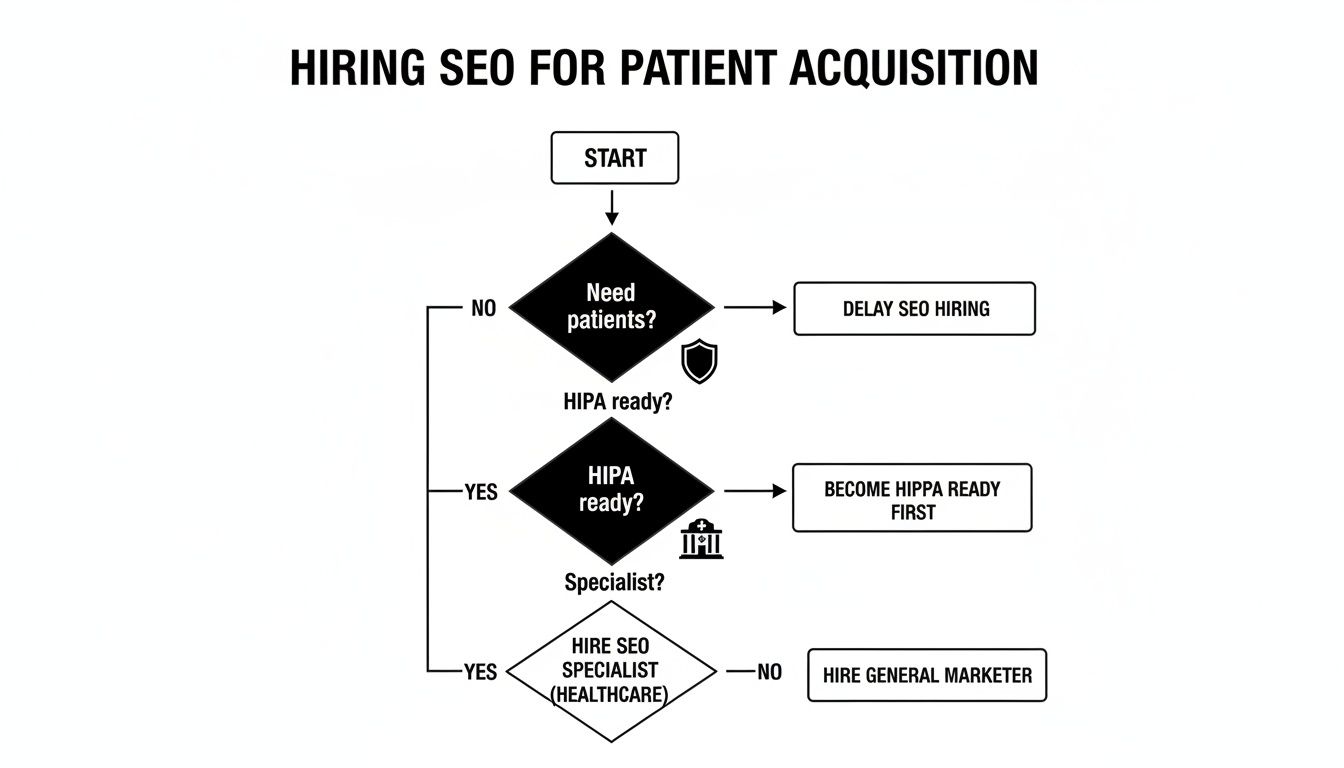
As you can see, HIPAA readiness is the critical first checkpoint. If they don't pass this test, nothing else matters.
Key Questions to Ask Potential Partners
Once you've confirmed they are BAA-ready, it's time to dig into their actual expertise. Your consultation call isn't a sales pitch; it's an interview where you are the one in charge. While our general guide on how to choose the right SEO company offers a great starting point, you need to get more specific for healthcare.
Come to the call armed with questions that reveal their real-world capabilities:
- How do you ensure our website contact forms are HIPAA-compliant? A weak answer is "we use an SSL certificate." A strong answer involves encrypted data transmission, secure form-handling databases, and protocols that prevent PHI from ever sitting in an email inbox.
- What is your process for creating and reviewing medical content? The best agencies have a clear, documented workflow. This either involves their own subject matter experts or, more commonly, a system that requires your team’s final medical approval to guarantee accuracy and uphold Google's E-E-A-T (Experience, Expertise, Authoritativeness, Trustworthiness) standards.
- Can you show me a local SEO campaign you ran for another medical practice? They should be able to walk you through exactly how they optimized a Google Business Profile for a specific service in a specific neighborhood, like "pediatric urgent care in Federal Hill."
Asking sharp, targeted questions like these is the best way to gauge an agency's true expertise and their commitment to keeping your practice safe while helping it grow.
Winning the Local Search Battle
For any healthcare practice, the fight for new patients is won or lost at the local level. When someone in your city urgently searches for a “pediatrician near me” or a visitor needs “urgent care open now,” your practice has to show up. It’s that simple. This is where a deep understanding of local search becomes your most powerful patient acquisition tool.
Top-tier healthcare SEO companies don’t just throw broad keywords at the wall and see what sticks. They master the specific nuances of your service area, turning your Google Business Profile (GBP) from a simple listing into a patient-acquisition machine. This isn't just about adding your address; it’s a strategic process.
Optimizing Your Digital Front Door
Think of your GBP as the digital front door for local patients. A specialist agency will make sure every single element works to attract and convert them.
- Correct Categorization: Are you listed as a "Pediatrician," or could you capture more qualified patients as a "Developmental-Behavioral Pediatrician"? The right category connects you with high-intent searches.
- Service Highlighting: An expert will prominently feature key services that matter right now, like “telehealth availability,” “same-day appointments,” or “in-house lab services.” This instantly answers patient questions and builds confidence.
- Q&A Management: The public Q&A section on your profile is a goldmine for misinformation if left unchecked. A proactive agency monitors this space, answering questions to ensure accuracy and control your practice's narrative.
To truly win locally, practices must leverage the power of Google My Business for local search and own those "near me" queries. It's the most direct path to connecting with patients at their exact moment of need.

Building Hyperlocal Authority
Beyond your Google profile, true local dominance comes from building a network of trust signals across the web. This means earning links and mentions—known as citations—from other authoritative, local sources. Think of it as building a local reputation that Google can see and verify.
A skilled healthcare SEO agency will pursue strategic opportunities that a generalist would completely miss.
Building local authority isn't about getting your name on hundreds of generic directories. It's about earning a place on the resources that local patients and other medical professionals in your area actually trust and use.
For example, a partnership with a local community health blog or a feature from a local wellness event sends incredibly powerful signals to Google. These hyperlocal links tell search engines that your practice is a legitimate, recognized part of the local healthcare community.
This targeted organic approach is also remarkably cost-effective. While healthcare keywords often cost a staggering $4–$35 per click in paid ads, a strong organic strategy can generate 5-10 times more traffic for a fraction of the cost. The return on investment is undeniable; one case study showed a 118.23% increase in user sessions and nearly 1 million Google impressions for a practice that focused on this approach. It's simply a smarter investment.
At Raven SEO, we specialize in these very tactics. For a deeper dive into this topic, you might be interested in our guide on local SEO for medical practices. It provides a detailed look at how to turn local search into a consistent source of new patients.
The Critical Role of Your Website's Health
Let's be blunt: your website is the digital front door to your practice, and for a potential patient, first impressions are formed in seconds. When someone is looking for care, a slow, confusing, or insecure website isn't just an annoyance—it's an immediate red flag that can send them straight to a competitor.
This is where the technical side of SEO moves from being a background IT task to a critical part of the patient experience. It directly impacts your ability to fill your schedule.
Think about how patients search today. They're on their phones, often in a moment of need or urgency. For this reason, a mobile-first design isn't a feature; it's a fundamental requirement. If your site is clunky and hard to use on a small screen, you're losing patients before they even have a chance to find your phone number.

This initial digital interaction sets the entire tone. A fast, intuitive site builds instant trust and confidence. A slow one creates frustration and leads to a high bounce rate, where users give up and leave almost immediately.
Key Elements of a Healthy Healthcare Website
A technically sound website isn't just about trying to please Google's algorithm; it’s about serving your future patients effectively. The best healthcare SEO companies understand that a strong technical foundation is built from several key pillars that work together to create a seamless user journey.
These are the non-negotiables that signal to both people and search engines that your practice is credible, professional, and trustworthy.
- Blazing-Fast Site Speed: Every second matters. A site that takes longer than three seconds to load can lose nearly half of its mobile visitors. Speed is essential for keeping potential patients engaged.
- HTTPS Security: A secure, encrypted connection (the little lock icon in the browser bar) is the absolute baseline. It protects any patient data submitted through forms and reassures users that their information is safe—which is paramount in healthcare.
- Intuitive Site Structure: Can a patient find what they need in two or three clicks? Clear, logical navigation to pages for services, provider bios, accepted insurance, and contact info reduces friction and guides them toward making an appointment.
We also have to talk about accessibility. Ensuring digital accessibility in healthcare is not just a box to check. An accessible site allows all potential patients, including those with disabilities, to access your information. It's the right thing to do, and it also signals to Google that you have a high-quality website.
Turning Technical Excellence into Patient Acquisition
So, how do all these technical details actually translate into more appointments on your calendar? It's simple: a well-built website foundation directly influences patient behavior and conversion rates. When a user lands on a site that is fast, secure, and easy to navigate, they are far more likely to take the next step.
A well-built website doesn't just rank better; it converts better. By removing technical roadblocks, you create a clear path for a user to transition from a curious visitor into a scheduled patient.
This is exactly why we developed Swyft Sites here at Raven SEO. It’s our purpose-built solution for practices that need a modern, high-performance web foundation without the technical headaches. Swyft Sites are designed from the ground up to be fast, secure, and mobile-friendly, addressing all the core elements patients—and search engines—expect.
It’s the ideal starting point for any practice that's serious about growing its patient base through its digital presence. If you want to dig deeper into how site speed specifically impacts your ranking, you can learn more about Core Web Vitals in our article and see why it’s such a major focus for Google.
Alright, you've done the homework. You know what to look for, the red flags to avoid, and the right questions to ask. Now it's time to turn all that knowledge into action. This is where the rubber meets the road—where you build a concrete plan to find the right SEO partner and start driving real growth for your practice.
Your first move is to assemble a shortlist. Based on the vetting criteria we've walked through, find three to five potential healthcare SEO companies that look like true specialists. Hunt for agencies with verifiable case studies in healthcare, a crystal-clear understanding of HIPAA, and a demonstrable focus on your local market.
Once you have your list, it's time to get on the phone. This is where your preparation really starts to pay off.
Getting the Most from Your Consultation Calls
These initial calls are your interview, not theirs. You're the one in the driver's seat. Come prepared with the targeted questions from this guide to cut through the sales pitch and see who really has the expertise your practice needs.
But here’s a pro tip: listen just as much to the questions they ask you.
- Are they digging into your specific patient acquisition goals?
- Do they show genuine curiosity about your practice's unique position in the market?
- Do they want to know about your target patient demographics in specific neighborhoods?
A real partner is curious. They want to understand your business inside and out. An agency that just monologues about their own services is a major red flag. They should be focused on crafting a strategy that fits your practice, not squeezing you into their one-size-fits-all template.
The goal of the consultation isn't to be sold to; it's to start a strategic conversation. A great agency will feel like a partner from the first call, working with you to figure out what success even looks like.
What a Meaningful Proposal Actually Looks Like
After the calls, it's time to ask your top contenders for a detailed proposal. Let me be clear: a generic, one-page quote won't cut it. A proposal worth your time is a strategic document that maps out a clear path to achieving your goals.
It must specifically define:
- The Proposed Strategy: What SEO activities will they actually do?
- Key Performance Indicators (KPIs): How will you measure success? Think patient form submissions, call volume from organic search, and rankings for your most valuable keywords.
- Deliverables and Timeline: What are you getting and when?
- Reporting Structure: How often will you get updates, and what will those reports include?
Choosing a partner with deep market knowledge is crucial. An agency like Raven SEO has a built-in understanding of competitive markets and how local patients search.
You have the framework. You have the knowledge. The only thing left is to take that final step.
If you’re ready to see how a specialized strategy can transform your patient growth, let’s talk. We can provide a no-obligation consultation to build out your custom roadmap. To get a jump-start, take a look at our guide on how to create a digital marketing strategy to help organize your thoughts before our call.
Your Top Questions About Healthcare SEO, Answered
When healthcare providers start thinking about SEO, the same few questions always come up. It's completely understandable—you need to know what you're getting into before committing your practice's time and resources.
We've heard them all. Here are the direct, practical answers to the most common questions we get, designed to clear up any uncertainty and give you the confidence to move forward.
What Makes SEO for Healthcare Different?
SEO for healthcare is held to a much higher standard by Google. Because it falls under the "Your Money or Your Life" (YMYL) category, content must demonstrate exceptional Expertise, Authoritativeness, and Trustworthiness (E-A-T). Furthermore, any company involved must be fully HIPAA-compliant to protect patient data, which is a legal requirement that general SEO firms often overlook. A specialized healthcare SEO company, like Raven SEO, builds its entire strategy around these critical compliance and quality standards.
How Much Do Healthcare SEO Services Cost?
The investment for healthcare SEO can vary widely based on your practice's specialty, location, and competition level. For a comprehensive strategy from a reputable U.S.-based agency, monthly retainers typically range from $2,500 to $10,000+. Be cautious of low-cost offers that promise guaranteed rankings, as they often use risky tactics that can harm your website's reputation. A professional firm will provide a custom proposal after a thorough audit of your specific needs and goals.
Can One Agency Handle Both My SEO and My PPC Ads?
Absolutely. In fact, it’s the ideal setup. The best healthcare marketing agencies, including Raven SEO, offer integrated services that put both organic search (SEO) and paid search (PPC) under one roof. The synergy you get from this is incredibly powerful.
An integrated strategy allows for:
- Shared Insights: Data from your PPC ads—like which headlines get the most clicks—can give your SEO content strategy a huge head start. As your organic rankings improve, you can strategically reduce your reliance on ad spend.
- Consistent Messaging: Patients see a unified brand story whether they find you through a paid ad or an organic search. This consistency is a massive trust-builder.
- Full-Funnel Coverage: You capture patients at every point in their journey, from when they're just starting their research to when they're ready to book an appointment right now.
When a single, cohesive team manages both channels, you can be sure every dollar of your marketing budget is working as efficiently as possible to grow your practice.
Ready to build a strategy that drives real patient growth for your practice? The team at Raven SEO has the local market knowledge and healthcare expertise to help. Contact us today for a no-obligation consultation.