
When a potential patient in your neighborhood searches "doctor near me," does your practice show up? Local SEO is the art and science of making sure the answer is a resounding "yes." It’s a specific strategy designed to put your practice at the top of local search results, turning online queries into new patients walking through your door.
This educational guide breaks down the essential local SEO strategies that medical practices in Maryland can use to attract more patients and grow their community presence.
Why Local SEO Is Essential for Maryland Medical Practices
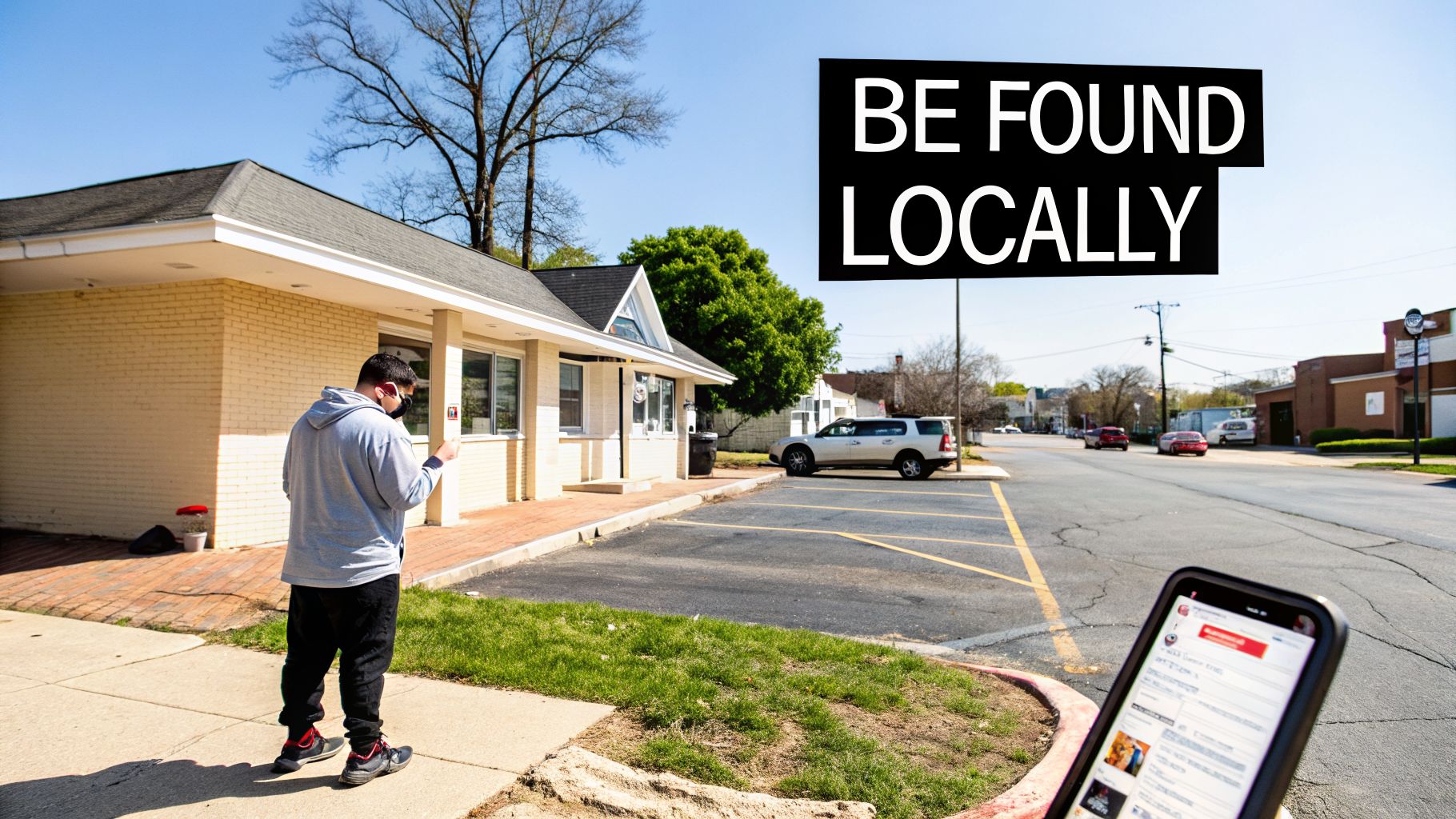
Let's be honest, the days of finding a new doctor through the phone book or even just word-of-mouth are over. Your next patient is on their phone, right now, typing "urgent care in Towson" or "dermatologist near Fells Point." Being visible in that exact moment isn't just a marketing advantage—it’s the new front door to your practice.
This means local search optimization isn't an optional add-on anymore. It's a fundamental part of patient acquisition and growth. If your clinic isn’t on the first page of Google's local results, you're essentially invisible to the vast majority of people in your community who are actively looking for care.
Leveling the Playing Field for Local Practices
Here’s the good news: in local search, size doesn't matter as much as strategy. A solo private practice with a perfectly optimized Google Business Profile, consistent online listings, and a steady stream of patient reviews can absolutely outrank a massive hospital network for neighborhood searches.
For healthcare providers in Baltimore, this is a huge opportunity. We've seen it time and again at Raven SEO: a smaller clinic in Canton can become the most visible option for its immediate community, simply by focusing on a smart local strategy. It's all about being present and trustworthy where it matters most—in your own backyard.
Key Takeaway: Local SEO allows smaller, independent medical practices to compete directly with large hospital networks for local patients by focusing on neighborhood-level visibility and trust signals.
What Does a Smart Local SEO Strategy Involve?
A winning strategy isn't built on a single tactic, but on several key pillars working together. We'll get into the nitty-gritty of each throughout this guide, but here’s a quick look at the essentials:
- Google Business Profile (GBP) Optimization: Think of this as your digital storefront. A complete, active, and well-managed GBP is the single most important factor for your local search ranking.
- Hyperlocal Content: This means creating service pages and blog posts that speak directly to your community (think "Allergy Season Tips for Dundalk Residents" instead of generic health advice).
- Citation & Directory Management: You need to ensure your practice's Name, Address, and Phone number (NAP) are correct and identical everywhere online. Consistency is king.
- Patient Review Management: Ethically encouraging new patient reviews and thoughtfully responding to all of them is crucial for building the trust and social proof Google loves.
For a solid foundation, a detailed guide on how to optimize your website for local search is a great starting point. Our team at Raven SEO builds on these fundamentals with tailored roadmaps, and you can find more of our insights in our guide to local SEO best practices.
Mastering Your Google Business Profile for Patient Trust
Think of your Google Business Profile (GBP) as the digital front door to your practice. It's often the very first interaction a potential patient has with your clinic online, long before they even think about clicking through to your website. For medical practices in Maryland, a fully optimized GBP isn't just another listing; it's a powerful tool for building immediate trust and attracting new patients.
Too many practices make the mistake of setting up their profile and then forgetting about it. But your GBP is a living, breathing part of your online presence that demands active management. It’s your best chance to control the narrative, provide critical, up-to-the-minute information, and showcase your commitment to patient care right where patients are looking—on Google.
This is especially true in crowded local markets. The Google Maps "Local Pack" has become the primary battleground for medical practices in 2026. Studies show that landing in those top three map results can boost patient calls by 50% or more. When a potential patient in Baltimore searches for "primary care doctor near me" or "pediatrician in Towson," those top three spots get almost all the attention. If you're not there, you're practically invisible to patients actively seeking care.
Selecting the Right Medical Categories
The very first step in getting your GBP right is choosing the correct categories. It sounds basic, but this is a critical signal you send to Google about the exact services you provide. Your primary category needs to be the most accurate, high-level description of your practice.
For a general doctor, this would be "Family Practice Physician" or "General Practitioner." A specialist would choose something like "Dermatologist" or "Cardiologist." The key is to be as specific as the platform allows.
After you've locked in your primary category, it's time to add secondary ones for every other relevant service you offer. Does your family practice also handle sports physicals or offer minor dermatological procedures? Add secondary categories like "Sports Medicine Clinic" or even "Medical Spa" if they truly apply. This is how you show up in searches for those niche services.
Pro Tip: Never guess your categories. A great tactic is to see what the top-ranking competitors in your specific Baltimore neighborhood—whether it's Fells Point or Canton—are using. This gives you a clear blueprint of what Google already associates with the leading medical practices in your area.
Writing a Service-Focused Business Description
Your GBP description gives you 750 characters to make your pitch. This isn't just a space to list services; it's your chance to connect with a potential patient who might be feeling anxious or overwhelmed. Ditch the corporate jargon and write with empathy, focusing on the patient's perspective.
For example, instead of this bland statement:
"We are a leading healthcare provider offering a range of medical services."
Try something more human and specific for a Baltimore practice:
"Canton Family Health provides compassionate, patient-centered primary care for your entire family right here in the neighborhood. We believe in building lasting relationships and offer same-day appointments for urgent needs. Your health and comfort are our top priorities."
See the difference? The second example is local, specific, and speaks directly to what a patient is looking for. You can learn more about turning your profile into a local SEO powerhouse in our detailed guide.
A fully optimized Google Business Profile is a complex asset with many moving parts. To help Maryland medical practices get it right, we've created a checklist covering the most critical elements that build patient trust and drive appointments.
GBP Optimization Checklist for Medical Practices
| GBP Element | Optimization Action | Why It Matters for Patients |
|---|---|---|
| Practice Name | Use your exact, real-world business name. Do not add keywords. | Consistency builds trust. Patients need to find the right practice easily. |
| Categories | Select a specific primary category and add all relevant secondary categories. | Helps patients find you for both general and specialized service searches. |
| Address & Service Area | Ensure the map pin is precise. Define your service area if you do home visits. | Accuracy is critical for directions and ensures you appear in the right "near me" searches. |
| Hours of Operation | Keep hours meticulously updated, including holidays and special closures. | Prevents patient frustration from showing up at a closed office or calling after hours. |
| Phone Number | Use a primary, tracked phone number. | Makes it easy for patients to connect and for you to measure call volume from GBP. |
| Website Link | Link directly to your homepage or a new patient landing page. | Provides a clear next step for patients who want more detailed information. |
| Services | Add every service you offer with descriptions and, if applicable, prices. | Patients can quickly confirm if you provide the specific care they need. |
| Photos & Videos | Upload high-quality, recent photos of your office, team, and equipment. | Visuals humanize your practice and set expectations for a clean, professional environment. |
| Reviews | Actively request and respond to all patient reviews (positive and negative). | Shows you value patient feedback and are engaged in managing your reputation. |
| Google Posts | Publish regular updates, health tips, and practice news (at least weekly). | Keeps your profile looking current and provides timely information to the community. |
| Q&A Section | Proactively seed this section with common questions and clear answers. | Reduces patient uncertainty and saves your staff time answering repetitive questions. |
By systematically working through this checklist, you ensure that your practice's "digital front door" is not just open, but welcoming, informative, and optimized to turn a local search into a new patient.
Leveraging Google Posts for Practice Updates
Google Posts are like a social media feed or mini-blog right on your GBP. It's a shockingly underused feature that can dramatically boost engagement and signal to Google that your profile is active and relevant.
Use posts to announce things like:
- New Staff: "Please join us in welcoming Dr. Emily Carter, our new pediatrician!"
- Practice News: "We've extended our Saturday hours to better serve the Towson community."
- Health Information: "Flu season is here. Here’s how to protect your family."
- Service Spotlights: Highlight a specific service you offer, like sports physicals or allergy testing.
These posts have a limited lifespan, so it's a good habit to create a new one every 7-10 days. It’s a simple way to show both Google and prospective patients that your practice is an active, current, and engaged part of the local community.
Proactively Managing the Q&A Section
The Questions & Answers section of your GBP is one of the most valuable—and riskiest—features on the platform. Anyone can ask a question, and crucially, anyone can answer it. If you don't take control of this section, you risk having incorrect information posted by well-meaning but uninformed users.
The best strategy here is a proactive one. You can and should "seed" this section by asking and answering your own questions. Think about the top five or ten questions your front desk staff fields every single day, and add them directly to your GBP.
Example Q&A Seeds:
- Q: "Do you accept Cigna insurance?"
- A: "Yes, we are in-network with most Cigna PPO plans. We always recommend calling our office with your specific plan details to confirm coverage before your visit."
- Q: "Is there free parking available at the clinic?"
- A: "Absolutely! Our Fells Point office has a dedicated patient parking lot located directly behind our building on Ann Street."
By answering these common questions before they're even asked, you reduce friction for potential patients, save your staff valuable time, and build a foundation of trust before a patient even picks up the phone. At Raven SEO, we've found this single tactic can dramatically improve the patient experience from the very first click.
Building Trust Across the Web: Citations and Schema Markup
Once your Google Business Profile is polished, it's time to build authority beyond Google's ecosystem. This is about making sure your practice’s information is consistent everywhere online and that your own website speaks Google’s language fluently.
Think of it this way: your GBP is your primary digital ID card. Local citations are all the other official documents—spread across the web—that prove your ID is legitimate. At the same time, schema markup is how you add special, clarifying notes directly onto your website so search engines have zero doubt about who you are and what you do.
A local citation is simply any online mention of your practice’s Name, Address, and Phone number (NAP). The absolute, unbreakable rule here is NAP consistency. Even a tiny variation, like "St." versus "Street" or "Suite #101" versus "Ste 101," introduces doubt. This inconsistency tells search engines your data might be unreliable, which can directly hurt your rankings.
Focus on High-Authority Medical Directories
Not all citations carry the same weight. While general directories like Yelp have their place, your time is best spent on the high-authority medical platforms that your potential patients are already using and trusting.
Make these four platforms your immediate priority:
- Healthgrades: A powerhouse for patient reviews and physician research.
- Vitals: Another major player in the online healthcare directory space.
- Zocdoc: Essential if you use it for booking, but also a critical citation source regardless.
- WebMD: One of the most recognized and trusted names in health information online.
Claiming and meticulously optimizing these profiles isn't optional. You need to fill out every field, list your services accurately, and ensure the NAP is a perfect mirror of your Google Business Profile. This creates a consistent, trustworthy echo of your practice's identity across the web.
Translating Your Expertise with Schema Markup
While citations build your off-site authority, schema markup clarifies your practice's details on your own website. It’s a specific type of code (or structured data) that you add to your site’s backend, acting as a translator for search engines.
For a medical practice, this is incredibly powerful. Instead of Google just seeing a block of text with a doctor’s name, schema tells it explicitly: "This person is a Physician, this is their specific medical specialty, and this is the Medical Clinic where they practice." It removes all ambiguity, helping Google match your practice to highly relevant patient searches with much greater confidence.
Google’s standards for medical practices have gotten incredibly sophisticated. In 2026, it's looking at far more than just keywords. Signals from your GBP, the medical credibility of your website, review patterns, and citation consistency are all part of the equation. In fact, patient reviews now make up a staggering 16% of the local ranking algorithm, turning your reputation into a direct, measurable SEO factor.
The diagram below shows how different parts of your Google Business Profile, like your chosen categories and the services you list, are foundational to this whole process.
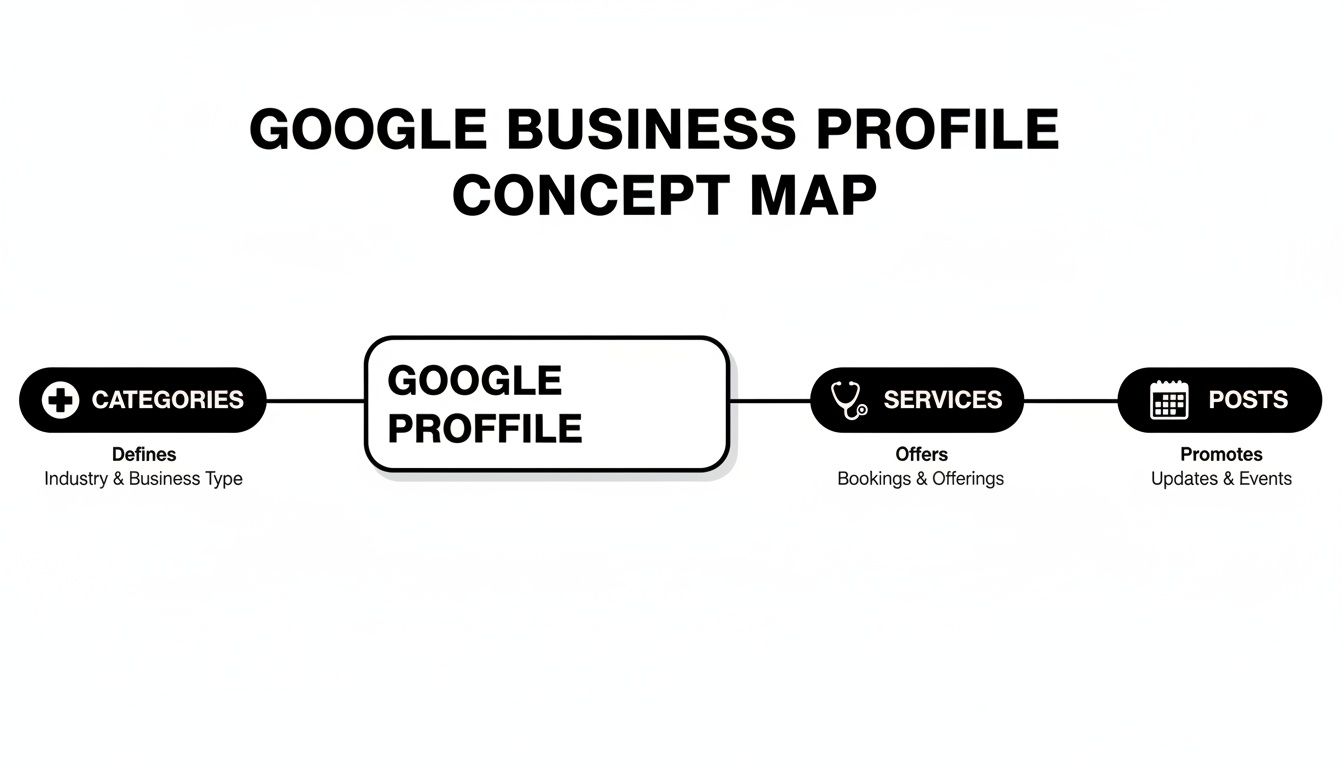
As you can see, a well-structured GBP is the central hub. When your categories are precise, your services are detailed, and your posts are active, all these elements work together to build a complete and trustworthy profile for search engines and, most importantly, for patients.
Key Schema Types to Implement
You don’t have to be a developer to get started. Many modern website platforms have tools to help, but knowing which schema to use is the real key. For a Maryland medical practice, you'll want to focus on these essentials:
MedicalClinicorPhysician: This is your top priority. UseMedicalClinicon pages about the practice itself andPhysicianon individual doctor bio pages.LocalBusiness: This reinforces your location-specific details, including your precise address, phone number, and hours of operation.Review: This schema allows you to mark up patient testimonials on your own website, which can help Google display those coveted star ratings right in the search results.
By implementing schema, you're not just organizing data; you're structuring your credibility. It's a technical way of telling Google, "We are exactly who you think we are," which is a cornerstone of effective local SEO for medical practices.
Adding schema might seem technical, but it's a critical step in a modern SEO strategy. If you're looking to dive deeper into the nuts and bolts, check out our guide on what schema markup is and how it works. At Raven SEO, we handle this technical implementation for our clients, ensuring their websites are speaking Google's language fluently from day one.
Creating Hyperlocal Content That Attracts Maryland Patients
A generic article about "seasonal allergies" won't cut it for a patient living in Canton. They need to know you understand their specific concerns, from the pollen counts near Patterson Park to how waterfront living in Fells Point might affect their symptoms. This is the core of hyperlocal content: moving past broad medical topics and becoming the go-to neighborhood health resource.
When your website speaks the local language, it does more than just provide information. It builds immediate trust and signals to both Google and prospective patients that you are an integral part of their community. This is how you attract highly qualified patients actively searching for care right in your backyard.

Develop Hyperlocal Service Pages
It’s time to transform your standard service pages into powerful local magnets for patients. Instead of having one general "Pediatric Services" page, think on a neighborhood level. Creating dedicated pages for the specific communities you serve is a game-changer for local relevance.
For instance, you could build out pages like:
- "Pediatric Sports Physicals in Towson": This page can go beyond a simple service description. Mention the requirements for Baltimore County Public Schools or popular youth sports leagues in the area, showing you understand the local landscape.
- "Allergy Treatment for Fells Point Residents": Here, you can discuss seasonal triggers unique to waterfront communities, referencing proximity to the harbor and local pollen patterns.
- "Urgent Care Near Canton Crossing": Weave in familiar landmarks. Mentioning easy access from Boston Street or how close you are to O'Donnell Square makes your location tangible and convenient.
These details might seem small, but they prove to search engines and patients that your practice isn't just in the community—it's part of it.
Craft Blog Content That Resonates Locally
Your blog is where you can truly cement your status as a local health authority. This is your chance to answer the specific health questions Marylanders are typing into Google, building trust long before they ever need to book an appointment.
Think about the unique lifestyle and health factors of your patient base. Your content should reflect their world.
Some ideas a Maryland practice could run with:
- A guide to managing springtime allergies along the Chesapeake Bay.
- "Runner's Knee? Prevention Tips for Tackling Baltimore's Hilly Parks."
- "How to Enjoy Maryland Blue Crabs Without Derailing Your Health Goals."
- "Staying Hydrated and Safe During a Humid Maryland Summer."
This approach shows you're committed to the well-being of the people in your area. If you want to dig deeper into this strategy, check out our insights on how to handle hyper-local content for maximum impact.
Use HIPAA-Compliant Success Stories
Patient testimonials are gold, but HIPAA compliance is non-negotiable. While you can't share personal stories without explicit, written consent, you can still create powerful, compliant narratives that resonate with prospective patients.
The key is to shift the focus from the person to the problem and your solution. A compelling testimonial can detail the frustration of chronic knee pain and the life-changing relief of finding an effective treatment plan—all without ever disclosing protected health information.
Consider creating composite "patient journeys" or generalized case studies based on common experiences at your practice. You could, for example, outline the process of a new mother navigating postpartum care at your clinic. This builds an emotional connection and showcases your compassionate approach while rigorously protecting patient privacy. It's this type of authentic, trust-building content that forms a core part of the local SEO strategies we implement for our clients at Raven SEO.
HIPAA-Compliant Review and Reputation Management
In healthcare, patient trust is everything. Online, that trust is measured in stars and reviews. For any medical practice in Maryland, patient reviews are one of the most powerful signals you can send to both prospective patients and Google. A steady stream of positive feedback validates your quality of care, but even more telling is how you handle the negative ones.
The secret isn't just collecting five-star ratings. It’s about building a secure, compliant dialogue with your patients. This process demonstrates your commitment to patient satisfaction, and it shows search engines that you're an active, reputable practice worth featuring.
Managed correctly, your online reputation transforms from a potential minefield into one of your greatest assets for earning authority and attracting new patients in your community.
Ethically Encouraging Patient Feedback
Let’s clear this up right away: you absolutely can—and should—ask patients for reviews. The critical detail is how you ask. Your entire process must be effective at generating feedback without ever compromising HIPAA regulations.
You can't offer gift cards or discounts for reviews, and your request must always be neutral. It can’t even hint at the specific service or treatment a patient received. A simple, general request is the safest and most effective path.
The best approach we’ve seen is automating the request through a secure platform, like a post-appointment email or text message.
- Email Example: "Thank you for visiting [Your Practice Name] today. We sincerely value your feedback and would appreciate you taking a moment to share your experience with our team on Google. Your input helps us improve and allows others in our community to find quality care."
- Text Message Example: "Hi [Patient First Name], thanks for your recent visit to [Practice Name]. We'd love to hear your feedback. You can leave us a review here: [Link to Google Review]."
This simple workflow makes it incredibly easy for happy patients to share their experience, systematically building your online reputation. If you're exploring text messaging, this guide on Health Care SMS for Modern Practices is a great resource for navigating the regulations.
Responding to Reviews While Protecting Privacy
Getting reviews is only half the battle. How you respond is just as important, and in many ways, it's where the real risk lies. Every single review, whether it's a glowing five-star rating or a critical one-star comment, deserves a professional and timely response.
Crucial Reminder: Your public responses are visible to everyone. Never, under any circumstances, acknowledge that the reviewer is a patient or mention any Protected Health Information (PHI). Your replies must be generic to protect privacy, no exceptions.
Here’s a simple, compliant framework for responding:
For Positive Reviews:
Acknowledge the feedback graciously without confirming a patient relationship.
- Example: "Thank you so much for the kind words! We are dedicated to providing a positive and welcoming experience for everyone who walks through our doors."
For Negative Reviews:
Acknowledge their stated concerns and immediately move the conversation to a private channel.
- Example: "Thank you for sharing your feedback. We take all comments seriously and are committed to providing the best possible experience. Please contact our practice manager, [Name], at [Phone Number] so we can listen and address your concerns directly."
This approach shows you’re listening and are proactive about solving problems, all while maintaining strict HIPAA compliance. For a deeper dive into turning feedback into a powerful marketing tool, check out our comprehensive Google reviews guide.
Frequently Asked Questions About Medical SEO
We get a lot of the same questions from practice managers and doctors across Maryland. It’s a specialized, complex field with its own set of rules, especially when you factor in HIPAA and the competitive nature of healthcare in our state.
So, let's clear up a few of the most common questions we hear, with straightforward answers based on our experience.
How Long Does It Take for Local SEO to Work for a Medical Practice?
This is always the first question, and the honest answer is that local SEO is a long-term investment, not a quick fix. Think of it like building a strong foundation for a house—it takes time, but it’s essential for lasting stability.
You'll see some early wins, for sure. Getting your Google Business Profile claimed and properly optimized can start showing results in just a few weeks. But the real, needle-moving growth comes from a comprehensive strategy.
For most medical practices in competitive Maryland areas like Baltimore or Bethesda, you can expect to see a significant, measurable increase in patient calls and online bookings within 4 to 6 months. This timeframe depends on your specialty, how much competition you have, and where your online presence stands today.
The goal of great medical SEO isn't about a temporary traffic spike. It's about methodically building real authority and trust with Google to create a reliable, steady stream of new patients for years to come.
It’s a gradual climb, but one that pays significant dividends. At Raven SEO, we build the foundational strategies that deliver exactly that kind of sustainable, long-term growth.
Can My Office Staff Handle Local SEO or Do I Need an Agency?
Your office staff is the backbone of your practice, managing patient care and operations with incredible skill. They can absolutely handle some basic SEO tasks, like updating your hours on Google or posting a holiday notice.
But a truly effective local SEO strategy goes far deeper than these surface-level updates. It’s a specialized discipline that requires dedicated time and expertise in areas that are simply outside the scope of an office manager’s already packed role.
Getting real results demands deep, current knowledge of Google’s algorithms and dedicated focus on tasks like:
- Technical SEO: Digging into your website's code and structure to ensure it’s perfectly optimized for search engines.
- Citation Management: Methodically hunting down and correcting your practice's information across dozens of medical and local online directories.
- HIPAA-Compliant Strategy: Building review request campaigns and response plans that are both effective and 100% compliant.
- Hyperlocal Content: Writing service pages and articles that speak directly to patients in specific Maryland neighborhoods, from Fells Point to Silver Spring.
Bringing in an agency like Raven SEO gives you a team of specialists who live and breathe this stuff. We ensure all the pieces of your local SEO puzzle work together, freeing up your staff to focus on what they do best—caring for your patients.
Is It a HIPAA Violation to Ask Patients for Online Reviews?
This is a critical question, and a common point of anxiety for medical professionals. Let's clear it up: No, it is not a HIPAA violation to ask your patients for online reviews.
Where HIPAA comes into play is in how you ask for and respond to those reviews. The absolute golden rule is to never, ever disclose any Protected Health Information (PHI) in a public forum.
This means your request for a review must be generic. More importantly, your public response to any review—good or bad—must be equally non-specific. You cannot mention a patient's condition, their treatment, or even confirm in your public reply that they are, in fact, a patient.
A safe response to a positive review is something simple: "Thank you for sharing your feedback." For a negative one: "We take all feedback seriously and are committed to patient care. Please contact our office directly to discuss your experience." That’s it.
The key is creating a secure process that completely separates the review request from any PHI, ensuring your public-facing channels remain fully compliant.
How Does Local SEO Work for a Practice with Multiple Maryland Locations?
Managing local SEO for a practice with several offices isn’t a "one-size-fits-all" job. You can't just copy and paste your strategy. Each location has to be treated as its own distinct entity in Google's eyes.
The first step is non-negotiable: each physical office needs its own separate, fully optimized Google Business Profile. If you have clinics in Annapolis and Columbia, you need two unique GBP listings.
From there, the strategy expands for each location:
- Dedicated Location Pages: Your website must have a unique page for each office. This isn't just a list of addresses. It’s a full page with the local address, a local phone number, and content tailored to that specific community.
- Hyperlocal Content: The content on each location page needs to be different. Mention nearby landmarks, talk about the specific services offered at that office, and feature testimonials from patients in that area.
- Individualized Citations: Each office needs its own set of local citations. Your Annapolis office and your Columbia office must have their own unique NAP (Name, Address, Phone) profiles built across the web.
This layered approach sends powerful signals to Google that you are a legitimate, established presence in each community you serve. It proves you're a true local provider in multiple neighborhoods, not just one business casting a wide net. Raven SEO specializes in creating these scalable, individualized roadmaps for multi-location medical groups across Maryland.
Ready to see how a professional, tailored SEO strategy can transform patient acquisition for your Maryland practice? The team at Raven SEO is here to help. We offer a no-obligation consultation to build a roadmap for your specific goals.
Learn more and schedule your free consultation with Raven SEO today!


![Maryland Social Media Marketing and Consulting Guide [2026] | Raven SEO](https://raven-seo.com/wp-content/uploads/2026/04/social-media-marketing-and-consulting-office-desk-400x468.jpg)