
Choosing the right SEO company is a significant decision for any business, and it starts with a clear understanding of your own goals. Before you start interviewing agencies, it's essential to define what a successful partnership will look like. This crucial first step transforms a hopeful guess into a strategic investment.
Setting Clear Goals Before You Start Your Search
Contacting SEO agencies without specific goals is like starting a road trip without a destination. Vague objectives like "get more traffic" or "rank #1 on Google" are common but lack the precision needed to build a winning strategy or measure real business impact.
The preparatory work you do now is non-negotiable. It allows you to communicate your needs clearly and, more importantly, hold your future partner accountable for the results. This initial planning turns your search from a shot in the dark into a focused, educational mission.

Define What Success Looks Like
Before you can figure out how to choose an SEO company, you need to define your finish line. Try to think beyond just traffic numbers and focus on tangible business outcomes. What will a successful SEO campaign actually deliver for your bottom line?
Your goals need to be SMART: Specific, Measurable, Achievable, Relevant, and Time-bound. This framework is a classic for a reason—it forces you to swap fuzzy ideas for concrete targets.
Here are a few examples of strong, measurable SEO goals:
- Increase qualified organic leads from our contact form by 25% within the next six months.
- Achieve top-3 rankings for five of our most important Baltimore-area service keywords by the end of the year.
- Boost organic revenue from our e-commerce store by 40% in the next fiscal year.
- Decrease paid ad spend by 15% by driving more organic traffic to key landing pages over the next nine months.
When you set these precise targets upfront, you give potential agencies a clear benchmark for success. A solid partner can then build a realistic strategy designed to hit those numbers, which makes calculating your ROI straightforward.
Conduct a Quick Self-Audit
Once you have your goals, take a quick look at where you're starting from. You don't need a deep technical dive—just a high-level snapshot to understand your starting point. For a more detailed look at what's involved, you can always explore our guide to local SEO best practices.
Ask yourself these simple questions to get a baseline:
- What are we doing now? Do we have a blog? Are we posting on social media? Have we ever tried SEO before, and what happened?
- Who are our top competitors? Jot down three to five local or online competitors who always seem to pop up when you search for your own services.
- What is our realistic budget? Figure out a monthly investment you're comfortable with. Remember, good SEO isn't a one-and-done expense; it's an ongoing investment in your growth.
Finding an Agency with the Right Experience
Once you have your goals mapped out, the next step is finding a partner with the right kind of experience. This is huge. Not all agencies are created equal, and a generalist firm that claims to do everything for everyone might not have the sharp-edged skills needed to win in a competitive market like Maryland.

True expertise often comes from specialization. Think about it: an agency that has already helped a Baltimore law firm rank for competitive legal terms, or guided a local home services contractor to the top of Google Maps, brings invaluable insights to the table. They already understand your audience’s search habits and the local competitive landscape.
This means they can hit the ground running with effective strategies, not learn your industry on your dime. Partnering with a specialist can seriously shorten the time it takes to see meaningful results.
The Power of Industry Specialization
I can't overstate the importance of specialization when you're choosing an SEO agency. The market has splintered into niches for a reason—there are SaaS SEO experts, technical SEO specialists, content-focused firms, and even healthcare-compliant agencies. For professional services firms, healthcare providers, and e-commerce retailers in the Maryland region, this specialization really matters.
A team that knows your industry’s unique challenges and customer behaviors holds a distinct advantage. A specialist agency can anticipate problems and opportunities a generalist might completely miss.
For instance, an e-commerce specialist lives and breathes things like:
- Schema Markup: Implementing product, review, and shipping schema to make your search listings pop.
- Site Architecture: Structuring category and product pages for a smooth user experience that Google loves to crawl.
- Conversion Rate Optimization: Knowing what design and content elements actually drive online sales in your specific niche.
Meanwhile, an agency focused on local services is going to be a master of:
- Google Business Profile: Advanced optimization strategies to get you in the map pack.
- Local Citations: Building consistent and authoritative mentions across directories that matter locally.
- Review Management: Strategies for generating positive reviews that build trust and boost your rankings.
Choosing a specialist is like hiring a surgeon for a specific operation instead of a general practitioner. Both are skilled, but one has the precise experience needed for the complex task at hand. This is the level of expertise you should seek from your https://raven-seo.com/baltimore-seo-company/.
How to Verify an Agency’s Expertise
Talk is cheap. Any agency can claim to be an expert, but the proof is in their past performance. Your job is to dig into their track record and verify that their experience lines up with your business goals.
Start by asking for case studies and client testimonials, but don't just take them at face value. Look for concrete data and specifics that match the goals you’ve set for your own business.
Here's what to look for when you're reviewing their work:
- Relevance to Your Industry: Are the examples from businesses similar to yours in size and sector? Success with a national software company doesn't automatically mean they'll know what to do for a local Maryland plumber.
- Specific Metrics and Results: Vague statements like "we increased traffic" are a major red flag. You want to see hard numbers: "300% increase in organic leads," "75% growth in non-branded keyword rankings," or "$50,000 in new revenue attributed to SEO."
- A Clear Process: A good case study outlines the how. It should briefly explain the initial challenges, the strategy they used (like a technical audit, content plan, or link building), and the timeline for getting results.
When you’re assessing an agency's experience, it’s also a good idea to dig into their specific SEO link building strategies to make sure they're using ethical and effective practices. This gives you a clear window into their methods.
By carefully vetting an agency's real-world experience, you move beyond marketing claims and find a true partner capable of delivering the results your business needs to grow.
Decoding an Agency's Process and Communication
A great SEO partnership comes down to two things: a proven process and transparent communication. Without both, you're essentially flying blind. You need to understand not just what an agency will do, but how they’ll get it done and how they'll keep you in the loop along the way.
When you’re evaluating potential partners, look for one with a documented, repeatable process. A top-tier agency doesn't just "do SEO"; they follow a structured methodology that starts with a deep dive into your business and ends with results you can actually measure.
This isn't about some mystical "secret sauce." It's about having a systematic approach that ensures no stone is left unturned. A solid process provides the framework for sustainable growth and helps you see exactly where your investment is going each month.
The Anatomy of a Strong SEO Strategy
An effective SEO strategy is a multi-faceted campaign, not a one-and-done task. A reputable agency like Raven SEO will walk you through a clear plan that gets several core components working in harmony.
During your conversations, listen for how they describe these key pillars:
- Technical SEO Audit: This should always be the starting line. The agency needs to perform a deep dive into your site’s technical health, checking for issues with site speed, mobile-friendliness, crawlability, and indexing that could be holding you back.
- Keyword Research and Strategy: They should be able to explain their process for identifying the high-value keywords your customers are actually searching for. This goes way beyond just targeting high-volume terms; it's about understanding user intent and mapping keywords to the different stages of a customer's journey.
- Content Creation and Optimization: High-quality content is the fuel for any successful SEO campaign. As you scrutinize an agency's approach, evaluate their adherence to current SEO content writing best practices, which are crucial for visibility and success. They must have a clear plan for creating or optimizing content that answers user questions and establishes your authority.
- Link Building: Ask them point-blank about their approach to building your website’s authority through backlinks. A good agency will focus on earning high-quality, relevant links from reputable sources—not buying spammy links that could get your site penalized by Google.
This entire system has to be adaptable. Google's algorithm is always changing, so a proactive agency will have a plan for monitoring updates and adjusting your strategy on the fly. For a deeper look into the specifics, check out our guide on how SEO agencies work.
Evaluating Communication and Reporting
Even the best strategy on paper will fail if the communication is terrible. An agency’s process for keeping you in the loop is just as important as the work itself. You should never be left wondering what's being done or if it's even working.
Before signing anything, it's crucial to ask the right questions to ensure their process aligns with your expectations. The table below outlines some essential inquiries to help you dig into their methodology and communication style.
Key Questions to Ask About an Agency's Process
| Area of Inquiry | Crucial Question to Ask | What a Good Answer Looks Like |
|---|---|---|
| Strategy & Onboarding | "What does the first 90 days of working together look like? Can you walk me through your onboarding process?" | A detailed response covering discovery, technical audits, keyword research, goal setting, and initial strategy development. It should sound structured, not improvised. |
| Tactical Execution | "How do you approach link building? What methods do you use to earn high-quality backlinks?" | They should emphasize earning links through quality content, outreach, and digital PR. Red flags include vague answers or mentions of buying links. |
| Communication Flow | "Who will be my main point of contact, and how often can I expect to receive updates or have meetings?" | A clear answer naming a dedicated account manager or specialist and outlining a specific cadence for communication (e.g., bi-weekly calls, monthly reports). |
| Reporting & KPIs | "What key performance indicators (KPIs) do you track, and what does your standard monthly report include?" | They should focus on metrics tied to business goals (leads, conversions, revenue) in addition to SEO metrics like traffic and rankings. The report should tell a story, not just dump data. |
| Adaptability | "How do you stay on top of Google algorithm updates, and how would you adjust our strategy if a major update impacts our site?" | They should mention continuous learning, industry monitoring, and a proactive (not reactive) approach to algorithmic shifts, focusing on long-term best practices. |
Asking these questions upfront will save you a world of headaches later. A confident agency will have clear, thoughtful answers for every single one.
A true partner doesn't just send you a spreadsheet of data. They translate that data into a story about your business growth, connecting SEO metrics to your actual bottom-line goals like leads and revenue.
Look for a clear communication rhythm. Will you have a dedicated point of contact? How often can you expect to meet? The industry standard is typically monthly reporting, but the quality of that report is what really counts.
A valuable report should clearly show progress toward the goals you established from the start. It should highlight the key performance indicators (KPIs) that actually matter, such as:
- Organic traffic growth
- Keyword ranking improvements
- Conversion rates from organic visitors
- Lead generation and revenue impact
The agency must be able to walk you through these reports, explain what the numbers mean, and outline their plan for the upcoming month. This level of transparency and accountability is the hallmark of a partner you can trust to help grow your business.
Breaking Down SEO Pricing and Contract Terms
Trying to make sense of SEO pricing can feel like a chore. Agencies package their services in all sorts of ways—from monthly plans to one-off project fees—making it tough to compare apples to apples. But getting a handle on these models is crucial for picking an SEO partner that fits your budget and what you’re trying to achieve.
The whole point is to cut through the jargon so you know exactly where your money is going. A transparent agency will have no problem explaining their pricing and connecting it directly to the work they’ll be doing. If they’re cagey about costs, that's a huge red flag.
Common SEO Pricing Models
You're likely to run into three main pricing structures. Each has its place, and the right one for you really depends on your specific needs, the scope of the work, and your long-term goals. Let's look at what you’ll see out there.
- Monthly Retainer: This is the industry standard for ongoing SEO. You pay a set fee each month for a consistent block of services, like content creation, technical SEO monitoring, and link building. It’s perfect for long-term growth because it allows the agency to build and maintain momentum over time.
- Project-Based Pricing: This is a one-time fee for a specific, well-defined task. Think of things like a full website migration, a deep-dive technical audit, or setting up your local SEO from scratch. It’s great for businesses with a clear, finite need but doesn't work for the sustained effort that real SEO requires.
- Hourly Consulting: Some freelancers or agencies bill by the hour for their time and advice. This can be handy for specific training or for getting a second opinion on a particular problem, but it gets expensive fast if you’re looking for comprehensive campaign management.
The monthly retainer model is usually the most effective, with prices typically ranging from $1,500 to $5,000+ per month for small and mid-sized businesses. This reflects the reality that SEO isn't a one-and-done task; it's a continuous process of testing, learning, and improving.
Scrutinizing the SEO Contract
Once you’ve landed on a pricing model, the contract is the next major checkpoint. This is where all the verbal promises get put down in black and white. Don't just give it a quick scan—read every single word. This document is your ultimate tool for holding the agency accountable.
Any agency worth its salt will give you a clear, detailed contract that includes a Scope of Work (SOW). The SOW is your game plan; it should spell out all the activities, deliverables, and key metrics. If you see vague language, demand more specifics.
As you review the contract, zero in on these critical details:
- Term Length: Be very careful with long lock-in periods. SEO certainly takes time, but a mandatory 12-month contract with no way out can be a serious trap. Most reputable agencies start with a 6-month term or even move to a month-to-month agreement after an initial period.
- Deliverables: The contract needs to state exactly what you’re getting. Are they writing four blog posts a month? Performing a monthly technical site check? Get it in writing. Vague promises lead to disappointment.
- Ownership Clause: Make sure the contract explicitly states that you own 100% of your website, its content, and any accounts set up for you (like Google Analytics). You should never be in a position where an agency can hold your assets hostage in their proprietary system.
- Cancellation Policy: What happens if the partnership just isn't working? A fair contract will have a clear termination clause, usually requiring a 30-day notice.
Getting these financial and contractual details right is just as important as vetting an agency's strategy. It sets the stage for a transparent and productive partnership where everyone is on the same page. You can learn more about how to tie these costs to real business outcomes in our guide on calculating the return on investment of SEO.
Spotting Red Flags and Unrealistic Promises
In the world of SEO, if a promise sounds too good to be true, it almost certainly is. Learning how to spot the red flags is one of the most critical skills you can develop when choosing an SEO company. It's what will protect you from bad actors who use flashy guarantees to lock you into worthless, long-term contracts.
Getting this right isn't just about avoiding a bad investment. Some agencies use tactics that don't just fail—they can actively harm your website. These shortcuts can lead to severe penalties from Google that are both difficult and expensive to reverse.
Guarantees That Should Make You Run
Let’s be blunt: the single biggest red flag is a guarantee of a #1 ranking on Google. No one, not even the most brilliant SEO expert, can honestly promise this. Search rankings are influenced by hundreds of factors, including Google’s ever-changing algorithm and what your competitors are doing day-to-day. An ethical agency knows this is impossible to guarantee.
Another common empty promise is the lure of instant or overnight results. Real, sustainable SEO is a marathon, not a sprint. It takes time to build authority and momentum. Anyone promising a shortcut is likely cutting corners in ways that will come back to haunt you.
A trustworthy SEO partner sets realistic expectations from the start. They’ll talk about projected growth, target rankings, and estimated timelines based on data and experience, but they will never offer an absolute guarantee of a specific rank.
The Problem with "Secret Sauce" Methods
Transparency is the bedrock of a healthy client-agency relationship. If a potential partner is cagey or secretive about their process, consider it a major warning sign. They should be able to clearly explain their approach to link building, content creation, and technical optimization without hiding behind buzzwords.
Here are a few evasive phrases that should raise your eyebrows:
- "We use a proprietary process." While every agency has a unique workflow, they should still be able to explain the fundamental strategies they employ.
- Vague or superficial reporting. If their sample reports only show vanity metrics like traffic—without context on quality or conversions—it's a problem.
- Refusal to share client references. A confident agency with a history of success will be happy to connect you with current or past clients who can vouch for their work.
A solid contract is your best defense against ambiguity. This infographic breaks down the key areas your agreement should cover, helping you weed out agencies that aren't upfront about their pricing, deliverables, and terms.
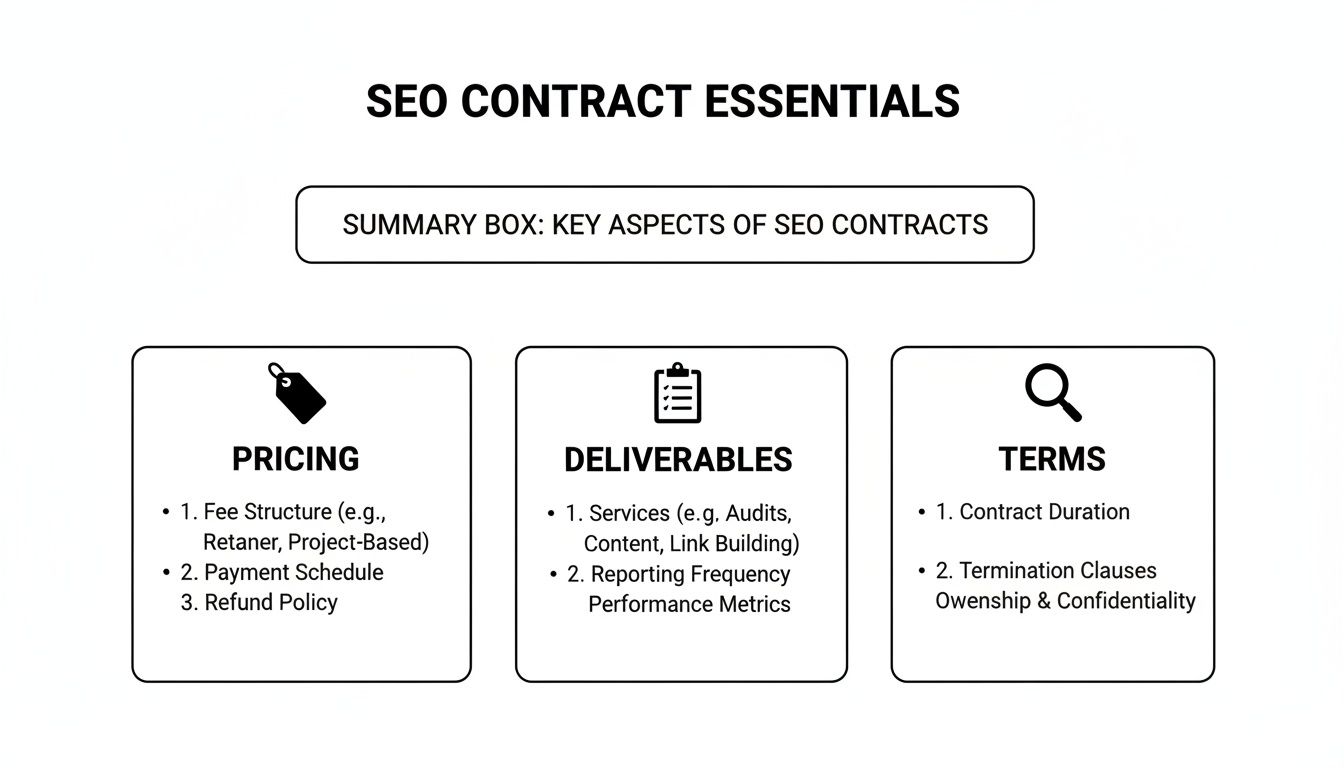
This visual guide highlights why a clear, detailed contract is non-negotiable. It ensures you know exactly what you're paying for and what success looks like.
Uncovering Black-Hat SEO Tactics
Some agencies resort to forbidden techniques, known as black-hat SEO, to try and cheat the system. These methods might deliver a temporary spike in rankings, but they almost always end in a severe penalty from Google that can get your site completely de-indexed. In other words, you become invisible online.
We've put together a guide with more critical questions you absolutely must ask before signing with a digital marketing agency to help you uncover an agency's true methods before it's too late.
To help you quickly tell the good from the bad, here’s a look at some common red flags versus their green-flag counterparts.
Red Flag vs. Green Flag SEO Agency Practices
| Red Flag (Warning Sign) | Green Flag (Positive Indicator) |
|---|---|
| Guarantees a #1 ranking on Google. | Sets realistic goals based on data and analysis. |
| Promises overnight results and quick fixes. | Explains that SEO is a long-term strategy that builds over time. |
| Uses a "secret sauce" or proprietary method they won't explain. | Is fully transparent about their strategies and processes. |
| Focuses on buying large quantities of low-quality links. | Focuses on earning high-quality links through outreach and great content. |
| Provides vague reports with vanity metrics like traffic or impressions. | Delivers detailed reports showing conversions, leads, and ROI. |
| Locks you into a long, inescapable contract from day one. | Offers flexible terms or shorter initial contracts to prove their value. |
| Is reluctant to provide client references or case studies. | Proudly shares case studies and connects you with happy clients. |
Always ask a potential partner about their link-building philosophy. Their answer will reveal a lot about their commitment to ethical, white-hat SEO. A reputable agency will talk about earning high-quality links through valuable content and manual outreach—not by taking risky shortcuts that put your business on the line.
Making Your Final Choice and Kicking Off the Partnership
You’ve done the hard work. You’ve vetted the candidates, checked their references, and sat through the pitches. Now, with a couple of strong finalists in the running, it’s time to make the call.
This final decision shouldn't just come down to the lowest bid. It’s about choosing the agency that feels like a true extension of your team—a partner you can trust to navigate the complexities ahead.
Weighing the Final Factors
Your final choice often rests on the subtle but critical distinctions between good agencies. Both of your top contenders might be technically skilled, but one will likely stand out in terms of partnership potential and genuine alignment with your business.
To get some clarity, think about these final points:
- Strategic Alignment: Which agency presented a strategy that felt truly connected to your specific business goals, not just a boilerplate SEO template?
- Communication Style: Whose communication felt more proactive and collaborative? Go with the team you feel most comfortable brainstorming with and asking the tough questions.
- Long-Term Vision: Did one agency talk more about a sustainable, long-term growth plan, while the other focused only on quick wins? A true partner is in it for the long haul.
It's also worth considering how forward-thinking an agency is. For instance, nearly 70% of businesses are seeing a higher ROI by incorporating AI into their SEO and content workflows. Smart agencies use these tools to handle routine tasks faster, which frees up their human experts to focus on the high-level strategy that actually grows your business. You can learn more about the impact of AI on SEO results to get a sense of these trends.
Kicking Off a Successful Partnership
Once you’ve made your choice, the onboarding process sets the tone for the entire relationship. A strong agency like Raven SEO won't just ask for your logins; they'll guide you through a structured kickoff designed to get everyone on the same page from day one.
The goal of onboarding isn't just to grant access to your accounts. It's to formally merge two teams around a shared set of objectives. A smooth start prevents misunderstandings and gets you closer to your goals, faster.
A proper kickoff meeting is non-negotiable. This is where you’ll finalize goals, confirm the KPIs that matter, and lock in a clear communication schedule.
You’ll need to provide access to your website backend, Google Analytics, and Google Search Console. A transparent, collaborative start like this builds the foundation for a partnership that’s built on trust and aimed at achieving real, sustainable growth.
Common Questions About Hiring an SEO Agency
Even with a solid evaluation process, you’re probably still weighing a few final questions. It's completely normal. Choosing the right SEO partner is a big decision, and getting clear on those last few details is what leads to a confident choice.
Here are some of the most common questions we hear from Maryland business owners right before they’re ready to team up with an agency.
How long does it take for SEO to start working?
This is a critical question, and the honest answer is that it requires patience. While you may see minor positive changes within the first few months, significant results from a comprehensive SEO strategy typically take four to twelve months to materialize. Be wary of anyone promising instant page-one rankings.
The timeline depends on several factors, including your website's current authority, the level of competition in your market, and the scope of the strategy being implemented. SEO is a long-term investment that builds sustainable growth over time, not a quick fix.
What should I look for in an SEO company?
When evaluating an SEO company, focus on these key areas: a proven track record of success with businesses like yours (look for case studies), a transparent and clearly explained process, a focus on measurable business goals (like leads and revenue) instead of just traffic, and open, consistent communication. A great partner will feel like an extension of your team.
Will I own my website and content?
Yes, absolutely. This is a non-negotiable point that must be clearly stated in your contract. A reputable agency like Raven SEO will always ensure you retain 100% ownership of your website, domain, and all content created for you. Avoid agencies that use proprietary systems that lock you in, as you could lose all your assets if you decide to leave.
What KPIs actually matter for measuring SEO success?
It’s easy to get distracted by vanity metrics like clicks and impressions. While they can be useful, the Key Performance Indicators (KPIs) that truly matter are those tied directly to your business goals.
Focus on metrics that show real impact, such as:
- Organic Traffic Growth: Are more qualified users finding your site?
- Conversion Rate: What percentage of organic visitors are taking a desired action (e.g., filling out a form, making a purchase)?
- Qualified Leads: How many valuable leads are being generated from search?
- Return on Investment (ROI): Is the revenue generated from SEO greater than your investment?
A good agency report will connect SEO activities to these bottom-line results, making the value clear and easy to understand.
Ready to partner with a transparent, results-driven SEO team that gets the Maryland market? Raven SEO builds practical strategies that align directly with your business goals. Start with a no-obligation consultation today and get a clear roadmap designed to grow your visibility, traffic, and revenue.