

If you're running an ecommerce store, "link building" might sound like just another piece of SEO jargon. But in reality, it’s one of the most powerful things you can do to drive real growth.
At its core, link building is the process of getting other websites to link to yours. Each of those links acts as a vote of confidence in the eyes of search engines like Google. These "votes"—or backlinks—are a massive ranking factor, and they directly translate into better visibility in search results, more organic traffic, and ultimately, more sales.
Why Link Building Is a Growth Engine for Ecommerce
For any online store, building links isn't just an abstract SEO task—it's a direct driver of your bottom line. Every high-quality backlink you earn is like a digital referral that points both new customers and search engines straight to your products.
Without these digital referrals, even the best products can get lost in the noise of a crowded online marketplace.
Imagine you've just launched a small online boutique specializing in handcrafted leather goods. You’re up against giants like Amazon and established national brands. Your amazing products won't move if no one can find your site. A smart link building campaign changes that entire dynamic.
Turning Endorsements into Authority
When a popular fashion blog writes a review of your best-selling wallet and links to the product page, that’s a powerful endorsement. When a well-known gear site includes your duffel bag in a "best travel bags of the year" roundup, it tells Google your product is worth paying attention to.
Each of those links builds your site’s authority, making it much more likely to show up on the first page when someone searches for terms you want to own.
The core idea is simple: Google trusts what other reputable sites trust. By earning links from authoritative sources, you're borrowing their credibility to boost your own.
This process is absolutely critical because organic search is a powerhouse for online retail. In fact, a recent analysis showed that 23.6% of all eCommerce orders come directly from organic traffic. That’s a massive audience of high-intent shoppers you can’t afford to ignore.
The Clear Path to Your Bottom Line
Effective link building is a core pillar of any solid ecommerce SEO best practices strategy because it drives the organic visibility needed for sustainable growth. This isn't just about rankings; it's about connecting with potential customers at the exact moment they're searching for what you sell.
Before we dive into the "how-to," let's quickly break down the essential components of ecommerce link building and what they achieve. This table outlines the foundational pillars that turn links into revenue.
The Core Pillars of Ecommerce Link Building
This is a breakdown of the essential components and their direct impact on your online store's growth.
| Strategy Pillar | Primary Goal | Key Action |
|---|---|---|
| Content & PR | Build Authority & Trust | Creating high-value content that naturally attracts links from media and blogs. |
| Outreach | Forge Relationships | Directly contacting relevant websites and influencers to secure placements. |
| Technical SEO | Maximize Link Equity | Ensuring your site is structured to pass authority efficiently from page to page. |
| Niche Tactics | Gain Competitive Edge | Leveraging supplier relationships, reviews, and unlinked mentions for quick wins. |
Each pillar works together to create a powerful, self-reinforcing cycle that fuels your store's growth engine.
This creates a direct path from discovery to purchase:
- More Traffic: High-quality links lead to better rankings, which drives more qualified visitors to your site.
- Enhanced Credibility: Links from respected sites build trust with consumers, making them more likely to pull out their credit card.
- Greater Revenue: More traffic and higher trust naturally lead to more sales and a healthier business.
A smart strategy transforms your store from just another option into a recognized authority in your niche. If you want to brush up on the fundamentals, our guide on general https://raven-seo.com/ecommerce-seo-best-practices/ is a great place to start.
Building Your Foundation with Linkable Assets
Let's be blunt: you can't earn links without having something worth linking to.
That simple truth is the cornerstone of any link building strategy that actually works for an ecommerce site. While your product and category pages are absolutely vital for making sales, they're rarely the kind of thing that inspires a blogger, journalist, or industry expert to give you a link.
To attract those high-quality backlinks, you need to create linkable assets.
These are high-value pieces of content designed to inform, educate, or even entertain your audience. Their primary goal isn't an immediate sale; it's to build your brand's authority and provide so much genuine value that other sites want to reference you. By creating these assets, you start transforming your website from just another store into a go-to resource in your niche.
Go Beyond Standard Product Pages
Think of it this way: a product page for a new coffee grinder is perfect for someone who's already decided to buy. But what about everyone else?
A comprehensive guide titled "The Ultimate Guide to Cold Brew Methods" speaks to a much broader audience of coffee lovers, home baristas, and food bloggers. That's the kind of content that earns links and builds a loyal following.
A robust content strategy for ecommerce is the bedrock here. It's all about creating compelling assets that not only attract backlinks but also boost sales by solving real problems for your customers—sometimes before they even know they need your product.
Key Takeaway: Linkable assets shift the focus from "buy this" to "learn this." They establish your brand as an expert, making you a go-to source for information, which is exactly what other websites want to link to.
The data backs this up. Research shows that long-form posts over 3,000 words pull in significantly more backlinks. Content formats like 'what' and 'why' posts can outperform 'how-to' guides by 25% in link acquisition. With 89% of digital marketers now creating content specifically to earn links, this isn't optional anymore.
Practical Ideas for Linkable Ecommerce Assets
So, what does a linkable asset actually look like? It’s not just about writing a long blog post. It can take many forms, each designed to provide a unique kind of value. The best asset for your store will depend entirely on your products, your industry, and your audience's biggest headaches.
Here are a few proven ideas to get the wheels turning:
- Comprehensive Buying Guides: Go deep on one of your main product categories. If you sell hiking gear, create the definitive guide to choosing the right hiking boot, covering materials, fit, terrain types, and care. It becomes an indispensable resource for both novices and seasoned hikers.
- Interactive Quizzes or Tools: Build a "Product Finder" quiz. A skincare brand could create a quiz that recommends a full routine based on skin type and concerns. These tools are incredibly shareable and provide personalized value that bloggers love to feature.
- Compelling Brand Stories: Share your origin story in a way that connects with your audience's values. Did you start your company to solve a personal problem? Is your brand fiercely committed to sustainability? An authentic story can attract links from publications looking to feature inspiring businesses.
- Original Data or Research: Do you have access to interesting sales data? Survey your customers or conduct a small industry study. An online pet store could publish a report on the "Most Popular Dog Breeds in Maryland." This kind of unique data is a magnet for links from journalists and researchers.
Once you’ve built these powerhouse assets, they become the primary targets for your outreach campaigns. They also play a huge role within your site's architecture. You can learn more about how powerful https://raven-seo.com/internal-linking-your-websites-secret-weapon-for-seo-and-user-experience/ helps your website's SEO by spreading the authority from these high-value pages over to your commercial pages. This is how the "link juice" you earn benefits your entire site, including the product pages that actually drive your revenue.
Actionable Link Building Tactics for Online Stores
Alright, you've built some fantastic linkable assets. That's the foundation. Now it's time to shift from passively hoping people find your content to actively getting your links out there. This is where the real work begins—the hands-on strategies that build the kind of authority that moves the needle on rankings and revenue.
The goal isn't just to get links from anywhere. For an ecommerce store, it's about precision. We need to find opportunities where your products and content provide genuine, undeniable value, making a link back to your site a no-brainer for another website owner.
Tap into Your Existing Business Relationships
This is the lowest-hanging fruit, yet so many people walk right past it. Your suppliers, manufacturers, and distributors already have a vested interest in your success. When you sell more, they sell more. It's a simple, symbiotic relationship.
Start by making a list of all your partners and check out their websites. Do they have a "Where to Buy" or "Stockists" page? If you're not on that list, you're missing out on a golden opportunity. A quick, polite email is often all it takes to get added. This is a five-minute task that can land you a hyper-relevant backlink from an established authority in your niche.
For instance, if you run a Baltimore-based boutique selling handcrafted jewelry, get in touch with the artisans who supply your pieces. Ask them to add a link to your store on their website. It’s a win-win that strengthens both of your online presences.
Master the Art of Broken Link Building
Broken link building is a classic for a reason: it works. The strategy is simple. You find a broken link on a relevant website—like a blog post or a resource page—and then you reach out to the site owner, point out the dead link, and suggest your content as a perfect replacement.
You're not just asking for a favor; you're helping them fix their website and improve their user experience. It's a brilliant way to get your foot in the door.
Imagine you sell high-end coffee brewing equipment. You could search for articles like "Best Gear for Pour-Over Coffee." Use a tool like Ahrefs or a free browser extension to scan these pages for dead links. When you find one that used to point to a competitor's now-discontinued product, you've found your opening.
Your outreach email can be short, sweet, and helpful:
"Hi [Site Owner Name],
I was just reading your fantastic guide to pour-over coffee gear and noticed that the link to the [Discontinued Product Name] is no longer working.
We offer a very similar [Your Product Name] that I think would be a great replacement for your readers. You can check it out here: [Link to your product].
Either way, just wanted to give you a heads-up about the broken link! Keep up the great work."
This approach is helpful, not pushy, which dramatically increases your chances of getting a link.
Leverage Local and Niche Directories
For ecommerce stores with any kind of local connection, community-focused link building is a goldmine. Think about local resource pages like "Made in Maryland" or "Shop Local Baltimore." Getting your store featured on lists like these provides a powerful, geographically relevant backlink.
Search for terms like:
- "[Your City] business directory"
- "Shop local [Your State]"
- "[Your Niche] + directories"
Pitching your store is usually straightforward, often just filling out a form or sending a quick email explaining why your business is a great fit for their resource. These links don't just help your SEO; they can drive direct referral traffic from highly motivated local shoppers. While you're at it, it’s crucial to understand the bigger picture of how to build backlinks naturally to ensure your efforts are sustainable.
Guest Posting on Sites Your Customers Actually Read
When done right, guest posting is about providing genuine value to another site's audience, not spamming links. The goal is to earn a single, authoritative link back to one of your best linkable assets, like a comprehensive buying guide or a helpful how-to article.
Forget generic blogs. Focus on the publications your ideal customers already read and trust. If you sell sustainable home goods, a guest post on a popular eco-friendly lifestyle blog is a perfect match. You could write an article on "10 Easy Swaps for a Zero-Waste Kitchen," including a natural, contextual link back to your in-depth guide on sustainable cleaning supplies.
Let's be real: link building is tough. Research shows that nearly 80% of SEO professionals view it as a key part of their strategy, yet 52% of marketers find it to be the most difficult aspect of SEO.
This challenge is underscored by a staggering statistic: a whopping 94% of online content gets zero external links. That means most product pages are practically invisible without a deliberate outreach strategy.
The first step to beating those odds is creating link-worthy assets like guides, quizzes, or compelling stories. This simple process flow shows how different types of assets can feed into your overall strategy.
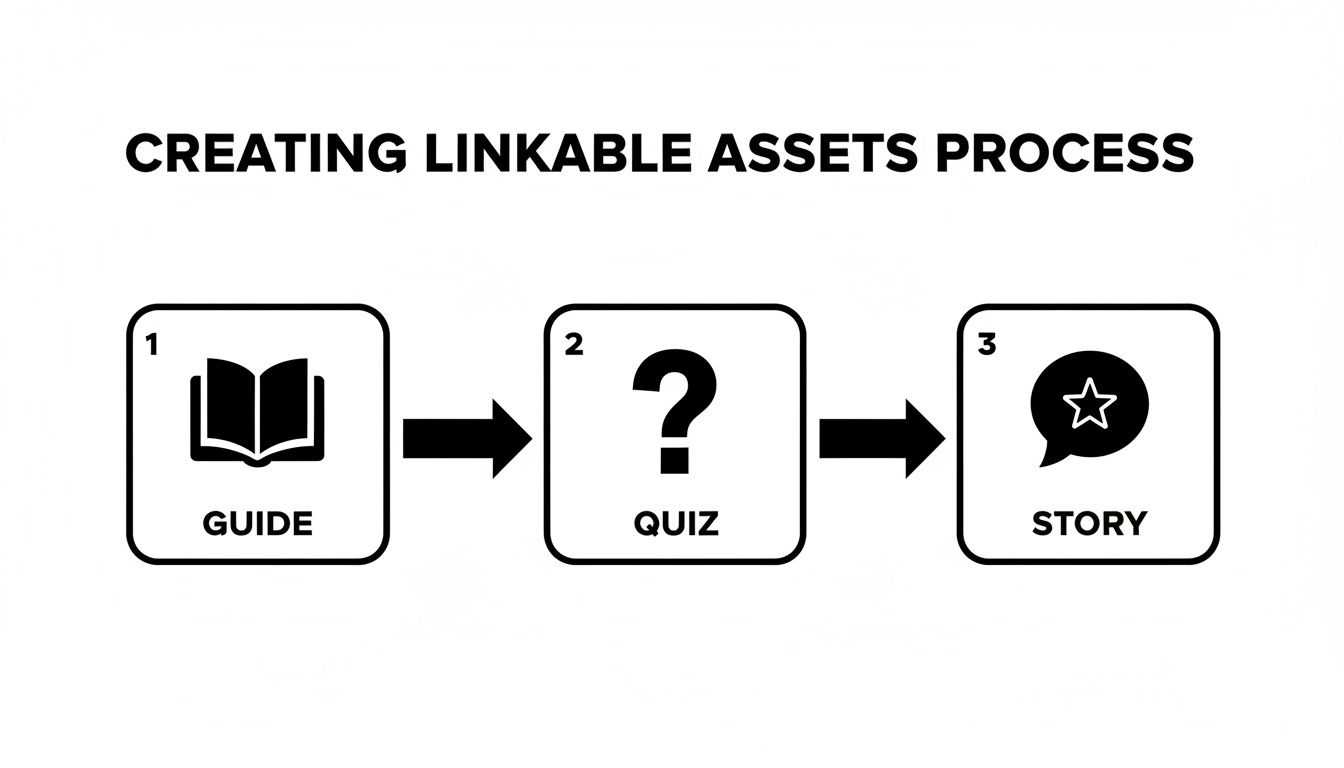
The key is to create a diverse portfolio of assets that cater to different needs—from educational guides for researchers to interactive tools for shoppers ready to buy. That's how you build a link profile that truly drives growth.
Building Links with Partnerships and Digital PR
Once you've got your foundational tactics humming along, it’s time to level up. This is where you move from asking for links to earning them through genuine relationships. Smart partnerships and savvy digital PR campaigns can land you the kind of high-authority links that truly move the needle on your site's credibility and search rankings.
These aren't just advanced tactics; they're a mindset shift. You stop thinking about simple link requests and start creating mutually beneficial collaborations. The goal is to provide so much value to another brand's audience that a link back to your site becomes a natural, enthusiastic endorsement.
Forging Mutually Beneficial Brand Partnerships
Start by thinking about the other businesses your ideal customers already love. These aren't competitors; they're your potential partners—complementary brands serving the exact same audience. A single, well-executed partnership can introduce your products to thousands of new customers and earn you a powerhouse backlink in the process.
Here are a few ways this could play out:
- Co-Created Content: If you sell high-end kitchen knives, you could team up with a popular food blogger on a "Guide to Essential Knife Skills." Your brand brings the product expertise, and they bring the engaged audience and platform.
- Joint Giveaways: Find a non-competing brand and run a social media contest. A company selling sustainable activewear could partner with one selling eco-friendly water bottles for a "Healthy Habits" giveaway. Both brands link to each other, and everyone wins.
- Product Features in Roundups: This is link building gold. Getting your products featured in gift guides or "best of" lists is one of the most effective link building for ecommerce sites tactics out there.
Imagine a small, Maryland-based apparel boutique. They could reach out to a local lifestyle blogger to create a "Baltimore Summer Style Guide." The boutique supplies the outfits, the blogger creates and promotes the content, and boom—the store gets a high-value link, targeted referral traffic, and priceless social proof.
Securing Placements in Gift Guides and Roundups
Publications are always on the hunt for great products, especially around holidays and major shopping seasons. Your job is to make it incredibly easy for them to feature you.
Start by digging up last year's guides. Use simple search queries like:
- "best gifts for hikers 2023"
- "mother's day gift guide" + blog
- "top travel accessories"
Build a list of these publications and pinpoint the right contact—usually an editor or a specific writer. When you pitch them for this year's guide, lead with value. Don't just ask for a feature; explain why your product is a perfect fit for their readers. Provide everything they need upfront: high-quality images, key product details, and a clear, concise pitch.
Pro Tip: Timing is everything. For holiday gift guides, you need to start your outreach in late summer, think August or September. For other seasonal roundups, give yourself a lead time of at least two months.
Using Digital PR to Tell Your Brand Story
Digital PR is the art of getting your brand mentioned in online publications. Every feature or news story usually comes with a high-authority backlink that can give your SEO a serious boost. The whole game is about finding a newsworthy angle for your brand.
So, what makes your story compelling?
- A Unique Founder Story: Did you overcome incredible odds to launch your business?
- A Powerful Company Mission: Are you all-in on sustainability, ethical sourcing, or a social cause?
- Real Product Innovation: Does your product solve a common problem in a totally new way?
- Interesting Business Data: Can you analyze your sales data to create a story, like a report on the "Top Fitness Trends in Maryland"?
Once you've nailed down your story, pitch it to journalists and bloggers who cover your industry. Your pitch needs to be short, punchy, and make it crystal clear why their audience would care. A successful digital PR strategy doesn't just build links; it builds credibility and establishes your brand as a leader. This aligns perfectly with Google's focus on Expertise, Experience, Authoritativeness, and Trustworthiness. To dig deeper on this, check out Raven SEO’s guide on the power of E-E-A-T in crafting high-quality content.
Here’s a simple template to get you started:
| Section | Content |
|---|---|
| Subject Line | Story Idea: [Your Compelling Angle] |
| Opening | Hi [Journalist's Name], I'm with [Your Brand], and I've been following your work on [mention a relevant article]. I thought you might be interested in a story we have. |
| The Pitch | [In 2-3 sentences, get right to the point. What's your unique story? Why is it newsworthy for their readers right now?] |
| The Ask | I'm happy to share more details, high-res images, or even send over a product sample. Would you be open to hearing more? |
| Closing | Thanks for your time, [Your Name] |
This approach positions you as a valuable source, not just another business begging for a link. You're building real relationships that lead to powerful, lasting SEO results.
How to Measure and Scale Your Link Building
So, you're building links. That's great. But if you're not measuring your results, you're essentially just guessing. You might be pouring time and money into campaigns that feel productive but aren't actually moving the needle for your business.
Flying blind is a terrible strategy.
The whole point of measuring your link building is to connect the dots between your outreach efforts and actual business growth. It's how you prove the ROI of your work and make smarter decisions about what to do next.
Key Metrics to Monitor for Success
Tracking success isn't about staring at a single number. You need to look at a mix of metrics that tell the whole story. Some are leading indicators (like new referring domains) that show your outreach is landing, while others are lagging indicators (like organic revenue) that confirm those links are making you money.
Here are the vitals every ecommerce store should be watching:
- Number of New Referring Domains: This is your most direct measure of outreach success. A steady increase in unique websites linking to you is a massive signal to Google that your authority is on the rise.
- Domain Rating (DR) or Domain Authority (DA): Think of these scores from tools like Ahrefs and Moz as your site's backlink credit score. As you acquire more powerful links, you want to see this number climbing.
- Organic Traffic Growth: Jump into Google Analytics and look at the organic traffic going to the specific pages you're building links for. Are those target category and product pages seeing more visitors from search?
- Keyword Ranking Improvements: Keep a close eye on your rankings for your most valuable, "money-making" keywords. As you build relevant, powerful links, you should see your pages climbing the SERPs for the terms that actually drive sales.
- Organic Revenue: This is the bottom line. Can you correlate your link building campaigns to a lift in revenue from organic search? This is how you prove the direct financial impact of your SEO investment.
The Big Picture: Success isn't just one metric going up. It's about seeing the entire chain reaction: more links lead to better rankings, which drives more traffic and ultimately results in more sales. That's the real impact of a solid ecommerce link building strategy.
Scaling Your Link Building Strategy Sustainably
Once you've got a process that works and the metrics are trending in the right direction, it’s time to scale. Scaling doesn't just mean "do more of the same." It means building a more efficient, powerful, and repeatable system for acquiring high-quality links.
You've really got two paths you can go down here:
- Building an In-House Team: This means dedicating internal resources to the cause. It could start with a marketing generalist spending part of their week on outreach and eventually grow into hiring a full-time link building specialist. This path gives you total control but comes with a hefty investment in training, salaries, and tools.
- Partnering with a Specialized Agency: For most growing ecommerce stores, this is the fast track. A dedicated agency like Raven SEO hits the ground running with established processes, expert knowledge, and access to premium tools from day one. It allows you to scale results much faster without the overhead and learning curve of building a team from scratch.
No matter which path you choose, having the right technology is non-negotiable. To get a sense of what's out there, you can explore some of the best link building tools to see what fits your workflow and budget.
Ultimately, effective scaling is about turning your link building from a series of one-off tasks into a predictable growth engine for your store.
Common Ecommerce Link Building Questions
Even with the best game plan, a few questions always pop up when you're in the trenches of ecommerce link building. Getting straight answers to these is key, so you don't waste time second-guessing your strategy.
Let's clear up some of the most common ones I hear.
How Long Until I See Results?
This is the big one, isn't it? Everyone wants to know when the magic happens.
While you might see some small initial bumps, it realistically takes three to six months of consistent effort to see a meaningful impact on your traffic and rankings. It’s a marathon, not a sprint.
The first few months are all about laying the groundwork—research, creating linkable assets, and kicking off outreach. After that, it takes time for Google to find, crawl, and give you credit for those new links. You’ll really start to notice the needle moving in keyword rankings and organic traffic around the three-month mark as your store’s authority compounds.
The secret ingredient here is consistency. Dipping your toes in for a month won't cut it.
What is the most effective link building strategy for ecommerce?
There isn't one "most effective" strategy; it's about using a mix of tactics that fit your niche. However, creating high-value "linkable assets" like in-depth buying guides or original research is a powerful foundation. These assets give other sites a compelling reason to link to you. Combining this with strategic outreach to partners, bloggers, and publications in your industry creates a sustainable and effective approach.
Can I Do Link Building Myself?
Absolutely. You can definitely get started on your own, especially with foundational tactics like hitting up your suppliers for links or finding easy broken link opportunities.
But—and this is a big but—it’s a massive time sink. Link building requires serious dedication to research, outreach, and relentless follow-up. It's a skill, and it takes practice to get good at it.
As your store grows, you'll likely find that your time is better spent on product, marketing, and operations. That’s the point where bringing in a specialized agency becomes a no-brainer. An agency brings expertise, proven systems, and powerful tools to the table, letting you scale your results way faster than you could on your own.
Ready to stop guessing and start growing your ecommerce store with a proven link building strategy? The team at Raven SEO has the expertise to build high-quality backlinks that drive real traffic and revenue. Schedule your no-obligation consultation today!