

Choosing an SEO company isn't like picking a software subscription or hiring a lawn service. It’s a major business decision, right up there with bringing on a key executive. Get it right, and you’ve found a strategic partner who can drive serious growth. Get it wrong, and you’re looking at wasted time, a drained budget, and a lot of frustration.
This educational guide makes it easy to understand the process. It really boils down to finding a team that gets your vision and has a repeatable process for getting results.
Your SEO Partner Is Your Most Critical Marketing Hire
Thinking about how to choose an SEO company feels less like hiring a vendor and more like bringing on a business partner. The right agency can unlock a steady stream of customers who are already looking for exactly what you offer. On the other hand, the wrong one can set you back months—or even years—with flimsy strategies or, worse, tactics that get you penalized by Google.

This guide is designed to cut through the fluff and industry jargon. We’re going to walk you through the exact framework you need to define your goals, properly vet potential agencies, and spot the red flags that scream “bad fit” from a mile away.
The Stakes of Your Decision
The impact of this single choice is massive. When you pick an SEO partner, you're handing them the keys to what could be more than half of your future website traffic. Think about it: globally, 53% of all website traffic originates from an organic search.
And since a staggering 75% of users never click past the first page of the search results, an agency’s ability to get you there isn’t just a nice-to-have. It’s a survival metric.
Before you even start interviewing, it helps to have a solid grasp of what is search engine optimization. Knowing the fundamentals empowers you to ask smarter questions and accurately judge an agency's competence.
A Partnership Focused on Business Growth
A great SEO partnership looks beyond simple vanity metrics like keyword rankings. The real goal is driving tangible results that actually grow your business. Rankings are just a means to an end.
What you're really after are outcomes like:
- Generating more qualified leads for your service business in Baltimore.
- Boosting online sales for your e-commerce shop.
- Building your brand as the go-to authority in your industry.
- Driving real foot traffic to your local Maryland storefront.
A true SEO partner doesn't just send you a traffic report once a month. They connect every action they take directly to your bottom line. Their success is measured by your growth, creating a powerful incentive to hit meaningful business goals together.
Understanding the nuts and bolts of this relationship is key. Our guide on how SEO agencies work offers a deeper look into the processes and collaboration that make a partnership successful. It’ll help you set the right expectations for communication, strategy, and reporting right from the start.
Define Your SEO Goals and Budget Before You Start Looking
Before you even think about Googling “SEO company near me,” the most important work has to happen inside your own business. You can't possibly find the right partner if you haven't defined what a “win” actually looks like. Just telling an agency you want "more traffic" is like telling a home builder you want a "bigger house" with no blueprints. You'll get something, but it probably won't be what you needed.
To get real, measurable results, you need a destination. Otherwise, you're just burning fuel.
Set SMART Goals for Real Business Outcomes
The best way to turn vague hopes into an actual plan is by setting SMART goals. This simple framework is a lifesaver for focusing your efforts and holding your future agency accountable.
- Specific: Nail down exactly what you want to achieve. Instead of a fuzzy goal like "rank higher," get specific: "Rank in the Google Maps top 3 for 'HVAC repair Baltimore'."
- Measurable: How will you know if you're winning? Define the metric. A great example is, "Increase organic contact form submissions by 20%."
- Achievable: Be ambitious, but stay grounded in reality. Doubling your entire website's traffic in 30 days is a fantasy. But a 15% lift over six months? That’s a strong, attainable target.
- Relevant: Your SEO goals have to actually support your main business objectives. If you need to book more consultations, then your goal should be "increase appointment bookings from organic search," not "get more blog comments."
- Time-bound: Every goal needs a deadline. "Increase online sales from non-branded keywords by 10% within 12 months" creates a clear finish line for everyone.
A well-defined goal completely changes your search. You're no longer looking for an "SEO provider"; you're looking for a partner who can specifically help you generate 25 new local leads per month or cut your dependency on paid ads by 30% in one year.
This kind of clarity acts as a powerful filter. If you're a home services company in Baltimore, it helps you immediately zero in on firms with proven local SEO wins and ignore the ones that only brag about their national e-commerce clients.
Getting a Handle on SEO Pricing Models
Once you know what you want to achieve, you can figure out what you can realistically invest. SEO is an investment in a long-term asset, not a monthly expense, and the pricing can be all over the map. Knowing the common structures will help you compare apples to apples when the proposals start rolling in.
You'll almost always run into one of these three models:
- Monthly Retainer: This is the industry standard for a reason. You pay a fixed fee each month for ongoing, consistent work. For small businesses, this typically falls in the $1,500 to $5,000+ per month range and keeps the momentum going.
- Project-Based Pricing: Perfect for a one-off job with a clear beginning and end. Think of things like a deep technical SEO audit, a website migration, or a big content overhaul. It’s a great fit when you have a specific, immediate problem to solve.
- Hourly Consulting: Some freelancers or agencies offer their expertise by the hour. This works best for companies that already have an in-house team but need some high-level strategic direction or training on a flexible basis.
Your budget should match your ambition and your market. Trying to rank for "personal injury lawyer Baltimore" is going to demand a much heavier investment than "artisan dog treats Catonsville." Be very skeptical of anyone promising page-one results for a few hundred bucks a month. Real SEO takes real expertise, time, and resources—cutting corners is a recipe for poor, or even damaging, results.
To truly understand what you're investing in, it's helpful to see the potential returns. We break this down further in our guide explaining the return on investment (ROI) of SEO, which can help you justify your budget and set stakeholder expectations. Armed with clear goals and a realistic budget, you are now ready to start searching for the right partner.
How to Vet an SEO Agency and Build Your Shortlist
You've got your goals and a budget. Now for the hard part: creating a shortlist of agencies and figuring out which one is the real deal. A slick sales pitch can make anyone sound like an SEO wizard, but your job is to look past the presentation and evaluate the core competencies that actually move the needle.
Creating a systematic vetting checklist is the only way to make an objective, evidence-based decision. This isn't about finding a "perfect" agency—that doesn't exist. It's about finding the right agency for your specific business. We'll break down the essential pillars to investigate: their track record, technical chops, industry focus, and communication style.
This simple decision tree can help you visualize how your goals should steer your search, whether you need a local, e-commerce, or national SEO expert.
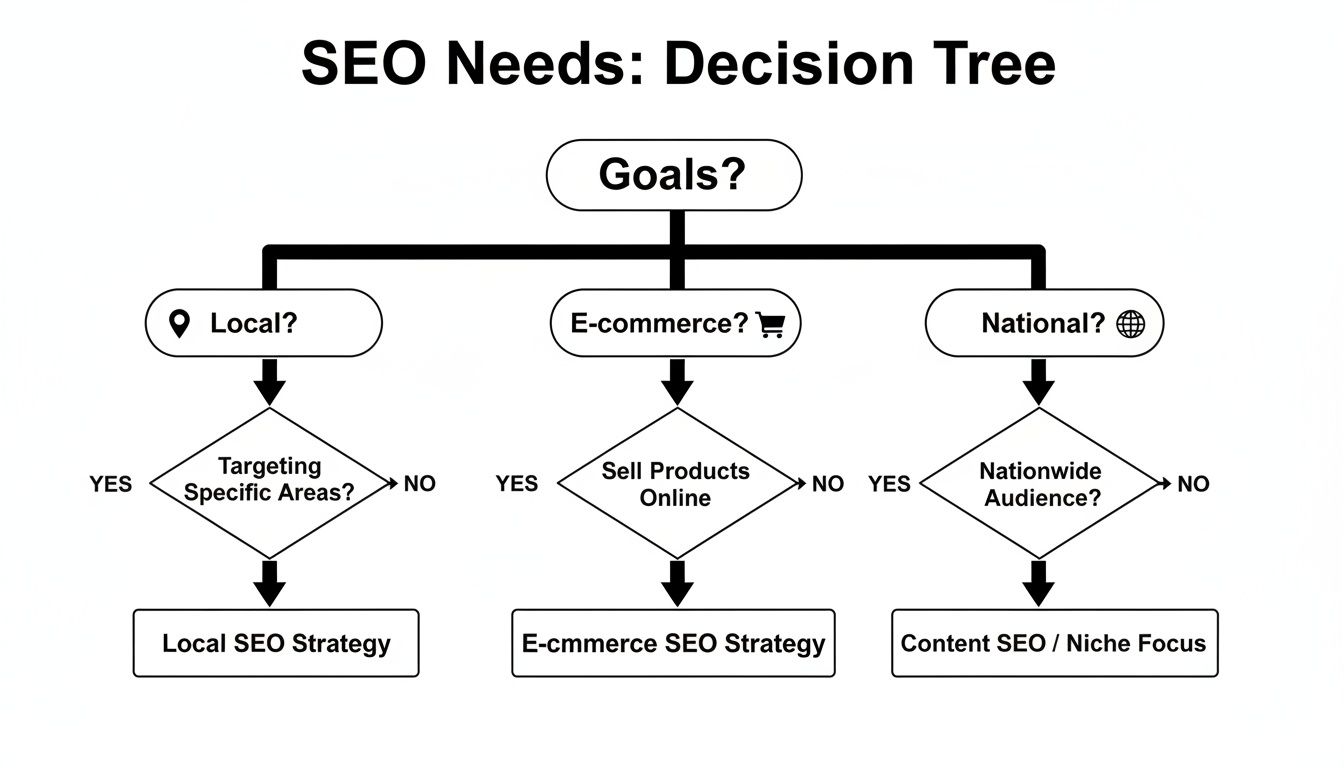
As the flowchart shows, your primary business objective is the very first filter. It helps you find a specialized partner built for your specific needs from the start.
Scrutinize Their Proven Track Record
Every agency on the planet will tell you they get results. The best ones will prove it. This is where you cut through the fluff and demand tangible evidence. A strong track record isn't just a slide with happy client logos; it’s a portfolio of measurable success stories.
When they show you case studies or work examples, don't settle for vague statements like "we increased their traffic." Dig deeper.
Here’s what you should be looking for:
- Specific Metrics: Ask for proof of increased organic traffic, sure, but more importantly, look for improvements in KPIs that actually matter to your bottom line—like conversion rates, qualified leads, or online revenue.
- Relevant Industries: If you run a plumbing business, an agency that has successfully ranked another Baltimore-based home service contractor is a much better bet than one that only works with national software companies.
- Client Testimonials and References: Don't just read the polished quotes on their website. Ask if you can speak with one or two of their current or former clients. This gives you an unfiltered look into their process and day-to-day relationship management.
Evaluate Their Technical and On-Page Expertise
Beneath all the content and link-building is the technical foundation of your website. Without a solid technical SEO base, even the most brilliant content can fail to rank. A top-tier agency must have a deep, practical understanding of how search engines crawl, index, and render your site.
Their expertise should cover critical areas like:
- Site Speed Optimization: Slow-loading pages are a known ranking killer and an even bigger turnoff for users.
- Mobile-First Indexing: With most searches happening on phones, your site has to be flawless on smaller screens.
- Crawlability and Indexability: They need to ensure search engines can easily find and understand all your important pages.
- Structured Data (Schema Markup): This is the code that helps search engines understand the context of your content, leading to those eye-catching rich snippets in search results.
Don't be afraid to ask how they approach a technical audit. A good agency will describe a detailed, multi-point inspection process. A poor one will give you a vague answer or try to gloss over the details—a massive red flag.
Confirm Their Specialization and Industry Knowledge
SEO is not a one-size-fits-all service. The strategies that work for a national e-commerce store are completely different from those needed by a local dentist in Annapolis. This is especially true for businesses in competitive markets like Baltimore, where local signals are everything.
Your vetting checklist must include questions about their specialization. A key filter is whether their services match how your customers search. For local businesses, this is non-negotiable. After all, 46% of all Google searches are for local information, and a staggering 88% of mobile local searches result in a call or visit within a day.
An agency with proven local SEO expertise understands how to optimize your Google Business Profile, build local citations, and target the geo-specific keywords that drive real foot traffic. You can explore more compelling SEO statistics to see why this specialization is so critical.
Assess Their Communication and Reporting Style
Finally, a successful partnership comes down to clear, consistent, and transparent communication. You need to know what work is being done, why it's being done, and how it’s performing—in plain English.
Ask potential partners about their communication rhythm and reporting process.
- Who will be your day-to-day point of contact?
- How often will you have meetings or calls?
- Can you see a sample of their monthly performance reports?
A great partner will provide reports customized to your goals. They will connect their SEO activities directly to the business outcomes you care about, not just overwhelm you with vanity metrics. Here at Raven SEO, we believe transparent reporting is the bedrock of trust and a successful long-term partnership.
Ask These Key Questions During Agency Interviews
You’ve done your research and narrowed down the field. Now it's time to get on the phone or a Zoom call and see who you're really dealing with.
This is where you separate the smooth talkers from the true strategic partners. The interview isn't just a sales pitch; it's your chance to see if they have the substance, process, and values to become a genuine extension of your team. A structured approach is everything. By grouping your questions, you can keep the conversation focused and uncover what you really need to know.
Strategy and Process Questions
This line of questioning is all about getting inside their heads. You want to see a custom-fit approach, not some off-the-shelf, cookie-cutter service. A great partner will be asking you questions and show they’ve already done some homework on your business and where you sit in the market.
-
"Can you walk me through your typical 90-day plan for a business like mine?"
A strong answer here will be specific. They should be talking about a deep-dive audit, competitive analysis, and prioritizing "quick wins" alongside foundational technical fixes. If you hear a generic response like, "We'll start building links and writing blogs," that's a red flag. It shows they're just checking boxes, not thinking strategically. -
"How do you approach keyword research and content strategy?"
Listen for a process that goes beyond just chasing high-volume keywords. A skilled agency will talk about mapping keywords to the buyer's journey, sniffing out long-tail opportunities, and zeroing in on user intent. They should be able to connect content ideas directly back to your business goals—not just suggest blogging for the sake of it. -
"What tools do you use for technical analysis, tracking, and reporting?"
This question peels back the curtain on their technical chops. Don't be afraid to ask about the specific tools they use for things like performance metrics or using an Ahrefs Website Authority Checker to gauge domain strength. A transparent agency will have no problem listing their software stack (think SEMrush, Ahrefs, Screaming Frog) and, more importantly, explaining why they chose each tool for the job.
Reporting and KPI Questions
This is all about accountability. You need to know exactly how success will be measured and how they'll keep you in the loop. Vague promises aren't worth much; you need a partner committed to data-driven results that line up with your goals.
-
"How will you measure the success of this campaign, and what metrics matter most for my goals?"
The best agencies will immediately tie their answer back to the goals you already defined. If you said your top priority is getting more qualified leads for your Baltimore-based contracting business, they should be talking about tracking organic conversions, phone calls, and form submissions. If they only fixate on rankings and traffic, they might be missing the bigger picture—your bottom line. -
"Can you show me a sample of a monthly performance report?"
This is non-negotiable. Ask for it. A good report is clear, concise, and tells a story about what was done, what the results were, and what the plan is for the next month. A bad report is just a confusing data dump with no context or actionable insights.
A true partner reports on outcomes, not just activities. They understand that you don't care about the 50 links they built; you care about the 15 qualified leads those links generated. Their reporting should always connect the dots between their work and your business growth.
Team and Communication Questions
At the end of the day, you're hiring a team of people, not just a piece of software. Figuring out who you'll be working with and how you'll communicate is absolutely crucial for a smooth and effective partnership.
-
"Who will be my day-to-day point of contact, and what is their experience?"
You need to know if you'll be working directly with a seasoned strategist or getting handed off to a junior account manager. An ideal answer introduces you to your main contact and highlights their specific expertise, especially if it’s relevant to your industry. -
"What is your communication cadence, and how do you handle urgent issues?"
Look for a clear, proactive plan. A solid response sounds something like, "We have scheduled bi-weekly calls to review progress and a monthly deep-dive reporting meeting. For anything urgent, you'll have direct email and phone access to your account lead." This sets clear expectations right out of the gate.
Armed with these questions, you’re in a much better position to make an informed decision. For an even deeper dive, check out our list of 10 questions you absolutely must ask before signing with a digital marketing agency. It provides extra insights to make sure no stone is left unturned.
How to Decode Proposals and Identify Red Flags
Once the interviews wrap up, the proposals will start hitting your inbox. This is the moment of truth, where an agency puts its promises in writing. Your job is to analyze these documents like a detective, separating a clear roadmap to success from a bundle of red flags disguised in marketing jargon.

Breaking down each proposal into its core components makes it much easier to compare your options side-by-side and spot potential issues before you sign on the dotted line.
What a Strong SEO Proposal Includes
A quality proposal should feel less like a sales brochure and more like the first chapter of your strategic plan. It needs to prove the agency actually listened to your goals and has a thoughtful, customized approach to getting you there.
Look for these key sections:
- Audit Findings: A brief but insightful analysis of your current website, pinpointing specific strengths, weaknesses, and opportunities they’ve uncovered.
- Scope of Work: A detailed breakdown of the exact services they’ll provide—technical SEO, content creation, link building, local optimization, and so on. No vague promises here.
- Deliverables: A crystal-clear list of what you'll actually receive. This should be tangible, like "four 1,500-word blog posts per month" or "a comprehensive technical audit report."
- Timeline: A realistic schedule for the first 30, 60, and 90 days. This demonstrates they have a clear plan of action from day one.
- Pricing: A transparent breakdown of costs, whether it’s a monthly retainer or a project-based fee, with unambiguous payment terms.
Good SEO is intensely data-driven, and the company you choose must be able to quantify its strategy. Since roughly 60% of searches now result in no click, a great partner tracks more than just rankings; they focus on impressions, branded search share, and on-site conversions. SEO drives over 1,000% more traffic than organic social media, making a data-focused, high-quality provider a critical investment.
The Red Flags You Cannot Ignore
As you review each document, keep a sharp eye out for warning signs that signal a bad partnership. These red flags often indicate an agency is using outdated tactics, lacks transparency, or is more focused on locking you into a contract than delivering results.
Be extremely cautious if you see any of the following:
- Guarantees of #1 Rankings: This is the oldest trick in the book. No one can guarantee specific rankings on Google. Honest agencies promise a proven process, not an impossible outcome.
- Vague "Secret Sauce" Techniques: If an agency can't explain its methods clearly, it's likely using black-hat tactics that could get your site penalized or, just as bad, it simply doesn't have a real strategy.
- Suspiciously Low Prices: If a price seems too good to be true, it absolutely is. Rock-bottom pricing often means outsourced, low-quality work that can do more harm than good.
- Inflexible Long-Term Contracts: A confident agency will earn your business every single month. Be wary of anyone demanding a rigid 12-month contract with no clear exit clause.
A proposal that focuses on activities ("we will build 20 links") instead of outcomes ("we will increase your domain authority to attract more qualified traffic") is a major red flag. A true partner connects every action to a business goal.
Your ability to interpret these proposals correctly is directly tied to knowing what success actually looks like for your business. Before making a final call, check out our guide on how to measure digital marketing success to ensure your chosen partner's reporting aligns with real growth metrics.
Common Questions About Hiring an SEO Partner
Even after you've done all the research, sat through the interviews, and compared the proposals, a few questions always seem to stick around. Pulling the trigger on an SEO company is a big deal, and it’s smart to get every last doubt cleared up. Let's tackle some of the most common questions we hear from business owners so you can move forward with confidence.
How Long Does It Take to See SEO Results?
Patience is probably the most underrated virtue in SEO. Generally, you can expect to see some early positive signs—like ranking for a few less competitive keywords—within about 4 to 6 months. This initial period is all about laying a strong foundation: technical audits, deep-dive keyword research, and getting all your on-page elements just right.
But the results that really move the needle for your business, like a noticeable and steady stream of qualified leads and sales, often take 6 to 12 months to really kick in. It just takes time for search engines to recognize your site's growing authority and trust the changes you're making.
Be very, very wary of any agency promising you overnight rankings. That’s a classic red flag for strategies that are either completely ineffective or, worse, use "black-hat" tactics that can get your site penalized by Google. A penalty can set you back years, not months.
Should I focus on local or national SEO?
This is a critical distinction, and getting it right means aligning an agency’s skills with your actual business. They are two completely different games with different playbooks.
-
Local SEO is for businesses with a physical storefront or a specific service area, like a plumber in Baltimore or a dentist in Annapolis. The entire goal is to show up for searches like "emergency roof repair near me." The strategy leans heavily on optimizing your Google Business Profile, building local directory listings, and gathering customer reviews.
-
National SEO is for businesses that aren't tied to a specific location, like an e-commerce store or a software company that sells to customers all over the country. Here, the focus is on ranking for broader, much more competitive keywords and building authority on a massive scale.
The right approach depends entirely on who you’re trying to sell to. A mismatch here is a fast way to burn through your marketing budget with nothing to show for it.
Should I Hire a Freelancer or an SEO Agency?
This decision usually comes down to the scope of your project, your budget, and how fast you want to grow. Both have their pros and cons.
A freelancer can be a great choice for smaller projects, one-off tasks, or businesses on a shoestring budget. You often get deep expertise in a specific niche, like a technical audit or content writing, and they can be more flexible.
An agency like Raven SEO, on the other hand, brings a full team to the table. You get specialists in technical SEO, content strategy, link building, and even paid ads all under one roof. This provides a more complete, scalable solution with access to better tools, more strategic depth, and the peace of mind that comes with having a full team behind you. For businesses serious about long-term, sustainable growth, an agency is almost always the better investment. It's also worth thinking about why businesses need SEO services in the first place to see the value a full-service team provides.
What Is a Reasonable Budget for Small Business SEO?
SEO retainers can be all over the map, but for a typical small or medium-sized business, a monthly investment between $1,500 and $5,000+ is a realistic range. Where you fall in that range depends on a few key things:
- How Competitive Your Industry Is: Trying to rank as a personal injury lawyer is going to require a much bigger budget than a niche boutique shop.
- Your Growth Goals: If you have aggressive targets for traffic and leads, you'll need to invest more in the resources to get you there.
- The Scope of the Work: A comprehensive plan that includes creating content, fixing technical issues, and building your online reputation will naturally cost more than a basic local SEO package.
Don't just hunt for the lowest price. Instead, focus on the value you're getting for your investment. Anyone promising real results for a few hundred dollars a month is cutting corners somewhere, and that can end up hurting your website in the long run. A good agency will be totally transparent about their pricing and connect every dollar to an activity designed to grow your bottom line.
Choosing the right SEO partner is one of the most important decisions you'll make for your company's future. If you’re looking for a Baltimore-based agency that puts clear communication and real-world results first, Raven SEO is here to help. Schedule a no-obligation consultation with us today and let's build a practical roadmap to grow your business.