
Effective lead generation for contractors isn't about throwing money at expensive ads right out of the gate. It all starts with a rock-solid digital foundation. Before you spend a single dollar chasing new customers, you need a website and an online presence built to turn curious visitors into scheduled jobs.
Think of it as your digital storefront—one that builds trust and makes it incredibly easy for homeowners to decide you're the right person to hire.
Building Your Digital Foundation for Contractor Leads
It helps to think about your marketing like you're building a house. You wouldn't install pricey windows and high-end fixtures on a cracked or unfinished foundation, right? In the same way, driving traffic to a weak website or an invisible Google profile is just a surefire way to waste money.
The goal here is to create a digital presence that works for you 24/7, capturing interest and converting leads even while you’re out on a job site.
This foundation really comes down to two core pillars: your professional website and your Google Business Profile. Get these two assets right, and you'll have the primary drivers for high-quality, exclusive leads locked in.
Crafting a High-Converting Contractor Website
Your website is often the very first impression a potential client has of your business. It has to do more than just list what you do; it needs to build immediate trust and clearly guide visitors toward getting in touch.
It's pretty staggering, but research shows that 94% of first impressions are directly related to your site’s design. That means a confusing or outdated layout can scare off a potential customer in seconds.
To make your website a true lead-generation machine, zero in on these key elements:
- Mobile-First Design: Well over half of all web traffic now comes from smartphones. Your site has to be a breeze to use on a phone, with phone numbers you can tap to call and simple, easy-to-fill-out forms.
- Clear Calls-to-Action (CTAs): Don't make people hunt for what to do next. Big, bold buttons like "Get a Free Estimate" or "Schedule a Consultation" should be front and center on every single page.
- Trust-Building Elements: This is huge. Show off your work with high-quality photo galleries of your completed projects. Sprinkle in genuine client testimonials and reviews to provide that all-important social proof and build your credibility from the get-go.
So many contractors make common website mistakes that cost them jobs, and they don't even realize it's happening. We've put together a guide that breaks down exactly what to avoid: Learn more about common website mistakes that cost you jobs.
Optimizing Your Google Business Profile
Your Google Business Profile (GBP) is, without a doubt, your most powerful free marketing tool for drumming up local business. When a homeowner searches for "roofer near me" or "plumber in Baltimore," the results are always dominated by the Google Map Pack—and that's powered entirely by GBP listings.
A fully optimized Google Business Profile is non-negotiable for contractors. It’s your digital billboard in your local service area, often generating more direct calls and website clicks than any other single source.
Just setting up a profile and calling it a day isn't enough. To rank high in those local results and actually get the clicks, you have to treat your GBP like a mini-website. That means meticulously filling out every single section with accurate, detailed information. For a deeper dive into making this work, check out a comprehensive guide to SEO for contractors—it’s packed with invaluable strategies.
Here’s how to turn your GBP into a lead-generating powerhouse:
- Complete Every Single Section: Add your precise service areas, hours of operation, and write a business description that's rich with the keywords your customers are searching for.
- Upload High-Quality Photos: Post pictures of your team, your branded vehicles, and most importantly, your finished work. "Before and after" shots are absolute gold here.
- List All Your Services in Detail: Don't just put "roofing." Get specific. List out services like "Asphalt Shingle Repair," "Metal Roof Installation," and "Gutter Cleaning." This helps you show up for more targeted, high-intent searches.
- Encourage and Respond to Reviews: Make it a habit to ask your happy customers for a review. A steady stream of recent, positive reviews is one of the single most powerful ranking factors for local search.
Choosing Where to Find Ready-to-Hire Homeowners
Once your digital foundation is solid, the big question becomes: where do you actually invest your time and money to get jobs? Not all marketing channels are created equal, especially in the contracting world. Homeowner intent is everything.
The secret to smart lead generation for contractors isn't about being everywhere; it's about being in the right places at the right time. You need to meet potential customers exactly where they are when they're actively looking for your services—not just scrolling on their couch.
A good strategy strikes a balance, combining channels that bring in calls today with efforts that will build your brand and keep you busy for years to come.
The Power Trio for High-Intent Local Leads
In my experience, when a contractor needs leads right now, three platforms consistently deliver the best results: Local SEO, Google Local Services Ads, and traditional Google Ads. Each one plays a unique role in grabbing the attention of homeowners who are ready to hire someone.
Your Google Business Profile (GBP) is the engine that drives all your local SEO efforts. A fully built-out profile is what gets you into that coveted Google Map Pack, which is often the first thing a homeowner sees when they search. To really make it work for you, you need consistent updates, detailed service listings, and a steady stream of fresh reviews. If you want to dive deeper, you can learn more about making your profile a local SEO powerhouse in our detailed guide.
Next up are Google Local Services Ads (LSAs). These are a total game-changer. They show up at the very top of the search results, even above the regular ads, and they have that "Google Guaranteed" badge. That badge is a huge trust signal for homeowners. The best part? You only pay when you get a legitimate lead—a phone call or a direct message. It’s an incredibly efficient way to make the phone ring.
Finally, there are traditional Google Ads (PPC). These give you a ton of control. You can bid on super-specific keywords like "emergency plumber near me" or "kitchen remodel contractor" to catch people with urgent problems. It definitely takes careful management to stay profitable, but a well-run campaign can be a reliable source of quality jobs.
Leveraging Social Media for Brand Building
While Google is where you capture immediate demand, platforms like Facebook and Instagram play a different—but still critical—role. Think of them as your long-term brand-building tools, perfect for staying top-of-mind with every homeowner in your service area.
Use social media as your digital portfolio. It's the place to show off your incredible craftsmanship with high-quality photos and videos of your finished work. Before-and-after posts are absolute gold here; they visually prove the value you bring to a project.
Social media for contractors is less about getting a call this second and more about building a pipeline for the future. It establishes your reputation, showcases your expertise, and keeps you visible so that when a homeowner eventually needs a new roof or a bathroom remodel, your company is the first one they think of.
You can also run highly targeted ad campaigns on Facebook to reach specific groups, like new homeowners or people who have shown an interest in home improvement. These leads might not be as "hot" as someone from a Google search, but it’s a fantastic strategy for long-term growth. A key part of your strategy involves learning effective methods for how to generate local leads for service businesses.
This infographic really drives home how these channels all rely on the core pieces of your digital foundation: a great website, a strong Google Business Profile, and plenty of good reviews.
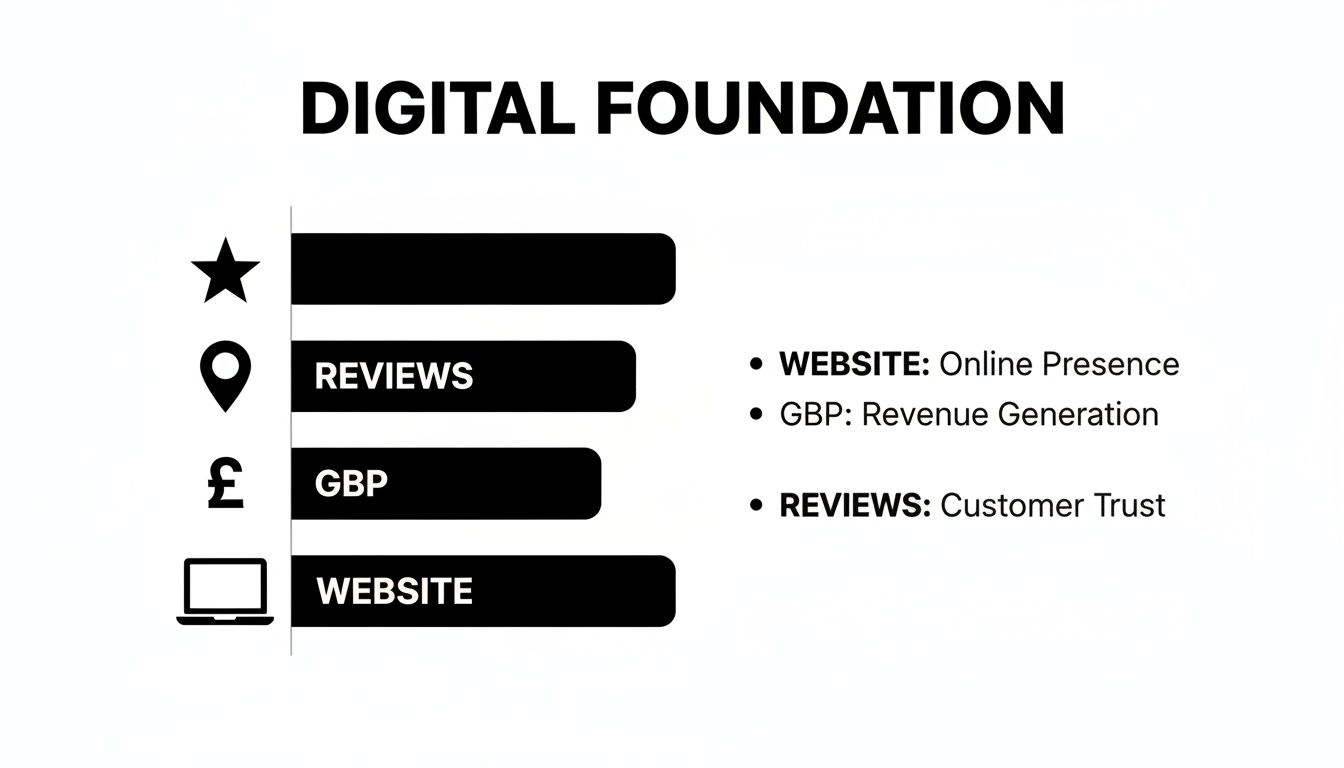
Without these fundamentals locked in, any money you spend on ads or time you put into social media just won't be as effective at turning lookers into paying customers.
To make an informed decision, it helps to see how these channels stack up against each other. Each has its own strengths when it comes to cost, speed, and the type of customer it attracts.
Comparing Top Lead Generation Channels for Contractors
This table breaks down the key lead generation channels, comparing them on factors like typical conversion rates, cost, and ideal use case to help contractors make informed budget decisions.
| Channel | Typical Conversion Rate | Average Lead Cost | Best For |
|---|---|---|---|
| Google Local Services | 15-25% | $25 – $75+ | Immediate, high-trust leads for urgent services (plumbing, HVAC, electrical). |
| Google Ads (PPC) | 3-10% | $40 – $150+ | Capturing high-intent searchers for specific, urgent, or high-value services. |
| Local SEO (Organic) | 2-5% (Varies) | $0 (Sweat Equity) | Building long-term, sustainable lead flow and local authority for all trades. |
| Social Media Ads | 1-3% | $15 – $60 | Brand awareness and reaching homeowners before they start actively searching. |
| Referrals | 30-50%+ | $0 | Generating the highest quality, pre-sold leads through word-of-mouth. |
Understanding these differences is key to building a marketing plan that aligns with your specific business goals, whether you need jobs for next week or are building a brand for the next decade.
Creating the Right Marketing Mix for Your Trade
The perfect blend of these channels really depends on your specific trade and what your local market looks like.
-
For Emergency Services (Plumbing, HVAC, Electrical): Your marketing should be heavily focused on channels that capture urgent demand. Google Local Services Ads and Google Ads are non-negotiable. A homeowner with a burst pipe isn't scrolling through Instagram; they're on Google, frantically searching for help now.
-
For High-Consideration Projects (Roofing, Remodeling, Landscaping): Your sales cycle is much longer, so your strategy needs to reflect that. While you still need a strong presence on Google, this is where Local SEO and Social Media really shine. Homeowners will research multiple companies, pore over portfolios, and read dozens of reviews. Showing off your beautiful kitchen remodels on Facebook and ranking #1 in local search for "best roofing company" is how you build the trust needed to land those big-ticket jobs.
The key is to create a balanced attack. Use paid ads to make the phone ring today, while you invest in SEO and social media to build a sustainable pipeline of jobs for tomorrow. When you understand where your ideal customers are looking and what they need to see, you can spend your marketing dollars wisely and create a consistent flow of ready-to-hire homeowners.
Turning Phone Calls Into Scheduled Jobs
For any contractor, a ringing phone isn't just noise—it's the sound of a motivated homeowner who’s ready to hire. Sure, web forms and emails have their place, but nothing cuts through the clutter like a direct phone call. It’s an immediate connection with someone who has a problem and needs you to solve it now.
But getting the phone to ring is only half the job. Truly effective lead generation for contractors is about having a rock-solid system to convert every single one of those calls into a scheduled, paying project. Your phone number is your single most valuable marketing asset, and the experience a caller has from the first ring to the final handshake will make or break your business.

Why Phone Calls Are the Gold Standard
The numbers don't lie: phone leads are, without a doubt, the most valuable channel for contractors. Phone calls that come from search results convert at an incredible 40%. Even better, their sales cycles are lightning-fast, typically closing in just 3-7 days.
What’s truly staggering is that phone leads generate 10 to 15 times more revenue than web form submissions. That stat alone should tell you where to focus your energy.
This massive gap exists for one simple reason: urgency. A phone call signals an immediate need. The person on the other end is actively looking for a solution and is way further down the buying path than someone just browsing websites and filling out forms.
Make Your Phone Number Impossible to Miss
To tap into this stream of high-intent leads, you have to make it ridiculously easy for people to call you. Your phone number needs to be everywhere, especially for customers searching on a mobile device.
Here’s your checklist for maximum visibility:
- Website Header: Put your number in the top-right corner of your site—on every single page. Critically, make sure it’s a "click-to-call" link so mobile users can dial you with a single tap.
- Google Business Profile: Your GBP listing is a lead-generation machine. Double-check that your phone number is correct and listed as the primary contact method.
- Google Ads & LSAs: Every single paid ad campaign should feature your phone number, either directly in the ad or through call extensions. This lets searchers call you without even clicking through to your website.
- Social Media Profiles: Your business phone number should be listed clearly on your Facebook page, Instagram bio, and any other social profiles you use.
Making your website a conversion powerhouse is key. If you need some practical tips on this, check out our guide on how to increase website conversions.
Best Practices for Handling Inbound Calls
Getting the call is just step one. How you handle that call determines whether you book the job or send that lead straight to your competitor. Every inbound call needs to be met with professionalism and a clear, efficient process.
Every missed call is a missed opportunity. Research shows that 85% of people whose calls aren't answered will not call back. That’s a potential job handed directly to another contractor.
To stop that from happening, you need a system that guarantees a professional response every time.
Develop a Simple Phone Script
Whether it's your office admin or you answering on a noisy job site, your team needs a consistent approach. A basic script ensures you gather all the right information without fumbling.
- Greeting: Start with a professional and friendly opening. "Thank you for calling [Your Company Name], this is [Your Name]. How can I help?"
- Info Gathering: Have a short list of questions ready to qualify the lead. Think name, address, service needed, and the best time for an appointment.
- Set Expectations: Clearly state the next steps. "Great, I have you scheduled for a free estimate on Tuesday at 10 AM. You’ll get a confirmation text from us shortly."
Consider an Answering Service
If you're a small crew and can't always grab the phone, a professional answering service is a game-changer. It's a worthy investment. They can screen calls, book appointments, and ensure a live person always answers, which builds immediate trust and captures leads you'd otherwise lose. This one move can dramatically improve your lead capture rate and make your business look far more established and reliable.
Your Follow-Up System is Where You Actually Make Money
Getting a lead is just the starting line. I’ve seen it a hundred times: a contractor gets a steady stream of inquiries but their business isn't growing. Why? Because the real money in this business is made in the follow-up.
When a homeowner fills out your form or calls your office, they have a problem right now. If you don’t have a bulletproof system to follow up on that interest, they’re not going to wait around. They’ll just move on to the next contractor on their list.
A solid lead generation plan isn't about making the phone ring; it’s about what you do the second it stops. A structured follow-up process is the machinery that turns a warm lead into a signed contract and ensures no potential job ever slips through the cracks.
Speed-to-Lead: Why the First Five Minutes Matter Most
In the contracting world, speed isn't just a suggestion—it's everything. We call it "speed-to-lead," and it’s a measure of how fast you respond to a new inquiry. The data is shocking: contact a new lead within five minutes, and your odds of converting them go through the roof. Wait just 30 minutes, and those odds plummet.
Put yourself in the homeowner's shoes. They submit a quote request and hear crickets. They aren't going to sit by the phone; they're already on Google contacting your competitor. A fast response immediately tells them you're professional, on the ball, and hungry for their business. That first impression builds instant trust.
Every minute you delay, you're practically handing that lead to another contractor. A simple, automated text that says "Got your request!" can be the difference between booking the job and never even getting a chance to quote it.
Getting Your Leads Organized for Follow-Up
You can't follow up on what you can't find. If your leads are scattered across a messy inbox, random sticky notes, and your call history, you're setting yourself up for failure. You absolutely need one central place to track every single lead and interaction.
For smaller shops, a well-organized spreadsheet can do the trick. Just make sure you have columns for the essentials:
- Lead Name & Contact Info
- Source (e.g., Google Ads, Website Form, Referral)
- Service Needed
- Date of Last Contact
- Next Step (e.g., Call back on Tuesday, Send quote)
- Status (e.g., New, Contacted, Quoted, Job Won/Lost)
As you grow, though, a dedicated Customer Relationship Management (CRM) tool is a total game-changer. Tools like Jobber or Housecall Pro are built specifically for contractors. They automate reminders, keep conversation histories, and give you a crystal-clear view of your entire sales pipeline.
Building Nurture Sequences for Leads Who Aren't Ready Yet
Let's be real: not every lead is ready to sign a contract on the first call. Many are just dipping their toes in the water, collecting quotes and figuring out their options. This is where a nurture sequence comes in, keeping you top-of-mind without being annoying.
It’s all about sending a series of pre-written, automated emails or texts over a couple of weeks. The goal isn't to push for a sale but to provide value and build your credibility as the go-to expert.
A Simple Nurture Sequence Might Look Like This:
- Immediate Response (Under 5 Minutes): An automated text goes out. "Hi [Name], thanks for reaching out to [Your Company]! We're looking over your project details now and will give you a call shortly."
- Day 3 (If No Contact): An email with a link to your project gallery or a helpful blog post like, "5 Mistakes to Avoid When Hiring a Roofer." This positions you as a helpful expert, not a pushy salesperson.
- Day 7 (If No Contact): A quick, casual text. "Hi [Name], just wanted to check in. Did you have any questions about the estimate we sent over? Happy to help when you're ready."
- Day 14 (Final Check-In): One last, friendly email offering to answer any final questions they might have.
Setting up these automated touches ensures you stay on the radar of homeowners with a longer decision-making timeline. For anyone serious about this, learning about cultivating connections through a modern approach to your email list offers powerful strategies that translate directly into more closed deals.
When you combine lightning-fast response times with organized lead tracking and smart, automated nurturing, you build a powerful follow-up machine that consistently turns inquiries into paying jobs.
Measuring What Works to Maximize Your Marketing Budget
Pouring money into a marketing channel without knowing if it's actually bringing in jobs is like buying a truckload of premium lumber without a blueprint. It's an expensive way to guess.
You don't need to be a data scientist to figure this out. Effective lead generation for contractors boils down to tracking a handful of key numbers that tell you exactly what’s working and what's just draining your bank account. This isn't about getting lost in spreadsheets; it's about having a simple, repeatable way to check your performance so you can make smart decisions about where your money goes next.
Knowing your numbers is what separates the contractors who are always scrambling for work from the ones who grow predictably, year after year.
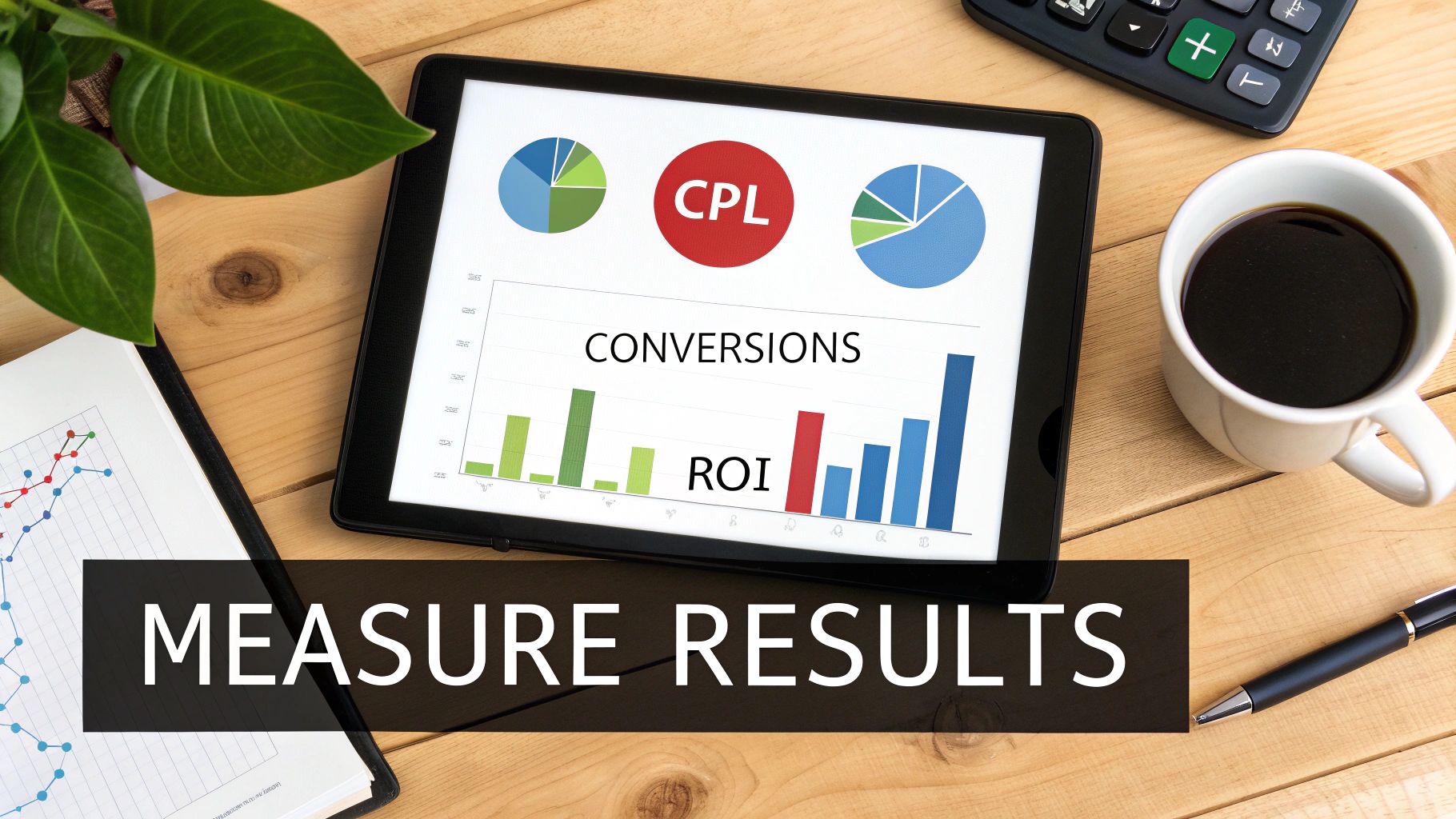
Pinpointing the Metrics That Actually Matter
Forget the fluff. Vanity metrics like "likes" or "impressions" don't pay the bills. As a contractor, you need to laser-focus on the numbers that tie directly to your bottom line. There are really only a few you need to watch to get a crystal-clear picture of your marketing's health.
These are the core metrics that should be on your dashboard:
- Cost Per Lead (CPL): This is ground zero. It's the first number you need to know. To get it, just divide what you spent on a channel (like Google Ads) by the number of leads it brought in. If you spent $1,000 on ads and got 20 leads, your CPL is $50. Simple.
- Conversion Rate: This tells you how good you are at turning those leads into paying jobs. If those 20 leads resulted in 4 signed contracts, your conversion rate is a solid 20%.
- Cost Per Acquisition (CPA): This is the real cost of landing a new project. Using that same example, your CPA is $250 per job ($1,000 spent / 4 jobs). This is the number that really tells you if a channel is profitable.
- Return on Investment (ROI): The grand finale. If those 4 jobs brought in $20,000 in revenue, your ROI is through the roof. Knowing this gives you the confidence to double down on what works.
Tracking these numbers gives you an unbiased look at performance. You might see that Google Ads is profitable, but find that while your social media ads bring in cheap leads, almost none of them ever convert into actual jobs. That's an insight you can act on immediately.
Using Free Tools to Track Your Performance
You absolutely do not need expensive, complicated software to get started. Google gives you a couple of incredibly powerful—and free—tools that provide all the data you need.
Google Analytics is the command center for your website. It shows you exactly where your visitors are coming from, whether it's organic search, a paid ad, or a referral from another site. You can set up simple goals to track how many people fill out your contact form or click your phone number, showing you which channels are sending the most motivated homeowners your way.
Key Takeaway: Setting up goal tracking in Google Analytics is non-negotiable. It’s the difference between having a digital brochure and a measurable lead-generation machine. It shows you precisely which marketing efforts are driving real business.
Google Search Console is the other must-have. This free tool gives you an inside look at how you're performing in organic search results. You can see the exact keywords people are typing to find you and which of your pages are getting the most clicks. This helps you figure out what content is resonating with potential customers so you can create more of it.
Creating a Simple Monthly Check-In
Consistency is everything. Just set aside an hour or two on the first of every month to run through your numbers. This simple habit will stop you from bleeding cash on an underperforming campaign for months on end.
Your monthly check-in can be this straightforward:
- Pull Your Data: Tally up the leads from each channel—Google Ads, organic search, LSA, social media, referrals.
- Calculate Your KPIs: Figure out your CPL and CPA for each one.
- Analyze and Decide: Which channel had the lowest CPA? Which one brought in the highest-value jobs?
- Adjust Your Budget: Now you know where to put your money next month. Double down on the winners, and either pause or rethink the losers.
This process takes all the guesswork out of your marketing. For a more detailed walkthrough, learning how to calculate your marketing ROI can give you an even sharper framework for measuring your return on marketing investment. By checking in regularly, you create a feedback loop that constantly tunes up your strategy, making sure every dollar you spend is working as hard as you do.
Common Questions We Hear About Contractor Lead Generation
Jumping into the world of marketing can feel like a lot, especially when you're already busy running the day-to-day operations of your business. We get it. Over the years, we've heard the same key questions come up time and time again from contractors just like you.
Here are some straightforward answers to the questions we hear most often.
How Much Should a Contractor Spend on Marketing?
The classic rule of thumb for most service businesses is to set aside 5% to 10% of your total revenue for marketing. If you’re in an aggressive growth phase and really trying to make a splash, you’ll want to lean closer to that 10% mark.
But honestly, the specific dollar amount isn't nearly as important as the return you're getting.
It’s far better to start with a smart, focused budget on just one or two channels that have huge potential—like Google Local Services Ads or local SEO. Track your Cost Per Lead (CPL) relentlessly. Even more importantly, track your Cost Per Acquired Customer (CPA).
Once a channel proves it can bring in profitable jobs, that's your green light. Reinvest those profits and scale up what's working.
Is It Better to Buy Leads or Generate My Own?
This is the big one, and there are definitely trade-offs. Buying leads from services like Angi or HomeAdvisor can feel like a quick fix, especially when you need to get the phone ringing right now. It’s a fast way to get volume.
The catch? You’re almost always one of many contractors getting that exact same lead. This immediately puts you in a race to the bottom, forcing you to compete almost entirely on who can offer the lowest price.
Generating your own exclusive leads through your website, SEO, and branded Google Ads is the only sustainable, profitable strategy for the long haul. When a homeowner finds you and decides to reach out directly, they're already sold on your brand. That pre-built trust leads to way higher conversion rates and, frankly, better clients.
What Is the Fastest Way to Get Leads for a New Contracting Business?
For immediate, "I need calls today" results, Google Local Services Ads (LSAs) are tough to beat. Once you get through the verification process and earn that "Google Guaranteed" badge, your business shows up right at the very top of local search results.
The best part is the pay-per-lead model. You literally only pay when a real, potential customer calls or messages you through the ad. It’s an incredibly efficient way to generate high-intent inquiries from people who are ready to hire.
For even more firepower, you can pair LSAs with a targeted Google Ads (PPC) campaign. This combination can get your phone ringing within a few days of launch. While these paid strategies deliver the speed you need upfront, you can't neglect the long game. Simultaneously building out your Google Business Profile and website SEO is crucial. That foundational work will eventually generate a steady stream of free, organic leads, creating a much more stable and profitable business down the road.
At Raven SEO, we specialize in building practical, results-driven marketing roadmaps for contractors. If you're ready to stop guessing and start growing with a clear strategy, let's talk. Learn more about how we help businesses like yours at https://raven-seo.com.