
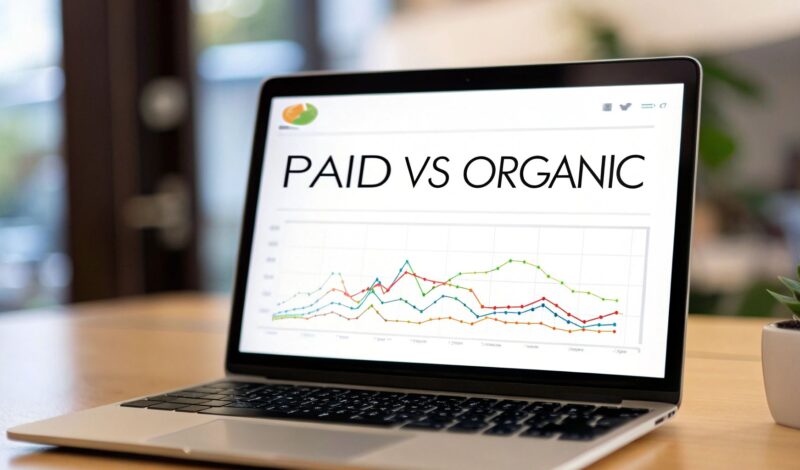
When you type a query into Google, the results page is a tale of two different approaches. One part is immediate, direct, and costs money to appear in. The other is built over time, earned through trust, and free to click on. Understanding the crucial difference between paid search and organic search is the first step toward building a marketing strategy that delivers real results.
To put it simply: paid search is like renting a billboard on a busy highway, while organic search is like building a flagship store that becomes a trusted landmark. Paid ads drive immediate traffic for as long as you pay, but organic results create a long-term, sustainable asset that continuously provides value.
Understanding the Foundations of Search Visibility
Both paid and organic search aim to connect your business with people looking for what you offer. However, they operate on completely different principles, timelines, and budgets. Let’s break down what each channel is and how it works in an easy-to-understand way.
What Is Paid Search?
Paid search is exactly what it sounds like—you pay to be seen. Commonly known as Pay-Per-Click (PPC), this model allows you to place ads at the top of the search engine results pages (SERPs), where they are clearly marked with a “Sponsored” label.
Here’s a simple breakdown of how it works: you bid on specific keywords that your ideal customers are searching for. When someone clicks your ad, you pay a fee. The main benefit is speed. You can achieve immediate visibility and attract highly targeted traffic, making it a powerful tool for new product launches, promotions, or reaching customers who are ready to buy now.
What Is Organic Search?
Organic search includes all the unpaid listings that appear below the ads. These are the results that Google’s algorithm believes are the most relevant, helpful, and authoritative answers to a user’s search. Earning a spot in these results is the primary goal of Search Engine Optimization (SEO).
Appearing in organic results doesn’t involve a direct cost per click, but it requires a significant investment of time and resources. SEO is a long-term strategy focused on creating high-quality content, ensuring your website is technically sound, and building your site’s credibility over months and even years. To learn more, check out our complete guide on what is search engine optimization and how it fits into a broader marketing plan.
The core difference comes down to intent and longevity. Paid search buys you a moment in the spotlight. Organic search builds you a stage that attracts an audience on its own.
To make the distinction crystal clear, here’s a quick side-by-side comparison of how these two powerful channels stack up.
Paid Search vs Organic Search: At a Glance
This table breaks down the essential differences at a high level, giving you a snapshot of where each channel shines.
| Attribute | Paid Search (PPC) | Organic Search (SEO) |
|---|---|---|
| Placement | Top of the SERP, labeled “Sponsored” | Below paid ads, in the main results area |
| Cost | Pay per click (CPC) | No direct cost per click, but requires investment |
| Speed of Results | Nearly immediate | Takes months to see significant results |
| Sustainability | Traffic stops when you stop paying | Creates a long-term, compounding asset |
| Targeting | Highly specific (demographics, location, keywords) | Broad, based on user intent and content relevance |
While this gives you the basics, remember that the most powerful strategies often don’t choose one over the other. Instead, they find a smart way to make paid and organic search work together.
Comparing Key Strategic Differences
Deciding between paid and organic search isn’t just a simple marketing tactic; it’s a core business strategy decision. While both are designed to get you in front of customers, they operate on completely different mechanics, timelines, and financial models. Understanding these strategic nuances is key to investing your marketing budget wisely.
The biggest difference boils down to one concept: speed versus sustainability. Paid search is all about immediate results. You can launch a campaign and, within hours, appear at the very top of Google, driving traffic and leads almost instantly. But that visibility comes with a catch—the second you turn off your ad spend, that traffic vanishes. It’s like renting prime real estate.
Organic search, on the other hand, is about building an asset. It’s a long-term investment. Earning high rankings takes a serious commitment of time and consistent effort, often for months. But once you achieve those rankings, you’ve built a reliable, steady stream of traffic that continues to deliver value long after the initial work is done. You own the real estate.
Precision Targeting vs Broad Intent
How you find your customers is another major point of difference. Paid search platforms like Google Ads give you incredibly detailed control. You can target people based on their specific demographics, their location, the device they’re using, and even their past browsing history through remarketing. This makes it a powerhouse for zeroing in on a very specific type of customer with a message crafted just for them.
For example, a local bakery could run a paid campaign that only targets users within a five-mile radius searching for “birthday cakes near me” on their phones between 4 PM and 7 PM. That kind of laser-focused targeting is something only paid channels can achieve.
Organic search is a bit different. It targets users more broadly based on the intent behind their search. The goal is to create the absolute best content to answer a user’s question, regardless of who or where they are. While it’s less precise, this strategy casts a wider net and builds your brand’s authority by becoming the go-to resource for a topic.
Paid search targets the person, using data to find the ideal customer. Organic search targets the problem, using content to provide the best solution.
Cost Structure and Investment
The way you pay for each channel couldn’t be more different. Paid search runs on a pay-per-click (PPC) model. It’s straightforward: you pay a direct, variable cost every time someone clicks your ad. Your budget has a direct impact on your traffic volume.
Organic search doesn’t have a cost-per-click, but don’t mistake that for being free. The investment is just different, focusing on:
- Content Creation: Crafting top-tier articles, guides, and pages that serve your audience.
- Technical SEO: Making sure your site is fast, secure, and easy for search engines to crawl.
- Link Building: Earning links from other reputable sites to build up your own site’s authority.
This is an investment in an asset that grows in value over time, not a rental payment that disappears each month. Understanding what role SEO plays in digital marketing is critical to appreciating its long-term financial impact.
User Trust and Click-Through Behavior
Finally, there’s a big difference in how users perceive and interact with paid versus organic results. Study after study has shown that people simply trust organic results more. They see them as more credible and authentic because an algorithm—not an ad budget—determined they were the best answer.
This trust directly affects how people behave. For any given keyword, the top organic result almost always gets a much higher click-through rate (CTR) than the top paid ad. While ads definitely work, many experienced searchers have trained themselves to scroll right past them to find the organic listings they trust. For a business, this means a top organic ranking can bring in not just more traffic, but more qualified and engaged visitors.
Ultimately, the paid search vs organic search debate isn’t about which one is “better.” It’s about which one is better for a specific goal at a specific time. An effective search strategy balances the immediate, targeted impact of paid search with the sustainable, authority-building power of organic search to drive real growth.
The Power and Cost of Paid Search
Think of paid search as the sprinter in the digital marketing world—it’s built for immediate, explosive impact. It’s the perfect tool for getting instant visibility when you’re launching a new product, running a seasonal promotion, or just trying to get seen right now in a crowded market. When you can’t afford to wait months for organic SEO to gain traction, paid advertising can place you at the top of the search results on day one.
This speed is made possible by platforms like Google Ads, which give you an incredible level of control. You can zero in on users with hyper-specific criteria, reaching your ideal customers at the very moment they’re searching for what you offer. This precision targeting ensures your budget is spent on clicks from people who are genuinely in the market for your solution.
Understanding the Financial Commitment
Of course, this speed and control come at a direct cost. Paid search operates on a cost-per-click (CPC) model, meaning you pay every single time someone clicks your ad. This makes budgeting a critical piece of the puzzle, as your visibility is directly tied to how much you’re willing to spend.
Success is almost always measured by return on ad spend (ROAS). This metric tells you how much revenue you’re generating for every dollar you invest in your ads. A positive ROAS means your campaigns are profitable, but achieving it requires constant monitoring and optimization. For a detailed walkthrough of getting a campaign off the ground, check out our beginner’s guide to Google paid advertising.
Paid search offers a clear transaction: you pay for immediate, targeted traffic. The challenge isn’t just getting clicks; it’s ensuring those clicks convert into profitable business outcomes.
The Economic Realities of Modern PPC
The paid search landscape is dynamic and becoming more competitive every day. This has caused significant shifts in both cost and effectiveness that every business needs to understand before investing.
For starters, while paid search is valuable, it only drives about 27% of total web traffic, a much smaller slice of the pie than its organic counterpart. The cost to get a piece of that traffic is also climbing. Google Search CPCs shot up by roughly 45% between 2024 and 2025, fueled by intense competition. With the average cost per lead from paid search now sitting around $66.69, it’s clear you need a solid budget to maintain visibility.
Navigating Rising Competition and SERP Changes
Make no mistake, the competition in paid search is fierce. You’re not just bidding against a couple of rivals; you’re often competing against an entire industry. This bidding war directly increases your CPC, making popular keywords incredibly expensive to target.
On top of that, the search engine results page (SERP) itself is constantly evolving. The introduction of AI-powered overviews and more complex ad formats means the ground is always shifting. These changes can impact your ad performance in a few key ways:
- Click-Through Rates (CTR): The average CTR for top paid ads has dipped to around 1.5%. New SERP layouts can push ads further down the page, making them less visible.
- Ad Format Complexity: To stand out today, you need to master everything from ad extensions and shopping ads to video formats. A simple text ad often isn’t enough anymore.
- Continuous Optimization: A “set it and forget it” approach is a recipe for burning cash. Your campaigns demand constant adjustments to bids, ad copy, and targeting just to maintain a positive ROAS.
For businesses looking to become more efficient, exploring modern tools like leveraging AI for ad launches can provide a real edge. Despite these challenges, the core benefit of paid search remains its ability to provide immediate, granular data on what’s working—letting you pivot your strategy on the fly.
Building Sustainable Growth with Organic Search
If paid search is a sprint, organic search is a marathon. It’s all about building a real, sustainable asset that provides compounding returns over time. Think of it as investing in your brand’s digital foundation—it takes patience and consistent work, but you end up with a powerful engine for durable growth that you own outright.
Organic search builds a deep, authentic user trust that paid ads simply can’t replicate. People tend to see non-paid results as more credible because they’ve been earned through quality and relevance, not purchased. This perceived authenticity is the bedrock of a loyal customer base.
The Pillars of Modern SEO
Winning at organic search isn’t about finding secret loopholes. It’s about a relentless focus on providing genuine value to your audience. A successful SEO strategy rests on a few core pillars that work together to signal quality and authority to search engines.
- High-Value Content Creation: This is the heart of any SEO strategy. It means creating content that doesn’t just sell, but genuinely answers the questions your audience is asking. Think detailed guides, helpful blog posts, and insightful articles that establish you as a trusted expert.
- Technical Website Health: Your website has to be fast, secure, and easy for search engine crawlers to understand. A technically sound site is the foundation that ensures your excellent content can be found and indexed.
- Building Domain Authority: This comes from earning high-quality backlinks from other reputable websites. Every link acts as a vote of confidence, telling search engines that your site is a credible source of information.
To really nail these fundamentals, you can explore our guide on the five areas to focus on for mastering organic search.
Organic Search Performance by the Numbers
The data is clear: organic search is the undisputed king of web traffic. In 2025, it remains the leading channel globally, driving about 53% of all website visits. This is because the top organic result attracts a massive 28–40% click-through rate (CTR), with the top three organic spots capturing nearly 69% of all clicks on a results page.
When you put paid search vs organic search head-to-head, the number one organic position gets, on average, 19 times more clicks than the top paid ad.
While paid search rents attention, organic search earns it. This earned trust translates directly into higher engagement, stronger brand loyalty, and a more sustainable flow of qualified traffic.
Adapting to Today’s Search Landscape
The world of SEO never stands still. New challenges constantly emerge that demand a smart, adaptive approach. For instance, the principles of organic growth aren’t just for Google; they apply across platforms. Learning how to grow Instagram followers organically relies on similar concepts of providing value and building authority.
Right now, two major shifts are changing the game:
- Zero-Click Searches: This occurs when a user gets their answer directly on the results page—from a featured snippet or knowledge panel—without ever clicking through to a website. The number of clicks to the open web has already dropped to around 360–374 per 1,000 searches in major markets.
- AI Overviews: AI-generated summaries at the top of the SERP are also changing user behavior, often answering complex questions before a user even sees the traditional organic listings.
Winning in this new environment means adapting your strategy. You have to optimize not just for clicks, but for visibility within these new SERP features. The goal is to become the source for these direct answers, reinforcing your brand’s authority even if a click never happens. Despite these changes, organic search remains the most powerful way to build brand credibility and achieve lasting online visibility.
Choosing the Right Strategy for Your Business Goals
Knowing the difference between paid and organic search is one thing, but translating that knowledge into a real-world strategy is where the magic happens. The best approach is never a one-size-fits-all solution. It’s a custom plan that aligns perfectly with your business model, your market position, and what you need to achieve right now.
Instead of getting stuck on “paid search vs. organic search,” the real question to ask is, “how can paid and organic search work together to hit my goals?” Answering that unlocks a much more powerful way to grow your business.
Scenarios for New eCommerce Stores
For a brand-new eCommerce store, the two biggest challenges are gaining visibility and securing those first few sales. You need to get your products in front of buyers quickly while also building a brand that can stand on its own for years to come. This is a classic case where a blended strategy isn’t just a good idea—it’s essential.
- Paid Search for Immediate Impact: This is your launchpad. Use Google Shopping ads and hyper-targeted search campaigns to drive immediate product sales. Bidding on specific, “buy-now” keywords like “women’s size 8 running shoes” puts you directly in front of customers ready to make a purchase. This not only generates revenue from day one but also provides invaluable data on which products and keywords convert best.
- Organic Search for Long-Term Dominance: While your ads are bringing in early wins, start laying the foundation for your future. Focus your SEO efforts on building out detailed category pages, writing genuinely helpful product guides, and earning backlinks to establish your authority. Over time, ranking for broader terms like “best running shoes” will create a steady, low-cost stream of traffic that you own.
Strategies for Local Service Businesses
If you’re a plumber, lawyer, or contractor, your business revolves around being the top choice in your community. Success means being the first name that appears when a local customer has an urgent problem.
For these businesses, hyper-local targeting is everything. A combined approach ensures you’re there at the exact moment of need.
A local business must win at the moment of need. Paid ads capture urgent queries, while strong local SEO builds the trust and visibility that makes you the default choice in your community.
For example, an HVAC company in Baltimore could use Google Ads with tight location targeting to show up for emergency searches like “AC repair near me.” At the same time, a powerful Local SEO strategy—focused on optimizing their Google Business Profile, gathering reviews, and creating city-specific service pages—builds the long-term visibility that brings in a consistent flow of qualified leads without paying for every click.
Approaches for B2B Companies
Business-to-Business (B2B) companies typically deal with a much longer sales cycle. The goal isn’t an instant sale but rather guiding a potential client through a complex decision-making process built on education, trust, and authority.
- Organic Search for Authority Building: SEO is the cornerstone of B2B marketing. Creating in-depth, expert content like white papers, case studies, and webinars that solve your audience’s biggest problems is non-negotiable. This is how you position your company as a thought leader and attract high-quality leads through organic search.
- Paid Search for Niche Targeting: Use platforms like LinkedIn Ads or highly targeted search campaigns to promote that high-value content to specific job titles, industries, or company sizes. Here, the goal isn’t to sell directly. It’s to drive leads to a demo or a resource download, pulling them into your sales funnel for nurturing.
This decision tree shows the key pieces of a winning organic strategy, which is vital for any business trying to build a lasting online presence.
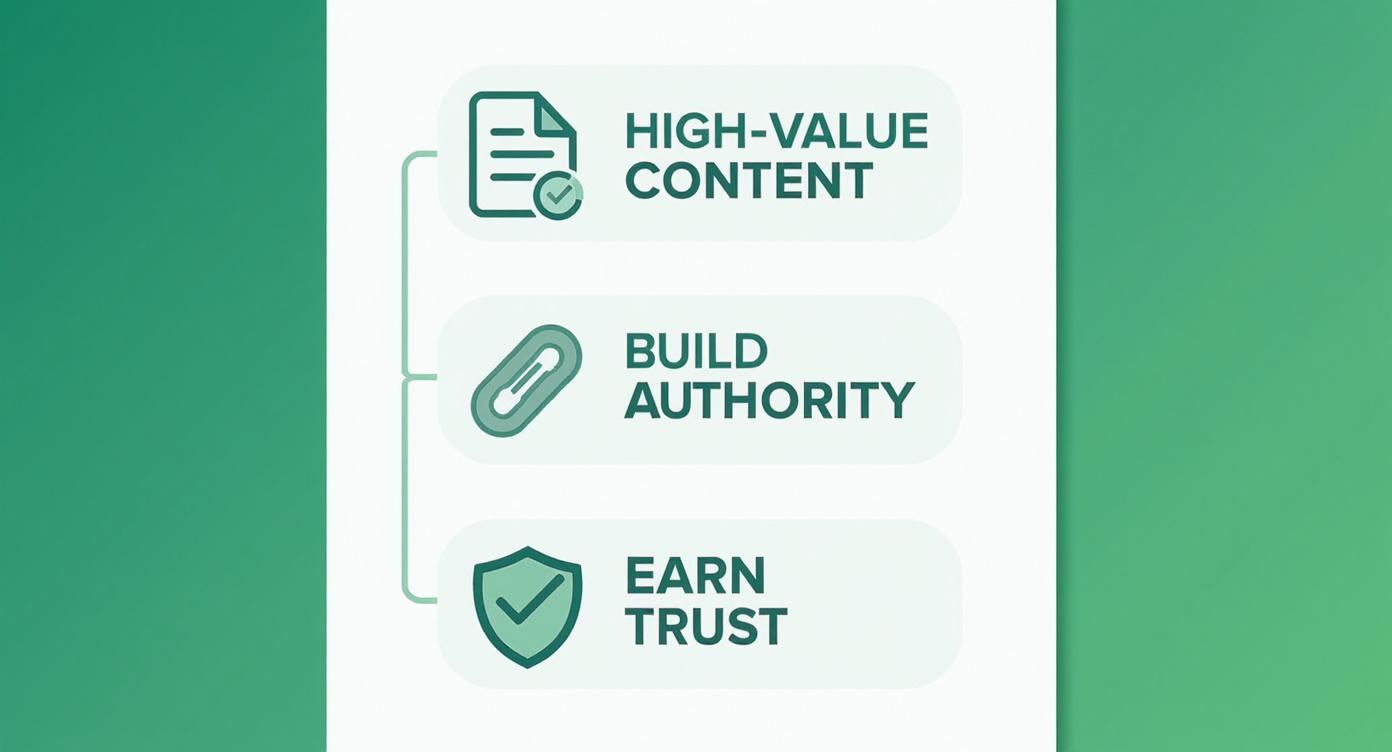
As you can see, sustainable growth is a three-step process: it starts with creating truly valuable content, which then helps you build authority in your space, and ultimately earns the trust of your audience.
Tactics for Startups
In the early days of a startup, it’s all about validation and learning as fast as you can. You have to test your product-market fit, figure out your customer acquisition cost (CAC), and prove to investors that you have a viable business. For this, paid search is an absolute game-changer.
A startup can launch targeted PPC campaigns to quickly drive traffic to a landing page and test different value propositions. The instant feedback you get on click-through rates, conversion rates, and cost-per-acquisition helps you validate demand before investing heavily in slower channels like SEO. This data-first approach allows you to pivot and adapt on the fly.
Ultimately, a truly effective search strategy is about more than just one channel. To see how these efforts fit into a larger marketing picture, you can learn more from our guide to cross-channel marketing attribution to better understand performance.
Got Questions? We’ve Got Answers.
Navigating search marketing always brings up questions, especially when you’re trying to figure out where to invest your budget and effort. Here are some clear, straightforward answers to the questions we hear most often from business owners weighing paid vs. organic search.
Which Is Better for a New Website: Paid or Organic?
For a brand-new website with zero history, paid search is almost always the right move right out of the gate. It provides instant visibility, allowing you to start driving traffic and collecting crucial customer data from day one.
Organic search, or SEO, is a long-term strategy. It takes months to build the authority and rankings needed to appear for competitive searches. A new site simply won’t have that credibility initially.
The best approach? Use paid search to kickstart your growth and validate your market. While that’s running, invest in a long-term SEO strategy that will build a sustainable, valuable asset for the future.
Can I Just Do SEO and Ignore Paid Search?
You absolutely can, but you might be leaving money on the table. Relying only on SEO is a perfectly viable long-term strategy, especially if your budget is tight or you’re in a niche with low competition. Organic search builds incredible brand trust and delivers returns that compound over time.
However, skipping paid search means you miss out on immediate traffic for big promotions, the ability to quickly test new offers, and the power to target hyper-specific customer segments. For most businesses, a blended approach is where the real success lies.
Think of it this way: SEO builds your brand’s reputation and foundational strength. Paid search gives you the tactical speed to jump on market opportunities the second they appear.
How Long Does It Take to See Results from Each?
The timeline is one of the biggest and most important differences between the two channels.
- Paid Search (PPC): Results are nearly instantaneous. Once your campaign is approved and your budget is live, your ads can start appearing at the top of search results within minutes or hours.
- Organic Search (SEO): This takes time and patience. You’re looking at months, sometimes over a year, for competitive terms. Building the authority, content, and backlinks needed to rank is a gradual process. You can usually expect to see some initial movement in 3-6 months, with significant results taking closer to 6-12 months.
How Do I Set a Budget for Paid and Organic Search?
Budgeting for these channels requires two entirely different mindsets. One is a direct media spend, while the other is an investment in building your own digital asset.
For paid search, your budget is a direct lever for traffic. You need to determine your customer lifetime value (LTV) and your target cost per acquisition (CPA). This will help you set a daily or monthly ad spend that aligns with your profit goals. Be prepared to adjust it based on performance data.
For organic search, your budget is an investment in resources, not in clicks. It typically covers costs like:
- Content creation (writers and strategists)
- Technical SEO expertise (audits, site speed optimization)
- Link building and outreach
- SEO tools and software subscriptions
Think of your organic budget as a long-term capital investment in a business asset that will pay dividends for years to come.
Ready to create a search strategy that actually drives results? The team at Raven SEO specializes in building practical roadmaps that combine the best of paid and organic search to increase your visibility, traffic, and conversions. Schedule a no-obligation consultation today and let’s build your plan for sustainable growth.