

In the competitive digital market of Baltimore and across Maryland, your website is more than a digital brochure; it’s the core engine driving your business growth. But like any engine, it requires regular maintenance and tune-ups to perform at its peak. How do you identify the friction points, missed opportunities, and technical glitches holding your site back from its full potential? The answer is a systematic, comprehensive website audit.
This guide moves beyond generic advice to provide a practical, actionable web audit checklist specifically for businesses like yours. We will break down the complex process into 10 distinct, manageable audits, from technical SEO and site performance to security vulnerabilities and conversion rate optimization. Think of this as your roadmap to diagnosing exactly what’s working, what’s broken, and where your greatest opportunities for improvement lie.
Our goal is to equip you with the knowledge to stop guessing and start making data-driven decisions that directly impact your bottom line. You will learn how to pinpoint critical issues that affect your search engine rankings, user experience, and ability to convert visitors into customers. Whether you’re a local Baltimore service provider aiming for more leads or a Maryland e-commerce store focused on boosting sales, this checklist provides the structured approach you need. By following these steps, you can create a clear, prioritized plan to enhance your online presence, improve traffic, and ultimately, drive significant revenue growth. Let’s get started.
1. Performance & Speed Audit
A Performance & Speed Audit is the first critical step in any comprehensive web audit checklist, evaluating how quickly and efficiently your website loads for visitors. This audit isn’t just about raw speed; it measures key user-centric metrics, including Core Web Vitals, to ensure a smooth, frustration-free experience that both users and search engines reward. A slow site drives away potential customers, especially in competitive markets like Baltimore, while a fast site directly impacts your bottom line.
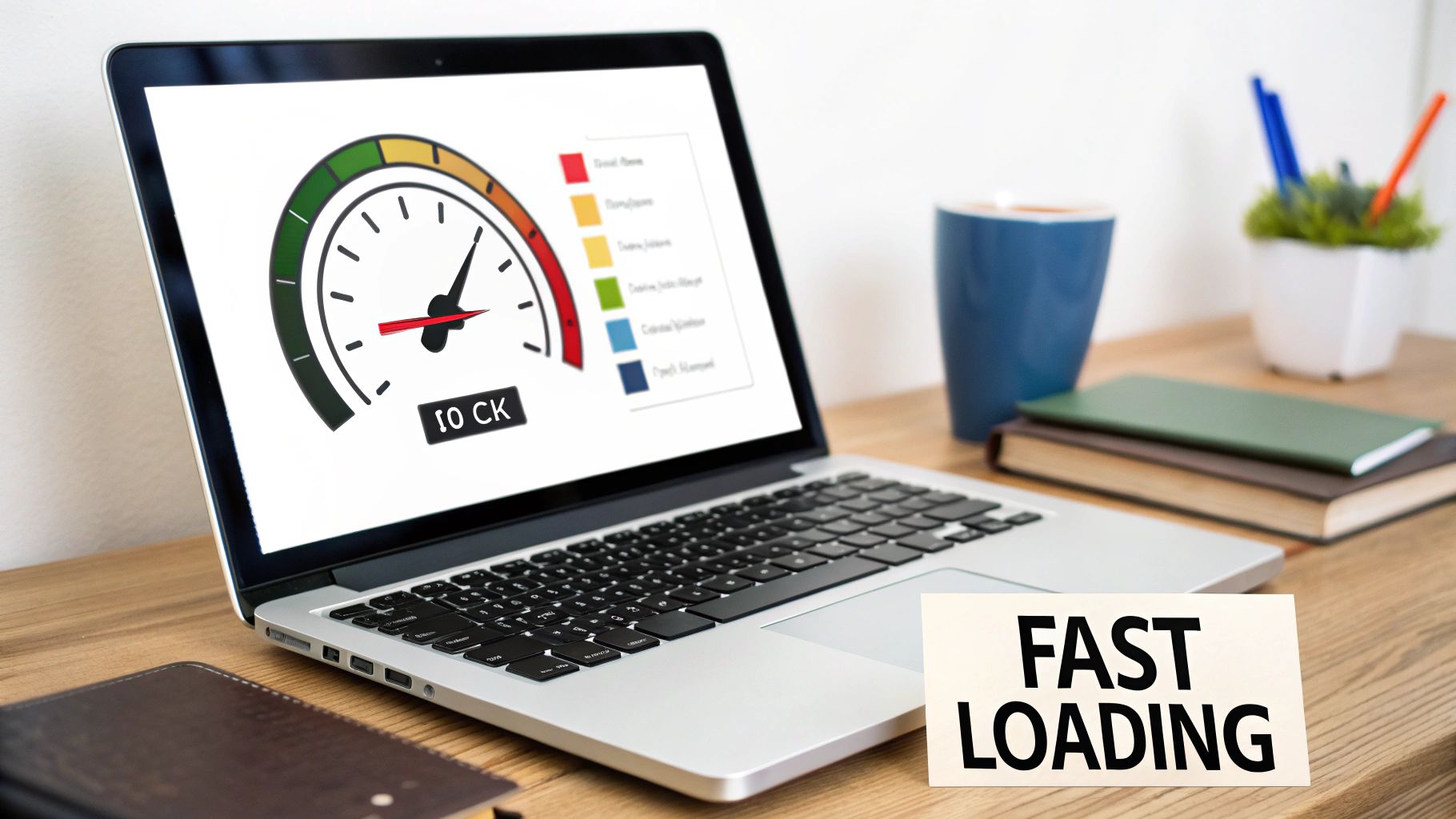
The data speaks for itself. Retail giants like Walmart saw a 2% increase in conversion rates for every one-second improvement in load time, while Amazon reported a 1% revenue increase for every 100ms of speed improvement. For a Maryland-based ecommerce store or service business, these small percentages translate into significant revenue gains and a stronger competitive edge.
Key Metrics to Analyze
During this audit, focus on three primary components of Google’s Core Web Vitals:
- Largest Contentful Paint (LCP): Measures how long it takes for the largest image or text block to become visible. Aim for under 2.5 seconds.
- First Input Delay (FID): Gauges interactivity, measuring the time from a user’s first interaction (like a click) to the browser’s response. Aim for under 100 milliseconds.
- Cumulative Layout Shift (CLS): Assesses visual stability, checking for unexpected layout shifts during loading. A score below 0.1 is ideal.
Actionable Tips for Improvement
- Establish a Baseline: Use tools like Google PageSpeed Insights and GTmetrix to get initial performance scores.
- Optimize Resources: Minimize CSS and JavaScript files, and enable GZIP compression on your server to reduce file sizes.
- Implement Lazy Loading: Configure images and videos to load only when they enter the user’s viewport, which drastically improves initial page load times.
- Prioritize Mobile: Always test performance on simulated 3G or 4G connections to understand the experience for mobile users.
Once you have your audit findings, you can explore actionable strategies to improve website speed and turn these insights into tangible performance gains.
2. SEO & Search Engine Optimization Audit
An SEO & Search Engine Optimization Audit is a foundational part of any web audit checklist, serving as a deep dive into your site’s visibility on search engines like Google. This comprehensive review analyzes on-page and technical elements to ensure your website is properly indexed, understood, and ranked for relevant queries. For a Baltimore-based business, a thorough SEO audit can uncover critical issues hindering your ability to attract local customers and compete effectively.
The impact is undeniable. SEO pioneer Neil Patel has consistently demonstrated how targeted on-page and technical fixes can dramatically improve SERP positions, while HubSpot’s own SEO efforts famously increased their organic traffic by over 300%. These examples show that a strategic SEO audit isn’t just a technical exercise; it’s a direct pathway to significant business growth.
Key Metrics to Analyze
During an SEO audit, your focus should be on both technical health and content relevance. Key areas include:
- Crawlability & Indexability: Is your
robots.txtfile blocking important pages? Is your XML sitemap submitted and error-free in Google Search Console? - On-Page Elements: Are meta titles, descriptions, and header tags (H1, H2) optimized with target keywords? Does your internal linking structure effectively distribute authority?
- Keyword Performance: Are you ranking for your target keywords? Are there “striking distance” keywords on pages 2-3 of Google that could be pushed higher?
- Mobile-First Indexing: How does your site perform and render on mobile devices? This is now the primary version Google uses for indexing and ranking.
Actionable Tips for Improvement
- Conduct a Technical Crawl: Use tools like Screaming Frog or SEMrush’s Site Audit to identify broken links, redirect chains, and missing meta tags.
- Analyze Your Keyword Gaps: Use a tool like Ahrefs to find valuable keywords your Maryland competitors rank for, but you don’t.
- Build Content Clusters: Develop a pillar page for a broad topic and surround it with detailed cluster posts that link back to it, establishing topical authority.
- Check Mobile-Friendliness: Use Google’s Mobile-Friendly Test to ensure your pages are fully optimized for users on smartphones and tablets.
As search engines evolve, your SEO audit must account for the increasing role of AI. For a comprehensive overview of these changes, consider a guide to AI Search Engine Optimization to stay ahead of the curve. You can also explore expert guides to understand the fundamentals of on-page SEO from Raven SEO to strengthen your strategy.
3. Security Audit
A Security Audit is an essential part of any comprehensive web audit checklist, designed to uncover and patch vulnerabilities that could expose your business and customers to risk. This process involves a systematic examination of your website’s security posture, from its SSL/TLS certificate and HTTPS implementation to its defenses against malware, data breaches, and unauthorized access. For any Baltimore-based business handling customer data, a proactive security audit isn’t just a best practice; it’s a critical measure to maintain trust and operational integrity.

The consequences of inadequate security are severe. The 2019 Capital One data breach, which exposed the personal information of over 100 million customers, was traced back to a misconfigured web application firewall. Similarly, the FTC settlement following the Equifax breach highlighted profound failures in their security audit and patching processes. These incidents underscore that for any Maryland SMB or eCommerce store, preventing a breach is far less costly than managing the fallout from one.
Key Metrics to Analyze
During a security audit, your primary focus should be on identifying and closing potential entry points for attackers:
- SSL/TLS Configuration: Ensure your SSL certificate is valid, properly installed, and uses strong encryption protocols. Tools like Qualys SSL Labs can provide a detailed report and grade.
- Software & Plugin Versions: Check that your CMS (like WordPress), themes, and all plugins are updated to their latest versions to patch known vulnerabilities.
- Security Headers: Verify the implementation of crucial security headers like HTTP Strict Transport Security (HSTS) and Content Security Policy (CSP) to protect against common attacks.
- User Access Controls: Review user roles and permissions to ensure that individuals only have the access necessary for their duties, minimizing internal threats.
Actionable Tips for Improvement
- Scan for Vulnerabilities: Use tools like Sucuri SiteCheck or OWASP ZAP to regularly scan your website for malware, blacklisting status, and known security weaknesses.
- Implement a Web Application Firewall (WAF): A WAF acts as a shield between your website and malicious traffic, blocking common threats before they reach your server.
- Enforce Strong Password Policies: Require strong, unique passwords for all user accounts and implement two-factor authentication (2FA) for administrative access.
- Schedule Regular Backups: Ensure you have a reliable, automated backup system in place with copies stored off-site, allowing for quick recovery in a worst-case scenario.
By performing these checks, you can fortify your digital presence and explore more advanced website security best practices to protect your business assets and customer trust.
4. Mobile Usability & Responsiveness Audit
A Mobile Usability & Responsiveness Audit is a non-negotiable part of any modern web audit checklist, designed to evaluate how your website performs on smartphones and tablets. With Google’s shift to mobile-first indexing, your mobile site is now the primary version for ranking and indexing. This audit ensures your site delivers a seamless, intuitive experience across all screen sizes, from navigation to readability. For a Baltimore-based business, a poor mobile experience means losing customers to local competitors who have already optimized for on-the-go users.
The impact of mobile optimization is undeniable. Airbnb, for instance, saw a 25% increase in bookings after focusing on their mobile experience, demonstrating how critical a well-designed mobile interface is for driving conversions. Similarly, over half of Amazon’s revenue now comes from its mobile app, proving that consumers are not just browsing but actively buying on smaller screens. For Maryland businesses, this trend highlights a massive opportunity to capture leads and sales directly from users’ pockets.
Key Metrics to Analyze
This audit focuses on ensuring your website is accessible and functional, not just a shrunken version of your desktop site. Key areas include:
- Responsive Design Implementation: Verifies that content, images, and layout fluidly adapt to different screen sizes without horizontal scrolling.
- Touch Target Sizing: Checks that buttons, links, and other interactive elements are large enough (at least 48×48 pixels) to be tapped easily without errors.
- Viewport Configuration: Ensures the
meta viewporttag is correctly set, telling browsers how to control the page’s dimensions and scaling. - Mobile Navigation: Assesses the clarity and ease-of-use of your mobile menu, ensuring users can find what they need quickly.
Actionable Tips for Improvement
- Test with Official Tools: Start by running your URL through Google’s Mobile-Friendly Test to identify immediate issues.
- Prioritize Real-Device Testing: Go beyond browser emulation. Test your site on actual iPhones and Android devices to catch platform-specific quirks.
- Simplify Mobile Forms: Reduce the number of form fields and use mobile-friendly input types (like a number pad for phone numbers) to streamline data entry.
- Optimize for Touch: Ensure there is adequate spacing between tappable elements to prevent accidental clicks.
After identifying areas for improvement, you can dive deeper and learn more about how to optimize your website for mobile to meet and exceed user expectations.
5. Accessibility (A11y) Audit
An Accessibility Audit, often abbreviated as A11y, is a vital component of any modern web audit checklist. This process evaluates your website’s compliance with Web Content Accessibility Guidelines (WCAG) to ensure it is usable by everyone, including people with disabilities. Neglecting accessibility not only excludes a significant portion of the population but also exposes your business to legal risks under regulations like the Americans with Disabilities Act (ADA).
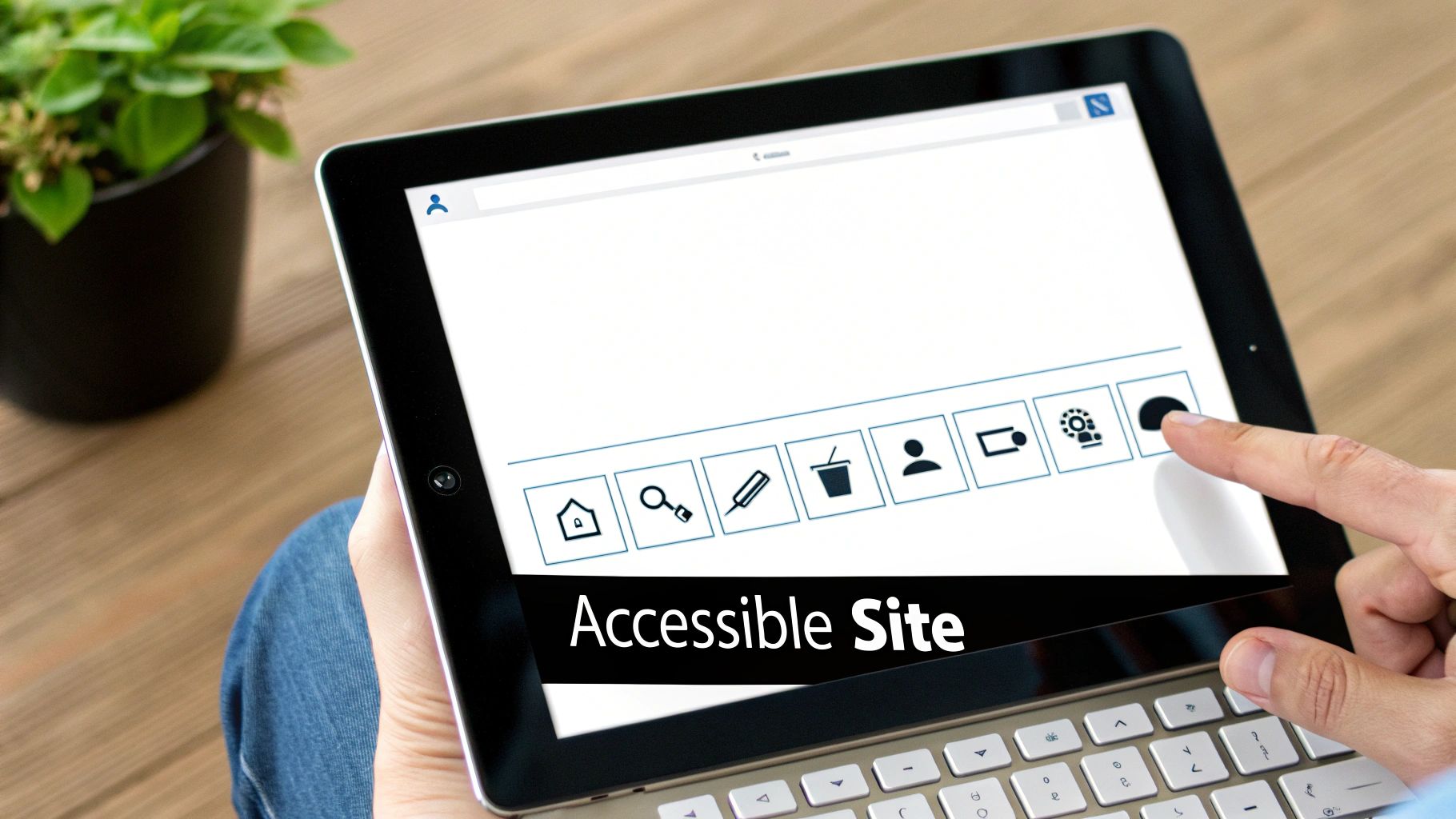
High-profile lawsuits, such as the one against Domino’s Pizza, underscore the importance of digital accessibility. By making your site accessible, you not only mitigate legal liability but also improve the overall user experience, enhance your brand reputation, and often see SEO benefits. For a Baltimore-based business, ensuring your website is accessible to all residents is both a smart business decision and a civic responsibility.
Key Metrics to Analyze
During an accessibility audit, you should evaluate your site against established WCAG standards, focusing on several key areas:
- Perceivability: Can users perceive all content? This includes providing text alternatives (alt text) for images and captions for videos.
- Operability: Is the interface and navigation operable? This means all functionality should be available from a keyboard, and users must have enough time to read and use content.
- Understandability: Is the information and operation of the user interface understandable? Content should be readable and predictable.
- Robustness: Can content be interpreted reliably by a wide variety of user agents, including assistive technologies like screen readers? This is achieved through clean, semantic HTML.
Actionable Tips for Improvement
- Automate Initial Checks: Use tools like the WAVE Web Accessibility Evaluation Tool to get an instant analysis of potential accessibility issues on any webpage.
- Test with Screen Readers: Manually navigate your site using screen readers like NVDA (free) or JAWS to understand the real-world experience for visually impaired users.
- Check Color Contrast: Ensure text and interactive elements have a color contrast ratio of at least 4.5:1 to meet the WCAG AA standard.
- Verify Keyboard Navigation: Unplug your mouse and try to navigate your entire website using only the Tab, Enter, and arrow keys. Every interactive element must be reachable and usable.
6. Content Quality & User Experience Audit
A Content Quality & User Experience Audit is a cornerstone of any effective web audit checklist, moving beyond technical metrics to evaluate what your audience actually sees, reads, and experiences. This audit assesses content relevance, readability, engagement, and the overall journey a user takes on your site. For a professional services firm in Baltimore or a Maryland ecommerce brand, high-quality content that directly addresses user needs is what separates a bounce from a conversion.
The impact of strategic content is undeniable. HubSpot’s legendary content hub strategy, which focused on creating comprehensive, high-value resources, resulted in a staggering 90% increase in leads. Similarly, Buffer’s transparent blog optimization case studies built immense trust and authority, turning readers into loyal customers. These examples prove that investing in content quality delivers tangible business growth and a stronger brand reputation.
Key Metrics to Analyze
During this audit, your goal is to ensure content is valuable, engaging, and easy to consume:
- Readability Score: Measures how simple your content is to understand. Aim for a score that matches an 8th-grade reading level or lower for broad appeal.
- Time on Page & Bounce Rate: High time on page and low bounce rates often indicate that users find your content engaging and relevant to their search query.
- Duplicate & Thin Content: Identify pages with duplicate or very little unique content, as these can harm your SEO performance and offer a poor user experience.
- Call-to-Action (CTA) Effectiveness: Analyze the placement, clarity, and click-through rates of your CTAs to ensure they effectively guide users to the next step.
Actionable Tips for Improvement
- Audit for Readability: Use the Hemingway Editor to simplify complex sentences, remove jargon, and improve clarity.
- Refresh and Consolidate: Identify outdated or underperforming posts. Update them with current information or consolidate thin content into a single, comprehensive “pillar” page.
- Structure for Skimming: Use clear H2/H3 headings, short paragraphs, and bullet points to make your content easy to scan, especially for mobile users.
- Analyze User Behavior: Use heatmap tools like Hotjar to see where users are clicking, scrolling, and getting stuck, providing direct insight into UX friction points.
A thorough content audit allows you to align your website with user intent and search engine standards. You can build on this by exploring how to craft high-quality content that builds both SEO and audience trust. Learn more about the power of E-E-A-T on raven-seo.com to further refine your strategy.
7. Technical SEO & Site Architecture Audit
A Technical SEO & Site Architecture Audit examines your website’s foundation to ensure search engines can efficiently crawl, understand, and index your content. This part of the web audit checklist dives into the backend mechanics, from URL structure and crawlability to how your site handles errors and communicates with search bots. A solid technical framework is non-negotiable; without it, even the best content may remain invisible to your target audience.
The impact of technical health is direct and measurable. For instance, a local Baltimore business that fixed its redirect chains saw its crawl efficiency improve by 40%, allowing search engines to discover new content faster. Similarly, implementing schema markup for services led to a 25% increase in visibility for rich results in SERPs, driving more qualified traffic.
Key Metrics to Analyze
During a technical SEO audit, you will scrutinize the underlying structure that supports your digital presence. Key areas include:
- Crawlability & Indexability: Can search engines find and add your pages to their index? Check for
robots.txtmisconfigurations andnoindextags on important pages. - Site Architecture & URL Structure: Is your site logically organized with a simple, descriptive URL structure? A shallow, intuitive structure helps both users and crawlers navigate.
- Redirects & Errors: Are you managing 301 redirects properly and minimizing 404 “not found” errors? Long redirect chains waste crawl budget and dilute link equity.
- Structured Data (Schema): Are you using schema markup to help search engines understand your content’s context, such as business hours, reviews, or services?
Actionable Tips for Improvement
- Run a Comprehensive Crawl: Use a tool like Screaming Frog or SEMrush’s Site Audit to get a complete picture of your site’s technical health.
- Monitor Google Search Console: Regularly check the “Coverage” and “Crawl Stats” reports in GSC to identify indexation issues and monitor Googlebot activity.
- Implement Proper Canonical Tags: Use
rel="canonical"tags to tell search engines which version of a duplicate page is the master copy you want indexed. - Minimize Redirect Hops: Aim for a single 301 redirect. Anything more than one hop is an unnecessary delay for users and crawlers.
- Use JSON-LD for Structured Data: Implement schema markup using the JSON-LD format for better organization and easier management.
8. Conversion Rate Optimization (CRO) Audit
A Conversion Rate Optimization (CRO) Audit is a vital part of any web audit checklist, focusing on how effectively your website persuades visitors to take a desired action. This process analyzes user behavior to identify friction points in the conversion funnel, from landing page engagement to the final checkout. For a Baltimore-based business, optimizing this journey means turning more local traffic into tangible leads, sales, and appointments, maximizing the return on your marketing investment.

The impact of CRO is well-documented. Amazon’s famous “1-Click” checkout streamlined the buying process and significantly boosted conversions, while Barack Obama’s 2008 campaign raised an additional $60 million by A/B testing their website’s call-to-action buttons. These examples show that even small, data-driven changes can produce massive results, a principle that applies equally to a Maryland service company or an ecommerce store.
Key Metrics to Analyze
A CRO audit moves beyond simple traffic numbers to focus on user actions and efficiency. Key areas of investigation include:
- Conversion Rate: The percentage of visitors who complete a desired goal (e.g., make a purchase, fill out a form).
- Bounce Rate & Exit Pages: Identifying which pages cause visitors to leave without interacting, signaling potential issues with content or user experience.
- Average Session Duration: How long users stay on your site, which can indicate engagement levels.
- User Flow & Funnel Drop-off: Analyzing the path users take and identifying where they abandon the process, such as during checkout or form submission.
Actionable Tips for Improvement
- Establish a Baseline: Use analytics to understand your current conversion rates for key goals.
- Implement User Behavior Tools: Use heatmaps (like Hotjar) to see where users click and session recordings to watch how they navigate your site.
- Simplify Forms: A study by Unbounce showed that reducing form fields from 11 to just 4 can increase conversions by 120%. Remove any non-essential fields.
- A/B Test Key Elements: Test one change at a time on elements like headlines, call-to-action buttons, and value propositions to scientifically measure what works best.
- Add Trust Signals: Incorporate customer testimonials, security badges (like SSL certificates), and clear privacy policies to build visitor confidence.
9. Link Profile & Backlink Audit
A Link Profile & Backlink Audit is a fundamental part of any thorough web audit checklist, examining the quantity, quality, and relevance of websites linking to yours. This process goes beyond counting links; it assesses the authority of linking domains, analyzes anchor text distribution, and identifies potentially toxic links that could harm your search rankings. For a Baltimore-based business, a strong, clean backlink profile is a powerful signal to Google that your site is a trusted local authority.
Think of backlinks as votes of confidence from other websites. High-quality links from authoritative sites like Forbes or a respected Maryland industry blog act as strong endorsements. Conversely, a high volume of links from low-quality, spammy sites can trigger Google penalties, as seen during the Penguin update era where many businesses had to disavow toxic links to recover their rankings.
Key Metrics to Analyze
When auditing your link profile, focus on these critical elements to gauge its health and potential:
- Domain Authority/Rating (DA/DR): A score predicting how well a website will rank. Focus on acquiring links from sites with a DR of 30 or higher.
- Referring Domains: The total number of unique websites linking to you. A diverse set of high-quality referring domains is more valuable than many links from a single site.
- Anchor Text Distribution: The clickable text used in a hyperlink. Your anchor text should be natural and varied, avoiding over-optimization with exact-match keywords.
- Link Toxicity: The risk level of a backlink. High toxicity scores indicate links from spammy, irrelevant, or penalized sites that should be disavowed.
Actionable Tips for Improvement
- Establish a Baseline: Use tools like Ahrefs, SEMrush, or Moz to get a complete picture of your current backlink profile.
- Diversify Anchor Text: Ensure your anchor text profile includes a healthy mix of branded terms, naked URLs, and partial-match keywords alongside your primary targets.
- Disavow Harmful Links: Regularly identify and submit a disavow file to Google for any spammy or low-quality links to protect your site from penalties.
- Pursue Quality Over Quantity: Focus on building relationships with relevant industry publications and local Baltimore-area authorities to earn high-value backlinks.
10. Analytics, Tracking & Data Audit
An Analytics, Tracking & Data Audit is a foundational component of any web audit checklist, ensuring that your website’s data collection mechanisms are accurate, comprehensive, and aligned with your business goals. This audit verifies that tools like Google Analytics and Google Tag Manager are correctly configured to capture meaningful user behavior, from initial visit to final conversion. Without reliable data, a business in a competitive market like Baltimore is essentially flying blind, making decisions based on guesswork rather than evidence.
Accurate tracking allows a Maryland-based ecommerce store to see which products are most popular, which marketing channels drive sales, and where users drop off in the checkout process. For a local service business, it reveals which pages generate the most leads. This data is not just a collection of numbers; it’s the direct voice of your customer, telling you what works and what doesn’t.
Key Metrics to Analyze
During this audit, your focus should be on the integrity and completeness of your data collection setup:
- Tracking Code Implementation: Verify that your analytics tracking code (e.g., GA4 tag) is present on every single page of your site and is not duplicated.
- Goal & Conversion Tracking: Ensure that key business objectives, such as form submissions, phone calls, or purchases, are set up as conversion events and are firing correctly.
- Data Accuracy: Cross-reference analytics data with backend data (like your CRM or ecommerce platform) to spot major discrepancies and ensure data reliability.
- Event Tracking: Confirm that important user interactions, like video plays, file downloads, or clicks on specific buttons, are being tracked as events.
Actionable Tips for Improvement
- Centralize with Tag Manager: Implement Google Tag Manager to manage all your tracking scripts (analytics, pixels, etc.) from one central dashboard, simplifying updates and reducing reliance on developers.
- Use Consistent UTM Parameters: Create and enforce a clear UTM tagging strategy for all marketing campaigns to accurately attribute traffic and conversions to the correct sources.
- Set Up Custom Goals: Define and configure goals in your analytics platform that directly reflect your primary business objectives, not just generic metrics like pageviews.
- Verify Data Monthly: Schedule a recurring monthly check to ensure tracking is still working as expected, especially after any site updates or changes.
- Ensure Data Privacy Compliance: Confirm that your tracking setup, cookie consent banner, and privacy policy are compliant with regulations like GDPR and CCPA.
10-Point Web Audit Comparison
| Audit | 🔄 Implementation complexity | ⚡ Resource requirements | ⭐📊 Expected outcomes | 💡 Ideal use cases | Key advantages ⭐ |
|---|---|---|---|---|---|
| Performance & Speed Audit | Medium — profiling, frontend & server tweaks required | Moderate — dev time, CDN, testing tools (PageSpeed/WebPageTest) | Faster load times, improved Core Web Vitals, better SEO & conversions 📊 | High-traffic sites, e‑commerce, mobile-first projects | Reduces bounce; improves UX and search rankings |
| SEO & Search Engine Optimization Audit | Medium — combines technical and content work | Moderate — SEO tools, content creators, ongoing effort | Increased organic visibility and CTR over time 📊 | Sites seeking sustainable organic growth | Long-term traffic gains; improved SERP presence |
| Security Audit | High — specialized testing, patching, compliance checks | High — security tools, pentesting, devops, monitoring | Reduced breach risk, compliance, restored trust ⭐📊 | Sites handling payments, PII, regulated industries | Protects data, reduces legal/reputational exposure |
| Mobile Usability & Responsiveness Audit | Medium — responsive fixes, UX adjustments across devices | Moderate — device testing, front-end dev time, emulators | Improved mobile UX, lower mobile bounce, mobile-first SEO gains 📊 | Mobile-heavy audiences, responsive redesigns, apps | Better engagement and conversions on mobile devices |
| Accessibility (A11y) Audit | Medium–High — WCAG compliance fixes and testing | Moderate — accessibility testers, dev resources, user testing | Legal compliance, broader access, improved usability ⭐📊 | Public sector, large-audience sites, legal-risk sites | Expands audience, reduces liability, benefits SEO |
| Content Quality & User Experience Audit | Low–Medium — editorial review and UX recommendations | Moderate — writers, editors, analytics/UX tools | Higher engagement, improved conversions and authority 📊 | Blogs, content hubs, lead-generation sites | Improves conversions, reduces churn, boosts SEO via quality |
| Technical SEO & Site Architecture Audit | High — in-depth crawling, redirect & canonical fixes | Moderate–High — dev time, crawling tools (Screaming Frog) | Better crawlability, indexation, and structural SEO gains ⭐📊 | Large sites, complex architectures, migration projects | Fixes indexing issues; improves ranking potential |
| Conversion Rate Optimization (CRO) Audit | Medium — hypothesis design, A/B testing setup | Moderate — analytics, testing platforms, design/dev | Increased conversion rate and revenue per visitor 📊 | Landing pages, checkout flows, subscription services | Increases revenue without extra traffic; high ROI |
| Link Profile & Backlink Audit | Medium — analysis and remediation/outreach work | Moderate — backlink tools (Ahrefs/SEMrush), outreach effort | Improved domain authority, reduced penalty risk 📊 | Sites recovering from penalties or building authority | Identifies toxic links; guides quality link-building |
| Analytics, Tracking & Data Audit | Medium — tagging, goals, event and data validation | Moderate — GTM/Analytics expertise, testing time | Accurate analytics, better attribution, informed decisions ⭐📊 | Data-driven teams, marketing campaigns, CRO programs | Enables reliable decisions; validates experiments and ROI |
From Checklist to Action: Partner with Raven SEO for Measurable Growth
You now have a comprehensive, multi-faceted web audit checklist in your hands. Moving through each category, from the granular details of technical SEO and site architecture to the user-centric elements of content quality and mobile usability, is a monumental first step. You’ve uncovered the hidden roadblocks, identified performance bottlenecks, and pinpointed the exact areas where your website can work harder for your business. This isn’t just a list of tasks; it’s a strategic blueprint for digital excellence.
The real challenge, and the greatest opportunity, begins now. An audit, no matter how thorough, is only as valuable as the action it inspires. The findings from your security audit, accessibility review, and CRO analysis must be translated into a prioritized, actionable roadmap. Simply knowing that your site speed is lagging or that your backlink profile needs attention isn’t enough. The key is to transform these insights into tangible improvements that drive measurable results, like increased organic traffic, higher conversion rates, and a stronger bottom line.
Key Takeaways: From Insights to Impact
Think of your website as a digital storefront, especially if you’re a local Baltimore business or a Maryland-based eCommerce brand. Every checkmark on this list represents a chance to improve your customer’s experience and strengthen your market position.
- Holistic Health is Non-Negotiable: A fast, secure, and technically sound website is the foundation. Neglecting performance, security, or mobile responsiveness undermines all your other marketing efforts. These aren’t “nice-to-haves”; they are core requirements for competing online today.
- User Experience is the Ultimate Tie-Breaker: In a crowded market, the user decides. An audit focused on content quality, accessibility (A11y), and conversion rate optimization ensures your site isn’t just visible to search engines but is also compelling and easy to use for your human visitors. A seamless user journey is what turns a visitor into a customer.
- Data-Driven Decisions Pave the Way: Without accurate analytics and tracking, you’re navigating blind. Your audit of these systems is crucial for validating your efforts, understanding user behavior, and making informed decisions that fuel sustainable growth rather than relying on guesswork.
Mastering this web audit checklist means you are taking direct control over your digital destiny. It empowers you to stop reacting to problems and start proactively building a high-performance asset that generates leads, nurtures prospects, and drives sales 24/7. It’s the difference between having a simple online brochure and a powerful, lead-generating machine.
Your Next Steps: Building a High-Performing Website
The path forward can seem daunting. You might have a long list of technical fixes, content updates, and strategic adjustments. Where do you start? How do you prioritize tasks to get the biggest impact for your investment? This is where a strategic partner can make all the difference.
For businesses in Baltimore and throughout Maryland, from professional services firms seeking local leads to eCommerce retailers aiming for national reach, implementing the findings of a detailed web audit requires expertise and resources. You need a team that not only understands the “what” but also the “how” and, most importantly, the “why” behind each recommendation. Don’t let your detailed audit findings become a source of overwhelm. Instead, view them as the starting line for a journey toward significant digital growth.
Ready to turn your comprehensive web audit checklist into a powerful growth strategy? Let Raven SEO be your implementation partner. We specialize in helping Maryland businesses translate audit insights into measurable results, from technical fixes to strategic SEO campaigns that drive conversions. Contact us today for a no-obligation consultation and let’s build the high-performing website your business deserves.