

At Raven SEO, PPC is a support service that works alongside your SEO – not a standalone spend. We run paid search to reach what organic cannot yet, feed keyword and conversion data back into your SEO, and keep your landing pages, tracking, and campaigns aligned with how people actually search. If you have compared a PPC advertising firm or a PPC marketing agency and wondered how paid fits with organic, this is that combined approach.
The old search playbook is breaking faster than most businesses realize. You can still buy visibility. You can still rank. But if your brand isn't being selected as a trustworthy source by AI-driven search, you're competing for a shrinking slice of the outcome.
That shift is already visible in the performance gap between channels. Recent industry reporting cited Google Ads' average conversion rate in 2024 at 6.96%, while SEO conversion rates were noted at 2.1% for B2C and 2.6% for B2B. The same reporting also noted that PPC can deliver a 200% ROI, while organic search builds durable authority over time, which is why treating SEO and PPC as separate programs now misses the point (Reboot Online PPC statistics).
The smart move isn't choosing one. It's using both for a new job.
Your paid campaigns should function like a fast lab. Your organic presence should function like a permanent asset. Together, they should build something more valuable than traffic alone: citation readiness for AI search.
Beyond the Click Integrating SEO and PPC for Tomorrow
Most businesses still split search into two buckets. SEO gets the long game. PPC gets the leads. That model was useful when the prize was a click.
It isn't enough anymore.
Search engines are turning into answer engines. Users ask a question, and the interface often responds directly. Sometimes that response includes links. Sometimes it cites a source. Sometimes it absorbs your expertise and leaves you out of the customer journey entirely.
Stop managing channels like separate departments
If you're buying SEO PPC services, you shouldn't be paying for two disconnected workstreams. You should be building one search intelligence system.
PPC tells you what buyers respond to now:
- Which headlines pull attention
- Which offers trigger action
- Which landing-page angles reduce friction
- Which search terms reveal strong commercial intent
SEO turns those validated signals into long-term visibility:
- Structured service pages
- FAQ sections aligned to real queries
- Entity-rich brand content
- Technical signals that support machine understanding
That combination matters even more if you're trying to make sense of attribution. A buyer may see an ad, revisit through an organic result, then ask an AI interface for reassurance before converting. If you're still judging search by last-click logic, you're undercounting the role each touchpoint plays. This is why the HireMediaBuyers insights on attribution are worth reviewing. They help frame search as a connected journey instead of a single-source event.
Practical rule: If your PPC team learns something useful and your SEO team doesn't change anything because of it, your search program is wasting signal.
What this means for your business
You need a unified keyword, landing page, and measurement model. Not eventually. Now.
A contractor, law firm, SaaS company, or ecommerce brand all face the same strategic issue. Paid search can surface demand quickly. Organic search builds trust slowly. AI search rewards brands that can do both and present a clear, credible footprint.
If you're still treating paid and organic as rivals, you're solving for the old SERP. A better framework is to compare paid search vs organic search by role, then merge them into a shared authority strategy.
The next big shift in search isn't more traffic hacking. It's building a brand that machines can confidently cite.
Why AI Search Values Citations Over Clicks
AI search doesn't behave like a traditional visitor. A human browses results, compares options, and clicks. An AI system acts more like a researcher assembling an answer from sources it considers reliable.
That's the core change.
A library visitor checks out one book. A research paper cites several. Traditional search optimized for the visitor. AI search optimizes for the citation.
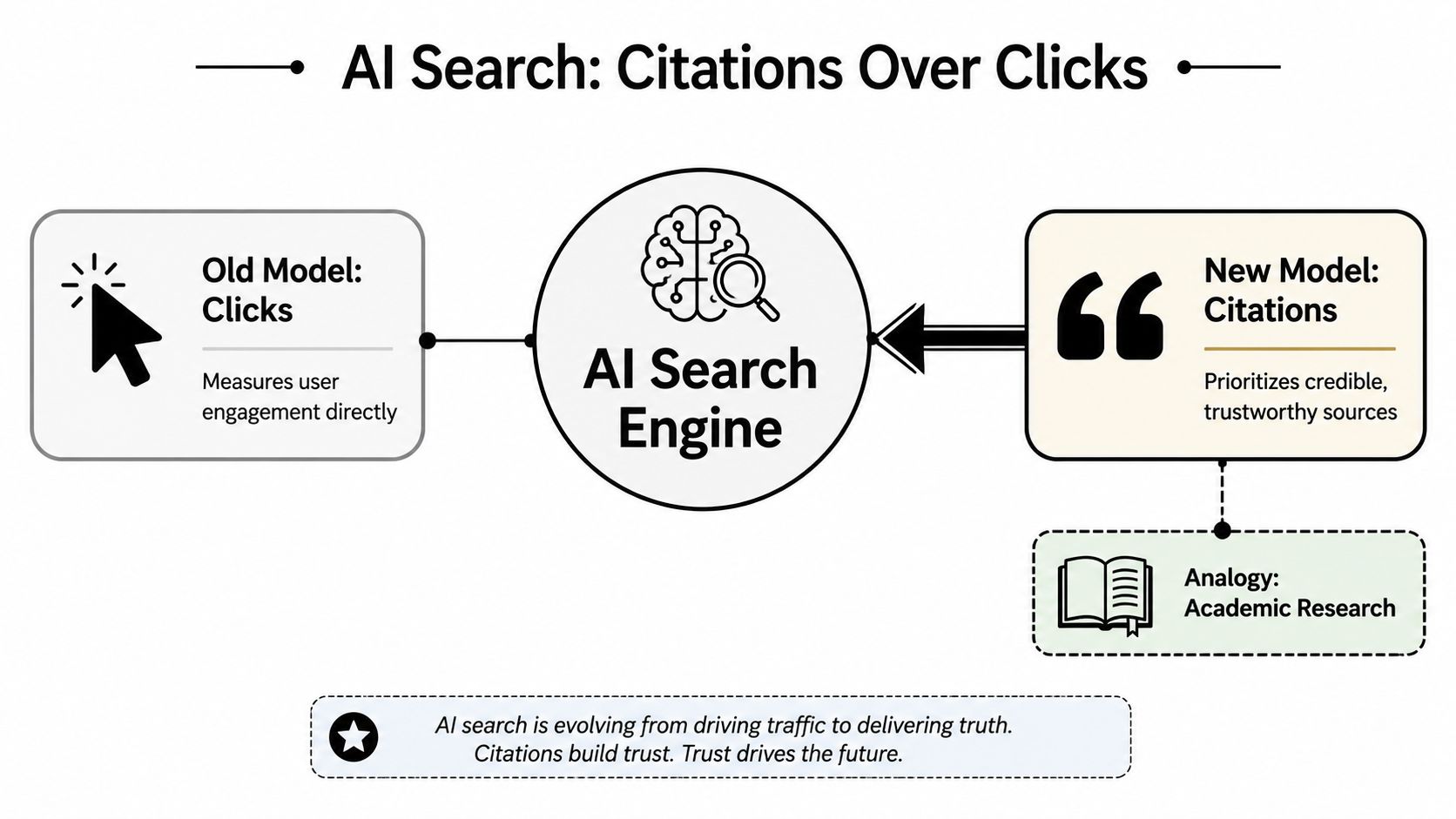
The old win was traffic
For years, search strategy revolved around a simple question: how do we get the click?
That produced familiar tactics:
- Rank higher for target keywords
- Write titles that improve click-through
- Use ads to capture top-of-page visibility
- Tune landing pages for conversions
Those tactics still matter. But they don't define the whole game now.
Recent industry reporting estimated that up to 60% of Google searches in 2025 were zero-click, meaning users often got the answer directly from the results page or an AI summary instead of visiting a website (Digital Applied paid search data points).
If a majority of searches can end without a click, ranking by itself stops being a complete business strategy.
The new win is being referenced
An AI summary doesn't reward the page with the flashiest title. It leans toward the source with the clearest, most trustworthy, most usable information footprint.
That usually means the brand has done several things well:
| Search behavior | What wins |
|---|---|
| Human browsing | Strong snippet, clear offer, persuasive CTA |
| AI synthesis | Clear facts, structured information, authority signals |
| Zero-click result | Brand visibility without a site visit |
| Follow-up query | Consistent trust across multiple surfaces |
This is why I tell business owners to think less like publishers chasing pageviews and more like experts building a public record.
AI citation is the new rank-zero advantage. If the system trusts your brand enough to reference it, you've moved closer to being the answer instead of just one option.
That requires a different measurement mindset. Clicks still matter. Leads still matter. But you also need to monitor whether your brand is understandable enough for machines to retrieve and trustworthy enough for them to surface.
One useful way to pressure-test that is to review your AI Visibility Score. If your site reads clearly to humans but poorly to machines, that gap becomes expensive.
Why this is urgent for savvy operators
The businesses that adapt first will own more than traffic. They'll own mindshare inside the interfaces buyers are starting to trust.
That doesn't mean abandoning SEO or cutting PPC. It means repurposing both. Your ad campaigns identify what people care about. Your organic presence turns those insights into structured, citation-worthy assets.
Clicks used to be the prize. Now they're often a byproduct.
Understanding Answer Engine Optimization
Answer Engine Optimization, or AEO, is the discipline of making your brand easy for AI systems to understand, trust, and reuse in answers.
A lot of marketers overcomplicate it. They make it sound like a mysterious new channel. It isn't. It's the practical extension of technical SEO, content strategy, and authority building into an environment where machines synthesize answers instead of listing pages.
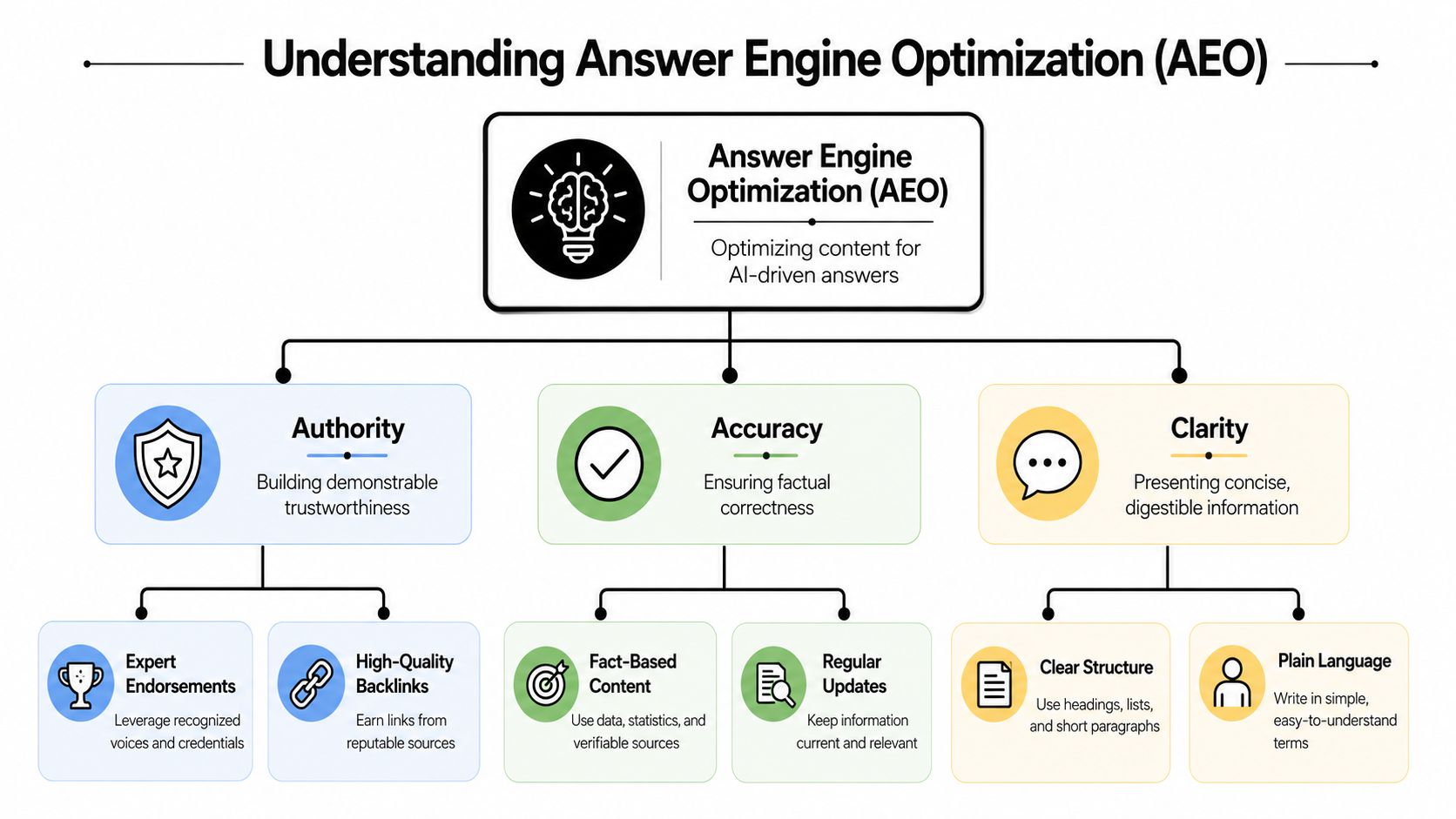
AEO rests on three working pillars
Authority
Your brand has to look verifiable, not just polished.
That means clear company details, expert bios, consistent service descriptions, aligned profiles across the web, and credible mentions beyond your own site. AI systems don't "trust" in a human sense, but they do rely on consistency and corroboration.
Accuracy
Your pages need to say what you do in plain language. No foggy taglines. No bloated paragraphs that bury the answer.
AEO favors content that defines services, constraints, locations, use cases, and common questions clearly enough that a machine can extract the point without guessing.
Clarity
Structure matters. Schema markup, FAQ formatting, comparison tables, scannable headings, and concise answers all reduce ambiguity.
Consider the packaging of inventory in a warehouse. If every box is labeled cleanly, retrieval is faster and more reliable.
Where PPC becomes far more valuable
Most SEO PPC services stop at keyword overlap. That's shallow.
A more useful approach is to treat paid search as a live testing layer for AEO. One industry analysis highlighted this strategic blind spot directly, arguing that brands should use PPC search term data as a rapid experimentation channel to validate which high-intent queries and user prompts deserve investment in structured data, FAQ content, and citation-ready pages for long-term AI retrieval (Results Repeat on how SEO and PPC work together).
Here's what that looks like in practice:
- Ad search terms reveal wording buyers use, not what your internal team assumes.
- Winning ad copy exposes language patterns that deserve permanent placement in organic pages.
- Landing-page conversion feedback shows intent depth, which helps you decide what content should get schema and supporting FAQs.
- Negative keywords reveal mismatches, which helps prevent you from building content around the wrong questions.
Field note: PPC tells you which questions deserve a long-term answer. AEO turns those answers into assets AI can retrieve.
If you want a cleaner definition of the discipline itself, this guide to Answer Engine Optimization is a useful reference point.
What to build first
Don't start with a giant content sprint. Start with precision.
Choose the commercial queries that repeatedly prove their value in paid search. Then build pages around them that are:
- Specific about the service
- Supported by schema
- Written with direct answers near the top
- Reinforced by FAQs and trust signals
- Connected to your brand entities and expert profiles
AEO isn't replacing SEO. It's forcing SEO to become machine-readable, evidence-backed, and commercially smarter.
How to Build Brand Authority for AI Discovery
If AEO is the framework, authority is the foundation. Without it, your content may be well written and technically clean, but AI systems still have weak reasons to surface your brand.
The simplest way to think about authority is this: your business needs a digital resume. Not a slogan. Not a home page hero line. A resume.

Build a resume that machines can verify
That resume should include the basics, but most companies still leave them incomplete or inconsistent.
Your brand authority stack should include:
- A complete company identity with consistent business name, services, contact details, and brand descriptions across owned properties
- Detailed author and leadership bios that explain real experience, credentials, and subject ownership
- Service pages with substance instead of generic copy that could apply to any competitor
- Third-party mentions and references that support your claims outside your own site
- A maintained Google Business Profile where relevant, especially for service businesses and multi-location operators
A machine isn't impressed by branding language. It looks for repeated, corroborated facts.
Know when PPC stops being the smart place to overinvest
For smaller and mid-sized businesses, budget discipline matters. One undercovered but important point in recent industry commentary is that as CPCs rise, paid search can become less efficient over time, which makes durable organic authority and citation-building more important for sustainable acquisition (William & Mary on SEO and PPC tactics).
That doesn't mean shut off ads. It means stop using ads as a substitute for brand infrastructure.
A healthy decision pattern looks like this:
| Business condition | Better emphasis |
|---|---|
| You need lead flow quickly | Use PPC to test demand and messaging |
| Certain queries convert repeatedly | Build organic pages and FAQs around them |
| Paid costs start tightening efficiency | Shift more effort into authority and structured content |
| Your brand appears inconsistent online | Fix trust signals before scaling further |
E-E-A-T isn't theory anymore
Experience, Expertise, Authoritativeness, and Trustworthiness now function like proof layers. They help search systems understand who is speaking, why they should be trusted, and whether the information aligns with a credible business identity.
That means you should tighten all of the following:
- About pages that explain the company with specifics
- Author pages that connect experts to topics
- Review management and reputation signals
- Case evidence stated carefully and truthfully
- Cross-linking between your service, company, and expert pages
If you're cleaning up this layer, this practical guide to E-E-A-T for AI gives a useful checklist.
Your brand authority should be obvious even if someone never lands on your home page. That's the standard AI search is pushing toward.
Businesses that ignore this end up renting visibility forever. Businesses that invest in authority build retrieval equity.
Your Four-Step Roadmap to AI Readiness
AI search will not reward the businesses with the most pages. It will reward the businesses whose facts are easiest to verify, connect, and cite.
That changes how you should use SEO PPC services. Paid search is no longer just a lead channel. It is your testing lab for future AEO assets. Use it to find the language, questions, and proof points that deserve permanent structure on your site.

Step 1 Audit what machines actually see
Start with machine visibility, not rank reports.
A business can have decent traffic and still look fuzzy to AI systems. If your service pages use inconsistent labels, your experts are disconnected from the topics they cover, or your external mentions don't match your site language, retrieval gets weaker. AI does not fill in those gaps the way a human buyer might.
Review these areas first:
- Core schema coverage
- Entity consistency across site pages
- Service-page clarity
- Brand mentions across external properties
- FAQ and answer formatting
- How PPC and organic data are currently separated
The point of the audit is simple. Find every place where your business is easy for a person to understand but hard for a machine to classify.
Raven SEO is one provider businesses use for AI-focused technical SEO and visibility auditing within a broader search strategy.
Step 2 Implement foundational schema and entity signals
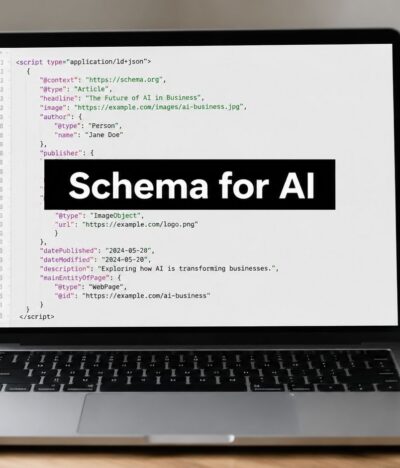
Schema works like a product label on a warehouse shelf. Without the label, the item exists, but systems sort it poorly.
Your site needs explicit signals for who you are, what you sell, where you operate, and which people speak for the brand. That is what turns a website from a collection of pages into a readable entity graph. If you need a practical reference, this guide to structured data implementation for AI visibility is a strong place to start.
For many businesses, the priority set includes:
- Organization schema
- Local business schema where applicable
- Service and product schema
- FAQ markup on validated question sets
- Author and profile connections
- Review or reputation-related structured elements where appropriate
Accuracy matters more than volume. Mark up what you can support on-page. Skip the rest.
Here's a short explainer that supports the implementation mindset:
Step 3 Turn PPC insights into citation-worthy content
This step creates a distinct advantage.
PPC gives you live market feedback. You see the exact queries people use, the promises they respond to, and the objections that block conversion. That makes paid search the fastest way to decide what your future AI-visible content should say and how it should be structured. OrangeMonke explains this well in its piece on integrating SEO and PPC services, showing how teams use Google Search Console, Google Ads, and Google Analytics together to test messages in paid search and carry the winners into organic assets.
Use PPC findings to decide:
- Which queries deserve a dedicated page
- Which questions belong in FAQs
- Which headlines should become H1s or subheads
- Which service comparisons need clearer explanation
- Which user concerns require trust-building proof on-page
This is the shift many companies miss. They treat PPC as a faucet for traffic and SEO as a separate content calendar. The better model is tighter. PPC tests demand. SEO turns winning patterns into structured, citable knowledge.
Recommendation: Build permanent pages only after paid search proves the query reflects real buying intent.
Step 4 Measure visibility beyond last-click conversion
If you only track leads and ROAS, you will miss the early signs of AI readiness.
You also need to measure whether your brand is becoming easier to retrieve, reference, and trust across search surfaces. That includes whether your branded language is tightening, whether question-based content aligns with actual search behavior, and whether your paid and organic messaging describe the same business in the same terms.
Watch for signals like:
- More consistent branded search language
- Better alignment with question-based queries
- Stronger entity coverage across search surfaces
- Content formatted for retrieval, not just ranking
- Closer message alignment between paid and organic assets
Reputation belongs in this measurement stack too. AI systems and buyers both use public feedback as a trust shortcut. If your team needs help responding at scale, automated AI review responses can help maintain consistency without slowing your staff down.
Measure the business outcome. Measure the machine-readable footprint too. That is how you stop renting attention and start building retrieval equity.
Secure Your Future in Generative Search
Search isn't disappearing. It's being compressed.
Users still need providers, products, and experts. But the route between question and decision now runs through AI summaries, zero-click results, and machine-selected sources. That's why SEO PPC services need a new operating model. PPC should validate demand fast. SEO should convert those lessons into durable authority and structured clarity.
The businesses that win won't be the ones with the loudest ads or the most blog posts. They'll be the ones with the cleanest factual footprint, the strongest brand signals, and the best alignment between paid insight and organic infrastructure.
That also applies beyond your website. Review velocity, response quality, and public trust signals all shape how your business is perceived online. If you're tightening customer feedback workflows, tools for automated AI review responses can help teams respond more consistently while protecting time and brand tone.
Your next move should be practical. Audit your entities. Fix your schema. Mine PPC search terms for question patterns. Build pages that deserve to be cited. Strengthen the trust signals around your brand. If your structured content is weak, this guide to structured data is a smart place to continue.
This shift is real, but it's also manageable. Businesses that act now can build an advantage before AI visibility becomes as crowded as traditional SEO.
Related Raven SEO Resources
- Free website audit – find where paid search can fill SEO gaps
- Local SEO services – the organic foundation PPC supports
- Contact Raven SEO – scope an SEO + PPC engagement
Want paid search that strengthens your SEO instead of competing with it? Raven SEO aligns PPC with your organic strategy for Maryland businesses – talk to our team or get a free website audit to see where paid can help.