

Meta Title: Vancouver Search Engine Optimization for AI Visibility | Raven SEO
Meta Description: Learn how vancouver search engine optimization is shifting from rankings to AI citations, structured data, and brand authority. Explore a practical AEO roadmap with Raven SEO.
Most advice about vancouver search engine optimization is already outdated.
It still treats search like a list of blue links, a keyword map, and a Google Business Profile checklist. Those things still matter, but they no longer describe the full job. Search platforms increasingly summarize, recommend, and cite. That changes what businesses need to optimize for.
Vancouver is a useful lens because it's no longer a casual local SEO market. It's a mature, benchmarked agency environment, with directories such as Semrush's Vancouver SEO agency listing and other city-specific rankings showing that buyers now compare specialists across technical SEO, content, local search, and analytics. That maturity makes Vancouver less of a local exception and more of a preview of where competitive search is heading across major markets.
Rethinking Vancouver Search Engine Optimization for 2026
Most businesses still approach Vancouver SEO as if the goal is simple. Pick keywords, optimize service pages, collect reviews, and push toward page one. That playbook isn't wrong. It's incomplete.
A lot of content in this space still overemphasizes local basics and under-explains how to earn visibility in AI-driven results like AI Overviews, which are becoming a mainstream search feature, as noted by Hiilite's Vancouver SEO page. The bigger question now is different: when an AI system summarizes a topic, compares providers, or answers a local-intent query directly, will it recognize your brand as a reliable source worth citing?

Why the old definition is too narrow
Traditional local SEO asks, “How do we rank?”
Modern search strategy also asks:
- Can machines identify your brand clearly
- Can they verify what you do
- Can they connect your expertise to a topic
- Can they trust your information enough to surface it
That's why local fundamentals still matter, but only as part of a broader visibility system. If you want a useful refresher on those fundamentals, Raven's guide to local search ranking factors is a good baseline. The problem is stopping there.
Practical rule: If your SEO strategy depends only on clicks from blue links, you're optimizing for one layer of search while newer answer layers make the selection upstream.
Vancouver is a signal, not an exception
In a market this competitive, businesses can't rely on light optimization and generic content. They need clean entity signals, stronger authority, and content designed to be reused by search systems.
That also changes how teams think about amplification. Press mentions, expert commentary, and brand references help users discover you, but they also help search systems validate you. Used correctly, Boost SEO rankings with press releases can support that broader credibility layer by reinforcing brand entities across the web.
The useful shift in thinking is this. Vancouver search engine optimization isn't just about winning a ranking position anymore. It's about becoming a citable source in a search environment that increasingly answers before the click.
The Shift from Clicks to Citations Introducing AEO
AEO, or AI Engine Optimization, changes the target.
SEO has usually focused on visibility inside a list of results. AEO focuses on whether an AI system can extract, trust, and reuse your information in a direct answer, summary, comparison, or recommendation. One model competes for clicks. The other competes for citation.
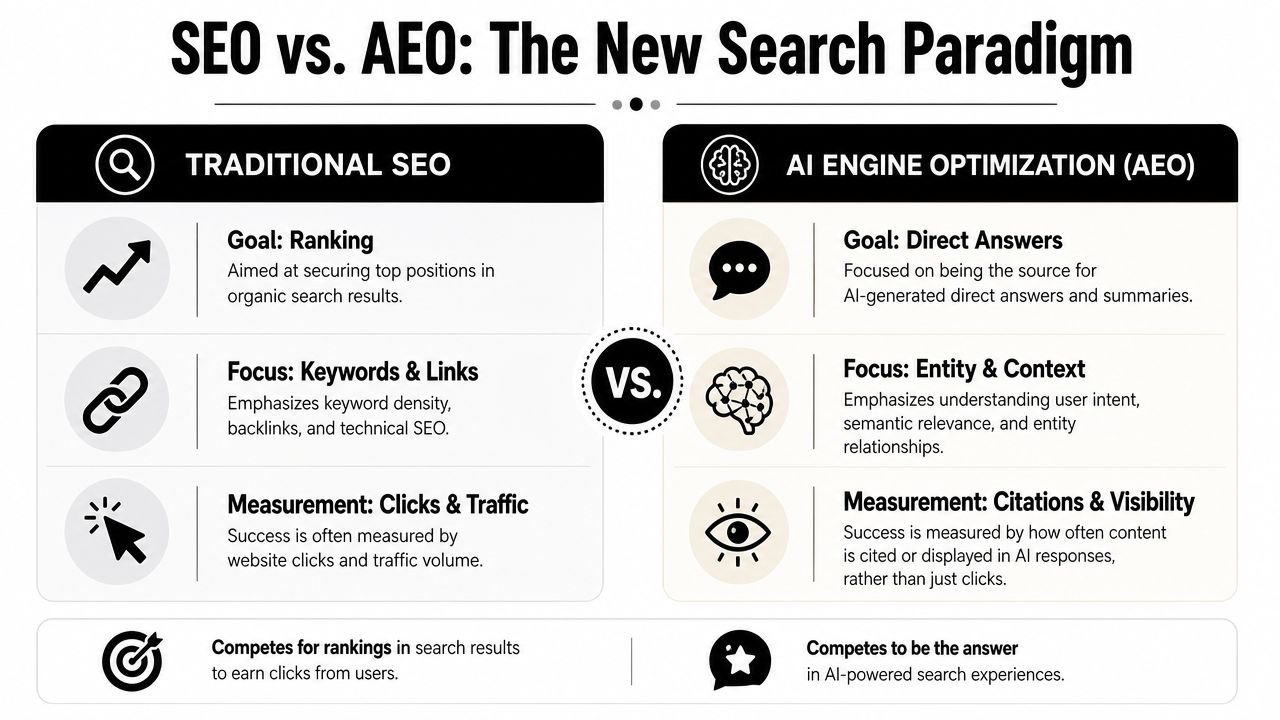
A simple way to think about it
SEO is like trying to get your book displayed at the front of the store.
AEO is like making sure your book is the one the librarian consults when someone asks a question.
That distinction matters because the system choosing a citation doesn't behave like a human skimming ten blue links. It parses structure, context, consistency, authorship, and source clarity. That's why the move from SEO to AEO isn't cosmetic. It changes how content gets produced and how websites get built.
For a deeper breakdown of that divide, Raven's explainer on AEO vs SEO in 2026 frames the operational difference clearly.
What AI systems look for
Generative systems need source material they can interpret with low ambiguity. In practice, that means:
- Clear entities: Your company, services, locations, and experts should be easy to identify.
- Structured context: Headings, schema, bylines, organization details, and supporting pages should reinforce each other.
- Reliable retrieval: Content should answer real questions directly, not bury facts inside vague sales copy.
- Consistent signals: Your site and off-site mentions shouldn't conflict on names, services, or business details.
This is also where retrieval matters. If you want a practical explanation of how RAG enhances AI, DataTeams offers a useful overview of how retrieval-augmented systems pull in external information before generating responses. That retrieval step rewards clarity. Messy sites get skipped or misunderstood.
A short visual example helps:
What changes for marketers
The KPI mix expands.
| Traditional focus | AEO-focused expansion |
|---|---|
| Rankings | Citation potential |
| Organic traffic | Search presence across answer surfaces |
| Keyword targeting | Entity clarity and topic depth |
| Page-level optimization | Brand-level trust and consistency |
SEO asked whether a page could rank. AEO asks whether a system can safely reuse what the page says.
That's why vancouver search engine optimization now sits inside a larger discipline. Businesses still need technical SEO, content strategy, and local optimization. They also need information architecture built for machine interpretation.
Why Brand Authority and Data Structure Are the New Cornerstones
In AI-mediated search, trust isn't abstract. It has to be encoded.
That's why two elements now carry disproportionate weight. The first is brand authority. The second is data structure. One tells search systems whether you should be believed. The other tells them what, exactly, to believe.
Entity consistency matters more than checklist SEO
A Vancouver-focused provider notes that local search success depends heavily on Google Business Profile, NAP data, review signals, and other local authority factors, and that these clean, trustworthy signals help AI systems infer credibility and cite a brand correctly in generative answers, according to New Media's Vancouver SEO company page.
That point is bigger than local SEO.
NAP consistency is really just one small slice of entity consistency. Your brand name, location references, service taxonomy, expert authors, and organization details all need to line up across your website and the wider web. If they don't, AI systems have to guess. When they have to guess, they often choose another source.
Authority without structure gets wasted
Many businesses already have real expertise. They publish useful pages, employ subject matter experts, and have solid reputations with customers. But if that expertise isn't structured well, search systems can't reliably attribute it.
That usually shows up in a few common failures:
- Anonymous content: No author, no credentials, no editorial context.
- Fragmented brand signals: Different service descriptions across key pages.
- Weak organizational markup: Search systems can't connect the company to the content.
- Thin supporting assets: No policies, about pages, team pages, or proof layers.
A useful starting point is to think in layers:
Organization layer
Who is publishing the content?Expert layer
Which person or team is responsible for the insight?Topical layer
Which subject does the brand consistently cover with depth?Validation layer
Which external and internal signals reinforce trust?
Teams working on this should also understand structured data implementation basics, because markup is one of the cleanest ways to reduce ambiguity.
Strong brands don't get cited just because they're well known. They get cited because their identity, expertise, and information are easy to verify.
For national brands entering competitive city markets, this is the key trade-off. You can publish more pages, or you can make your expertise machine-readable. The second option often offers a greater advantage in the generative search environment.
A Practical Roadmap to Achieve AI Visibility
AEO work becomes manageable when you treat it as a sequence instead of a buzzword.
A reinvention isn't often the solution. What's required is a disciplined process that cleans up weak signals, strengthens authority, and gives search systems clearer material to cite.

Stage one builds the baseline
Start with an audit, but not a generic SEO audit.
Review your site as if a retrieval system has to identify your brand, understand your services, and connect your claims to the right source. That means checking:
- Entity alignment: Brand name, service names, locations, and expert profiles
- Content clarity: Whether key pages answer questions directly
- Attribution signals: Bylines, organization details, contact information, and support pages
- Technical readiness: Indexation, crawl paths, duplicate topics, and structured data coverage
Agencies and internal teams often discover that their strongest content is buried inside poor architecture. The issue isn't quality alone. It's accessibility and clarity.
Stage two creates the machine-readable layer
Once the weaknesses are visible, move into markup and architecture.
This stage usually includes schema implementation, internal linking cleanup, template improvements, and page hierarchy fixes. Think of it as the layer that helps search systems interpret your content with less friction.
A simple comparison helps:
| Weak setup | Stronger setup |
|---|---|
| Service page with generic claims | Service page tied to organization, location, and topical context |
| Blog post with no author | Article with clear author, publisher, and topical relevance |
| Conflicting business info | Unified business identity across core pages |
| Loose site hierarchy | Clear clusters and supporting pages |
For teams redesigning or rebuilding, Raven's 6 step design process is useful because AI visibility starts in planning. It doesn't get bolted on successfully at the end.
Stage three earns citation value
This is the content stage, but not in the usual “publish more blogs” sense.
You need assets that answer, compare, define, and clarify. Product pages matter. So do service pages, expert bios, FAQs, policy pages, and topical explainers. The common thread is that each asset should contribute usable facts, not just persuasion copy.
Working standard: If a paragraph can't stand alone as a helpful answer, it probably won't perform well in generative retrieval.
A practical stack might include:
- Expert-led articles that tie advice to named authors
- Category pages that define scope and use cases
- Location pages that reflect real service delivery, not duplicate templates
- Supporting reference content such as glossaries, process pages, and comparisons
Stage four reinforces trust beyond the website
AI visibility isn't only on-page.
Brands also need corroboration through mentions, profiles, reviews, earned media, and platform consistency. For this reason, a lot of national companies lose traction in local markets. They centralize the brand, but they don't localize trust signals.
That final stage also requires monitoring. Teams should watch how branded queries surface, how pages are being interpreted, and where ambiguity still exists. Some businesses manage this internally with content, SEO, and development teams. Others use agency support, including providers that now package AI-readiness work alongside technical SEO and web design. Raven SEO is one such option for brands that want an audit-based approach tied to implementation.
The roadmap is practical because it forces prioritization. You don't need to optimize everything at once. You need to make your brand easier to understand, easier to trust, and easier to cite.
Essential Structured Data Patterns for AI Citations
Technical SEO has always mattered, but in generative search it becomes more directly tied to visibility. A technical audit in a competitive market typically reviews crawlability, architecture, page speed, mobile usability, structured data, sitemaps, robots directives, broken links, duplicate content, orphan pages, and internationalization signals. That matters for AI visibility because machine-readable site signals help systems extract and cite facts accurately, as outlined on Seologist's technical SEO page.
Three schema types worth prioritizing
The goal of schema isn't decoration. It's disambiguation.
If you're trying to improve vancouver search engine optimization in an AI-heavy environment, three patterns often carry the most practical value.
Organization schema
This tells search systems who the publisher is.
{
  "@context": "https://schema.org",
  "@type": "Organization",
  "name": "Example Brand",
  "url": "https://www.example.com",
  "logo": "https://www.example.com/logo.png",
  "sameAs": [
    "https://www.linkedin.com/company/example-brand"
  ]
}
Use this to establish the canonical identity of the business. The sameAs property helps connect your site to recognized brand profiles elsewhere.
Person schema
This helps connect expertise to a named individual.
{
  "@context": "https://schema.org",
  "@type": "Person",
  "name": "Jordan Lee",
  "jobTitle": "Senior HVAC Consultant",
  "worksFor": {
    "@type": "Organization",
    "name": "Example Brand"
  },
  "url": "https://www.example.com/team/jordan-lee"
}
This is useful for expert bios, author pages, and advisory content. It reduces the risk of anonymous expertise, which is a common weakness in local and service-business sites.
Article schema
This helps systems understand a content asset as a specific published resource.
{
  "@context": "https://schema.org",
  "@type": "Article",
  "headline": "How to Choose a Commercial HVAC Maintenance Plan",
  "author": {
    "@type": "Person",
    "name": "Jordan Lee"
  },
  "publisher": {
    "@type": "Organization",
    "name": "Example Brand"
  },
  "datePublished": "2026-01-15"
}
The key properties here are author and publisher. They help tie the content to both expertise and brand ownership.
What these patterns solve
Schema works best when it supports a clean content system.
- It clarifies identity: Organization markup defines who is speaking.
- It clarifies expertise: Person markup defines who knows the topic.
- It clarifies document type: Article markup defines what kind of asset the system is reading.
For implementation details, Raven's guide to schema markup and search visibility is a practical starting point.
Technical SEO for AI visibility is really about removing uncertainty. The cleaner the site signals, the easier it is for a model to attribute facts correctly.
Schema alone won't make a weak brand citable. But without it, even strong brands often leave too much interpretation up to the machine.
Future-Proofing Your Brand in the Generative Era
The market has already moved.
Vancouver agency listings increasingly describe services that combine technical SEO, content strategy, link building, and AI-aware optimization. That shift shows up in current agency positioning on Clutch's Vancouver SEO firms page, where the practical benchmark is broader visibility across organic search, local packs, and AI-mediated discovery.
What businesses should do next
The safe assumption now is that search will keep blending ranking systems with answer systems. Brands that prepare for that environment will have more durable visibility than brands still optimizing only for a click-through model.
That means prioritizing:
- Authority you can verify
- Content that answers clearly
- Schema that reduces ambiguity
- Brand signals that stay consistent across platforms
If you operate ecommerce alongside local or regional search, it also helps to study how AI-ready content works in product-heavy environments. This wRanks AI content guide for Shopify is a useful example of how teams are adapting content workflows for AI-assisted discovery.
The strategic takeaway
The future of vancouver search engine optimization won't belong to businesses that publish the most generic pages. It will belong to brands that become dependable reference points.
That is the practical standard for generative search. Not just visibility. Citability.
Frequently Asked Questions About AI Engine Optimization
Is AEO replacing SEO
No. AEO builds on SEO.
You still need crawlable pages, useful content, internal links, and sound technical foundations. What changes is the success condition. Ranking alone isn't enough if search systems answer the query without sending the same volume of clicks.
Does local SEO still matter for AI visibility
Yes, but the role is broader now.
Local signals such as business identity, reviews, and consistent location data help search engines understand who you are. In generative environments, those same signals can support trust and source clarity.
What kind of content gets cited most often
Content that answers specific questions clearly tends to be more reusable than vague marketing copy.
Good citation candidates usually have direct definitions, comparisons, concise explanations, expert attribution, and strong alignment between the page topic and the business publishing it.
Do small businesses need schema markup
If they want stronger AI visibility, yes.
Schema doesn't replace quality, but it helps systems interpret quality correctly. Small businesses often compete well here because they can make their service pages, author pages, and organization details much cleaner than large organizations with messy websites.
How should businesses measure success if clicks decline
Use a wider view of search presence.
Look at branded search behavior, local pack visibility, how clearly your business appears across search features, and whether your content is showing up in answer-driven discovery paths. Traffic still matters. It just isn't the only signal worth watching anymore.
If your business wants to move from conventional rankings to AI-ready visibility, Raven SEO can help you start with a no-obligation review of your current search presence, structured data, and citation readiness.