

If your SEO strategy still treats the click as the only win, you're solving yesterday's problem.
A growing share of buyers now get what they need from an AI-generated answer before they ever visit a website. That changes the job of search. The goal isn't only to rank. It's to become the source an AI system chooses to cite, summarize, and recommend.
Small and mid-sized businesses have been told this shift favors giant brands with massive press footprints. I don't buy that. The businesses that will win in generative search aren't always the loudest. They're the clearest, the most structured, and the most credible.
The End of the Click as We Know It
The old SEO model was simple. Earn rankings, attract clicks, convert traffic. That model still matters, but it no longer describes the full path to visibility.
AI search tools now answer questions directly. Users ask ChatGPT, Google AI Overviews, Perplexity, and Gemini for recommendations, explanations, comparisons, and summaries. In many cases, they never need to open ten blue links.
The pace of change is a wake-up call. By October 2025, ChatGPT reached 800 million weekly users, AI adoption rose from 14% to 29.2% in six months, and nearly 40% of Americans were using AI tools monthly, according to this generative search guide. That isn't a side trend. It's a new behavior pattern.
Why old success metrics are breaking
If a buyer gets a complete answer inside the interface, your pageview never happens. Your analytics dashboard may show less traffic even while your brand influences more purchase decisions.
That forces a harder question. Are you optimizing for visits, or are you optimizing for influence?
Search visibility now includes being quoted inside the answer, not just listed beneath it.
This is why businesses need to rethink what they're measuring. Impression share in AI interfaces, brand mentions in generated answers, and citation frequency now matter alongside traditional rankings.
For a deeper look at where this shift is heading, review the future of SEO with AI. The takeaway is straightforward. If your content can't be extracted, trusted, and cited, it can disappear from the moments that shape buying decisions.
What this means for smaller brands
This shift is uncomfortable, but it creates an opening.
Traditional SEO often rewards domain strength and link equity at scale. Generative search also values precision, directness, source clarity, and machine-readable structure. Smaller companies can compete there. They just need to stop publishing vague marketing copy and start publishing answer-ready content.
Defining Generative Search Optimization
Generative search optimization is the practice of structuring digital content so AI systems can retrieve it, trust it, and use it in generated responses. That's the practical definition. The formal version is close: Generative Engine Optimization (GEO) is the practice of structuring digital content to improve visibility in AI-generated responses, and AI systems favor evidence-backed authority, clear authorship, and transparency signals, as summarized in Wikipedia's GEO overview.

Think of it like this
Traditional SEO is like getting your book listed in a library catalog.
Generative search optimization is getting your book quoted by the librarian when someone asks a question.
That distinction matters. Ranking gets you discovered. Citation gets you embedded in the answer itself.
How GSO differs from standard SEO
A simple comparison makes the shift obvious:
| Area | Traditional SEO | Generative Search Optimization |
|---|---|---|
| Primary goal | Ranking in results | Being cited in AI answers |
| Main asset | Optimized page | Extractable passage or verified fact |
| Winning signal | Relevance plus authority | Trust plus clarity plus structure |
| Core output | Click opportunity | Direct answer presence |
| Best metric | Traffic and rankings | Mentions, citations, recommendation presence |
This doesn't mean SEO is obsolete. It means SEO is now the floor. Generative optimization builds on top of it.
What AI systems actually need from your site
AI tools don't "appreciate" brand messaging. They process signals.
They look for content that is:
- Clearly authored: Real experts, named contributors, visible credentials
- Easy to extract: Strong headings, short paragraphs, concise definitions, direct answers
- Supported by evidence: Verifiable facts, cited claims, transparent sourcing
- Technically understandable: Clean HTML, schema markup, crawlable public pages
If you want a useful outside perspective on how teams are organizing AI content systems, BuddyPro's AI knowledge base is worth reviewing. It's a good reference point for thinking beyond blog posts and toward reusable source content.
A lot of business owners ask whether this is just a new label for the same old work. It isn't. Generative search changes the output you're targeting and the way your content gets selected. If you want the tactical bridge between classic optimization and AI visibility, this guide on SEO for generative AI search is the right next read.
The New Currency of Search From Clicks to Citations
The most important metric in generative search isn't traffic. It's whether your brand gets mentioned when the answer is generated.

That sounds abstract until you look at how these systems work. AI platforms often pull a specific passage, product detail, comparison point, or explanation from a page. They don't need your whole article. They need the one part of it that cleanly answers the prompt.
According to Search Engine Land's GEO explainer, the primary success metric in generative search is the frequency of brand mentions and citations, and AI systems are more likely to reuse individual passages that provide clear, direct answers. That's why structure and factual clarity beat bloated copy.
What a citation actually does for a business
A citation in AI search has value even if the user never clicks.
It can:
- Build branded recall: Your company name appears during the decision phase
- Transfer authority: The AI system treats you as a source, not just a vendor
- Shape comparisons: Your offer gets included when the user asks "best," "top," or "how does X compare to Y"
- Support indirect conversions: Users may search your brand later, call directly, or convert through another channel
The business win isn't always the session. It's being present when the recommendation is formed.
Many reporting frameworks fail. They still reward only last-click performance. In AI search, influence starts earlier and often ends elsewhere.
Why structure beats length
Long-form content isn't bad. Unstructured content is.
If a page buries its strongest answer under a thousand words of filler, AI systems have to work harder to use it. Most won't. The pages that get cited tend to make extraction easy.
Practical formats that work well include:
- Short answer blocks: One question, one clean answer
- Comparison tables: Especially for products, services, and feature differences
- Numbered steps: Good for procedures and service workflows
- Definition paragraphs: Strong for educational queries and category pages
Here's a quick visual primer on the change in search behavior:
If your content team still writes every page like a brochure, fix that first. AI doesn't reward polished vagueness.
The Core Strategies for Brand Authority in AI Search
Most companies don't have an AI problem. They have a credibility and structure problem.
AI systems need a reason to trust your brand, a clean way to understand your content, and public signals that confirm you're a legitimate source. Those requirements aren't optional.

According to Google's AI optimization guidance, pages must be indexed and eligible for snippets in standard search before they can appear in generative features. The same guidance emphasizes unique, non-commodity content, and the verified data tied to that guidance shows that AI models reward transparent citations and unique content with a 35% higher share of voice in AI-generated responses.
Pillar one: technical eligibility
You can't win citations on pages search systems can't reliably access.
Start with the basics:
- Indexability: Important pages must be crawlable and indexable
- Snippet readiness: Pages should answer questions clearly enough to qualify for search features
- Semantic HTML: Use headings, lists, tables, and clean page structure
- Speed and stability: Slow, unstable pages create processing friction
A surprising number of companies skip this and jump straight to AI copy tactics. That's backward.
Pillar two: expertise that can be verified
E-E-A-T still matters because AI systems need proof that a source deserves trust.
That means your site should show:
- Named authors or reviewers
- Relevant experience
- Topical specialization
- Consistent brand entities across the web
For a deeper breakdown of how experience and trust signals translate into AI visibility, review E-E-A-T for AI.
Practical rule: If a human buyer can't tell who wrote the page or why they should trust it, an AI system has no reason to elevate it.
Pillar three: content built for extraction
The best-performing AI-ready pages usually share the same traits. They answer a narrow question directly, support the answer with evidence, and separate facts from fluff.
Use content patterns like:
- FAQ blocks: Strong for conversational prompts
- Tables and comparisons: Excellent for commercial investigation
- Direct lead paragraphs: Put the answer high on the page
- Clear sourcing: Cite your own claims transparently when relevant
If your team wants to speed up topic discovery and prompt research, Samuel Woods has a useful breakdown on how to automate SEO research with AI. Use tools for research, but don't outsource judgment.
Pillar four: off-site corroboration
Your website can't be the only place your expertise exists.
AI systems look for consistency across your digital footprint. Brand mentions, profiles, reviews, expert commentary, and public references all reinforce entity confidence. This matters a lot for service businesses, legal practices, healthcare groups, and multi-location brands where trust is part of the product.
Pillar five: data hygiene
Outdated claims, missing authorship, inconsistent service details, and broken structured data create doubt. AI systems don't need a dramatic reason to ignore you. Small trust gaps are enough.
The businesses that win here usually aren't gaming the system. They're maintaining it better than everyone else.
How to Become an AI Source with Structured Data
Structured data is the most practical lever in generative search because it translates your content into a format machines can interpret with less guesswork.
If your page says, "We serve clients nationwide, our founder has 15 years of experience, and this guide was updated recently," a human can piece that together. Schema markup turns those ideas into explicit labels. It tells machines what's a business, who's the author, what service is offered, when the content was published, and where the organization operates.
Why completeness matters more than presence
Adding schema isn't enough. Incomplete schema leaves ambiguity, and ambiguity kills citations.
The clearest data point on this comes from the verified analysis cited in your brief: brands with 95%+ schema completeness were cited 3.4 times more often in AI Overviews than brands with 70% completeness, including details such as dates, authorship, and geographic coordinates. That gives businesses a real target. Don't aim for "we added some schema." Aim for near-complete markup.
What to prioritize first
For most small and mid-sized businesses, I recommend this order:
Organization or LocalBusiness schema
Define who you are. Include consistent business identity details, service area information, and contact attributes where appropriate.WebPage and Article schema
Clarify page purpose, author, reviewer, and update details. Through this, expertise signals become machine-readable.FAQPage schema
Use it for real customer questions, not spammy filler. Good FAQ markup creates direct question-answer pairs that AI systems can reuse.Product or Service schema
Explain what you sell with precision. Keep naming consistent across site templates and supporting pages.
The operational standard most teams miss
Schema needs maintenance.
That means:
- Check dates: If content is updated, reflect that accurately.
- Align authorship: The on-page author and schema author should match.
- Standardize entities: Business name, service names, and locations should stay consistent.
- Validate regularly: Broken markup erodes visibility.
If you're building support content or resource centers, Mava's guide to AI-friendly knowledge bases offers useful ideas for making reference content easier for AI systems to use.
What this looks like in practice
A contractor, legal firm, or healthcare practice doesn't need a giant media footprint to compete. It needs a site that removes uncertainty.
That means every core page should answer:
- Who is responsible for this information?
- What service or topic does this page cover?
- Where does the business operate?
- When was this reviewed or updated?
- Which questions does this page answer directly?
If your current site can't answer those questions in machine-readable form, start with structured data. This primer on what structured data in SEO is is the foundation.
Future-Proofing Your Brand A Practical GSO Roadmap
Most businesses don't need a giant transformation plan. They need a sequence.
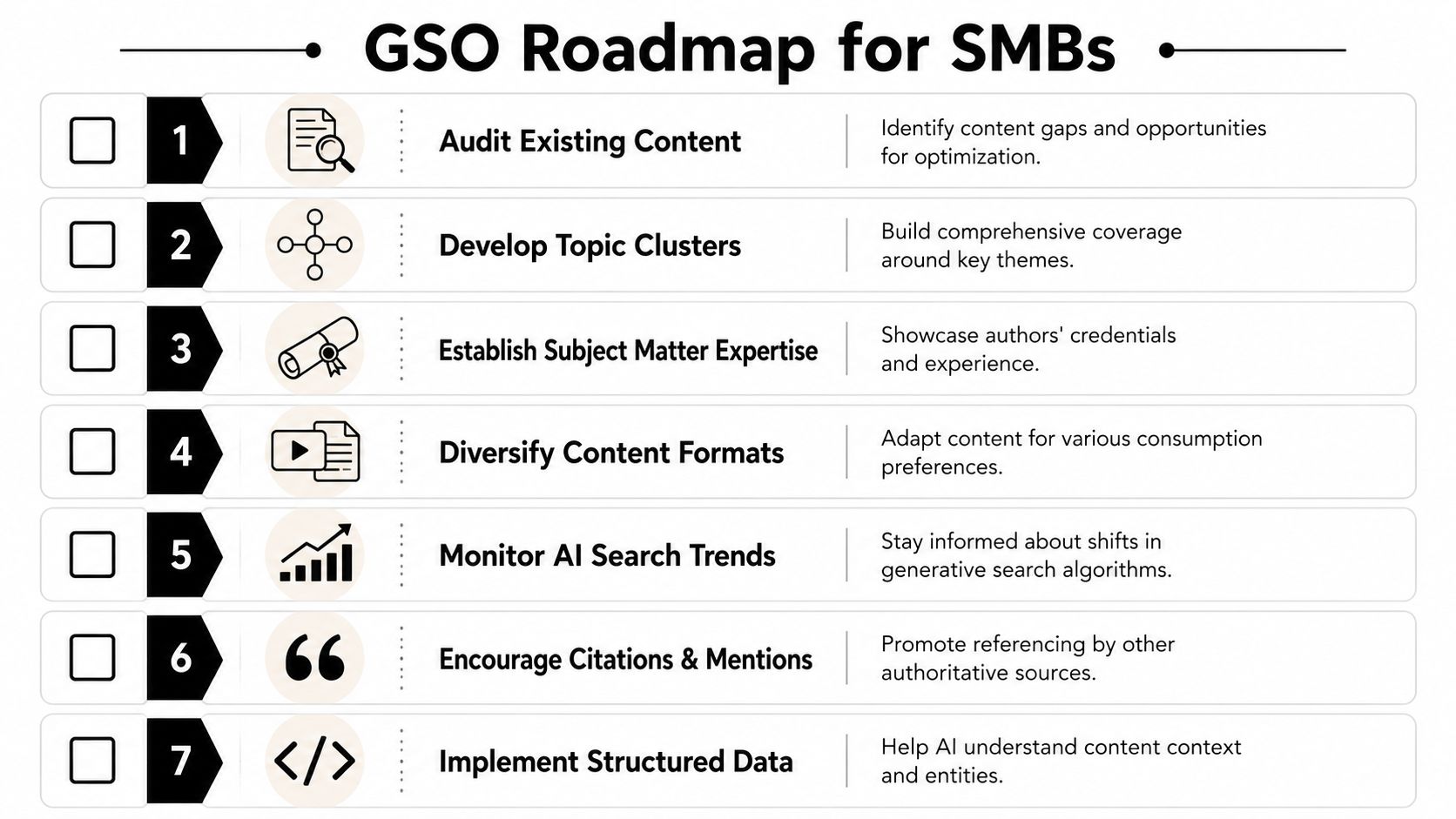
Start with an honest audit of where your brand appears in AI-generated answers, which pages are technically eligible, and how complete your schema really is. If you skip the audit, you'll waste time rewriting pages that were never crawlable enough to compete.
A workable rollout for SMBs
- First, clean technical foundations: Fix indexability, weak page templates, and inconsistent metadata.
- Next, map high-value prompts: Focus on the commercial and informational questions buyers ask.
- Then, restructure priority pages: Add direct answers, FAQ blocks, comparison formats, and author signals.
- After that, upgrade schema coverage: Push for completeness, not token implementation.
- Finally, monitor citation presence: Track which prompts surface your brand, competitors, or neither.
Most SMBs shouldn't try to optimize every page. They should optimize the pages most likely to become reference points.
Discipline matters. A small company can beat a bigger rival if its service pages, about pages, author bios, FAQs, and schema are tighter and more trustworthy.
If you want a practical starting point, use an AI readiness assessment to identify your highest-impact fixes before expanding into broader content production.
Start Your Journey to AI Visibility Today
Generative search isn't replacing every part of SEO, but it is changing what visibility means. Businesses that keep optimizing only for rankings will miss the moments when AI systems summarize the market, recommend providers, and shape buyer trust before a click ever happens.
The good news is that this isn't reserved for enterprise brands. Smaller companies can compete if they build pages that are technically eligible, factually clear, structurally extractable, and backed by trustworthy entity signals.
That's the answer to what is generative search optimization. It's not a gimmick. It's a disciplined way to make your brand usable inside AI systems.
The companies that move now will build durable visibility. The ones that wait will spend the next few years trying to recover lost ground from competitors that became the cited source first.
If you're ready to see how your brand shows up in AI-driven search, start with a no-obligation consultation from Raven SEO. We help businesses assess AI visibility, strengthen structured data, and build an AI-ready search presence designed for sustainable growth.