
Meta Title: 99 Cent Store Hours & the Future of Search | Raven SEO
Meta Description: Searching for 99 Cent store hours now exposes a bigger search problem. Raven SEO explains how AEO, structured data, and citability shape AI visibility.
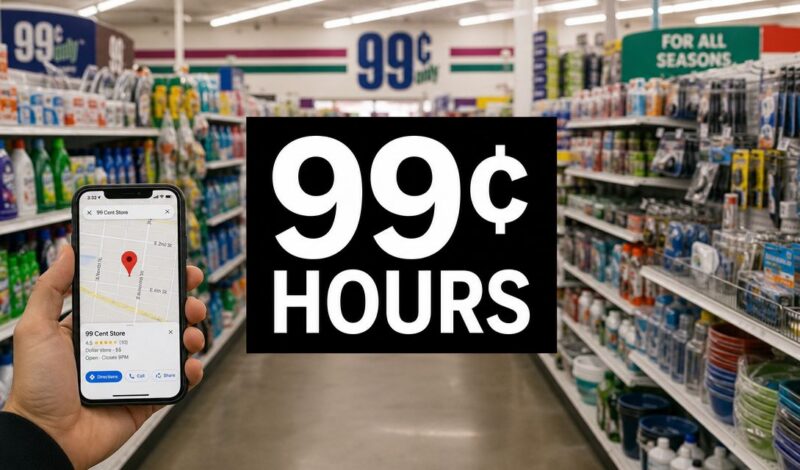
A customer searches for 99 Cent store hours because they need a simple answer. Are you open, closed, or gone?
That should be easy. It isn't.
This query now exposes one of the most important changes in search. A page built to rank for keywords is no longer enough when the actual business status has changed, local listings are inconsistent, and AI systems need clean signals before they can answer with confidence. If your business relies on discovery through Google, maps, AI Overviews, or chat-based search, the failure of this query should concern you.
The collapse of the best-known 99 Cents chain turned a routine local-intent search into a trust problem. That's not just a retail story. It's a search strategy warning.
The Search for 99 Cent Store Hours Is Broken
Type in 99 Cent store hours and you'll see why old SEO breaks under pressure. Some results still imply a normal shopping experience. Some pages talk about store schedules as if the brand still operates at scale. Some users are looking for a nearby dollar store that happens to sell low-cost goods, while others mean the former chain specifically. Those are not the same search intent, and search results often blur them together.
That confusion has a hard business cause. 99 Cents Only Stores liquidated its entire fleet of 371 stores across California, Texas, Arizona, and Nevada in 2024, which made generic “hours” content misleading unless it clearly separated the defunct chain from surviving local dollar retailers, according to Retail Dive's reporting on the liquidation.
Why this query became unreliable
The problem isn't just outdated blog posts. It's the whole local discovery stack.
A user searching for store hours often needs one of four answers:
- Open now
- Temporarily closed
- Permanently closed
- This brand no longer operates in your market
Traditional SEO pages were built for a simpler web. They targeted a phrase, repeated it in headings, and tried to win a click. That worked when store operations were stable and the brand itself was stable. Once a chain disappears, that content model collapses.
Generic hours content fails the moment brand reality changes faster than page templates do.
What business owners should take from this
If your business has multiple locations, seasonal changes, temporary closures, service-area exceptions, or shifting inventory, you're dealing with the same underlying risk. Search systems can only answer accurately if they find consistent, machine-readable truth across your website, business profiles, and third-party listings.
That's why local infrastructure matters more than ever. If you're still relying on thin location pages or outdated third-party information, you're vulnerable. The same issue is already hitting businesses that depended on lightweight local web presences, especially after changes covered in Raven SEO's update on Google Business Profile websites shutting down.
The 99 Cents example looks dramatic because the brand was so visible. But the lesson is simple. Search isn't broken because users ask bad questions. Search breaks when businesses don't publish clear answers in a format machines can trust.
The Shift from Clicks to Citations in AI Search
The old model was straightforward. You published a page, ranked for a query, and hoped the user clicked.
The new model is different. AI systems summarize, compare, and answer without always sending the same volume of clicks. That changes the job. Your brand now needs to be citable, not just discoverable.
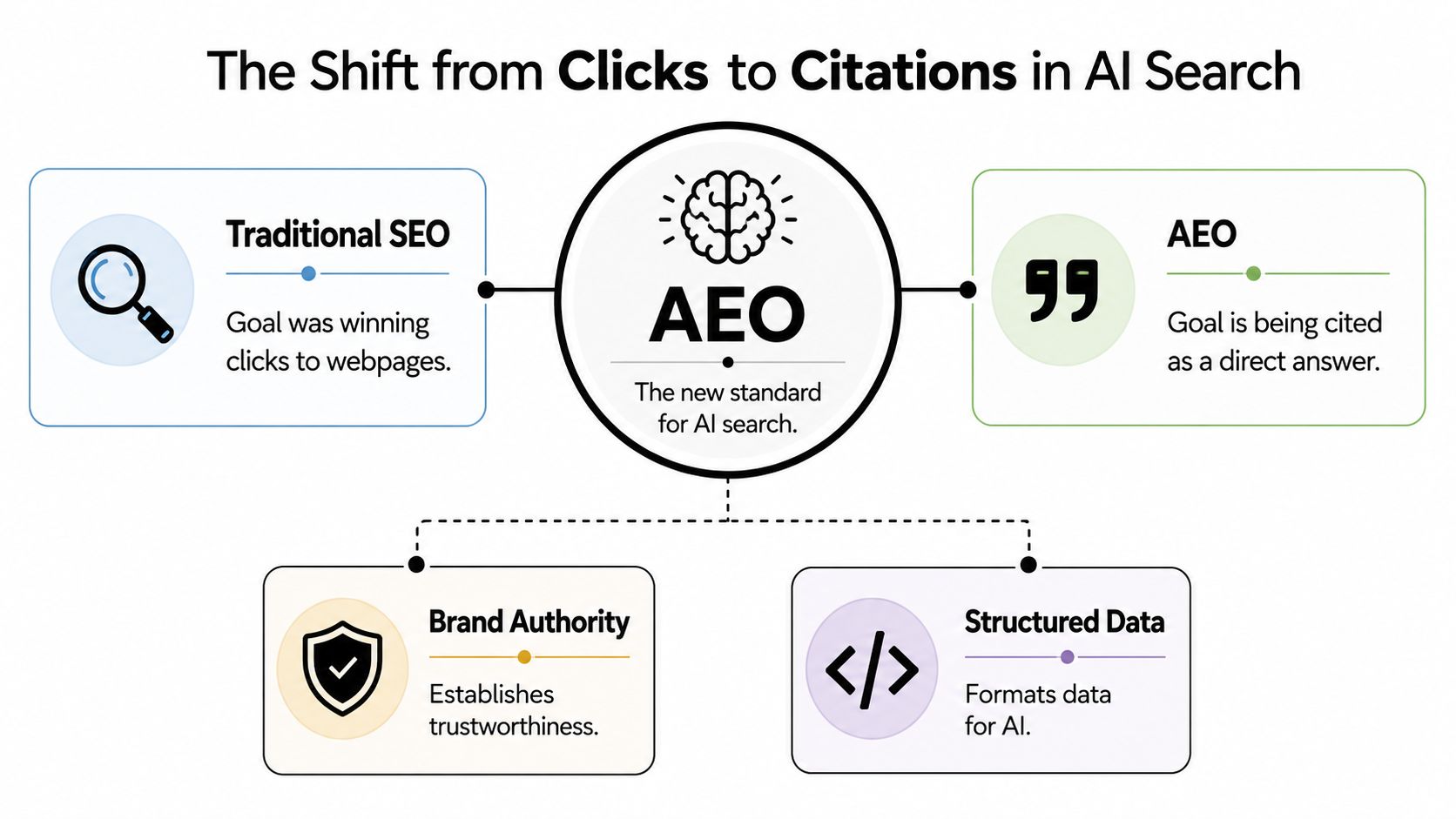
SEO ranked pages. AEO earns trust signals.
Answer Engine Optimization, or AEO, is the discipline of making your business easy for AI systems to understand and cite. That includes Google AI Overviews, conversational assistants, and large language models that assemble answers from multiple signals.
A normal SEO page asks, “How do I rank for this phrase?”
AEO asks, “Why should a machine trust my version of the answer?”
That difference matters. Those seeking hours no longer just want a schedule. They want operational certainty. The nuance is visible even on live retail location pages that surface statuses such as “Closed Now” and “Temporarily closed,” which is why static hours pages miss what modern searchers need, as shown by Dollar Tree's location experience.
The new visibility goal
For years, digital teams measured success mainly by rankings and traffic. Those still matter. But in AI search, another standard now matters just as much:
| Search model | Primary win |
|---|---|
| Traditional SEO | The user clicks your page |
| AEO | The AI cites your business as the answer |
| Local operational search | The user sees trusted status without friction |
This isn't a theory exercise. If your hours, services, coverage areas, pricing policies, or appointment availability are unclear, AI won't confidently surface you. It will either hedge, pull from weaker sources, or skip you.
Operational rule: If a customer can ask it in a sentence, your business should publish the answer in a format AI can extract cleanly.
If you want a practical breakdown of where these disciplines overlap and where they diverge, Raven SEO's comparison of AEO vs SEO in 2026 is worth reading. The short version is this: SEO still gets you into the race, but AEO determines whether the machine trusts you enough to speak on your behalf.
Building Citable Brand Authority for LLMs
Brand authority used to be treated like a vague SEO concept. Get links, publish content, collect reviews, and hope your rankings improve.
For AI systems, authority is less fuzzy. They look for consistent identity. They need to see the same business facts repeated across reliable places without contradiction. When those signals fracture, confidence drops.
A strong cautionary example came in 2024, when 99 Cents Only Stores filed for Chapter 11 bankruptcy, liquidated 371 locations, and laid off more than 10,800 employees, according to The Robin Report's analysis of the collapse. The shutdown created a brand authority vacuum. The name still had recognition, but the operating reality had changed faster than the web could cleanly reflect it.
What authority looks like to an AI system
An AI model doesn't “believe” your website because you say you're trustworthy. It compares signals.
Here's what helps:
- Consistent business identity across your website, Google Business Profile, directories, social profiles, and marketplace listings.
- Clear location truth so each office, store, or service area has distinct status and contact details.
- Human proof through recent reviews, real staff bios, and visible expertise.
- Third-party reinforcement from industry publications, associations, and reputable citations.
- Stable entity signals such as matching brand names, services, phone numbers, and URLs.
What to fix first
If you're advising a business owner, don't start with content volume. Start with contradiction cleanup.
Check business names everywhere
If your legal name, storefront name, and directory name vary too much, AI gets mixed signals.Audit every location page
Each location should answer practical questions fast: where it is, what it does, whether it's active, and how to contact it.Update profiles before publishing new articles
A polished blog won't overcome bad entity data.Add evidence of real expertise
For service businesses, named professionals, credentials, and specific service descriptions matter.
A business becomes citable when its digital footprint stops arguing with itself.
If you want a useful framework for that trust layer, Raven SEO's guide to E-E-A-T for AI lays out the signals that matter most. The key point is blunt. LLMs aren't rewarding noise. They're rewarding consistency.
Structuring Your Data for AI Consumption
Authority answers the question, “Should this business be trusted?”
Structured data answers the question, “Can a machine interpret this business without guessing?”
That's the technical gap many brands still ignore. They publish decent pages written for humans, but they leave core facts buried in paragraphs, image text, or inconsistent templates. Machines can infer some of it. They won't infer all of it correctly.
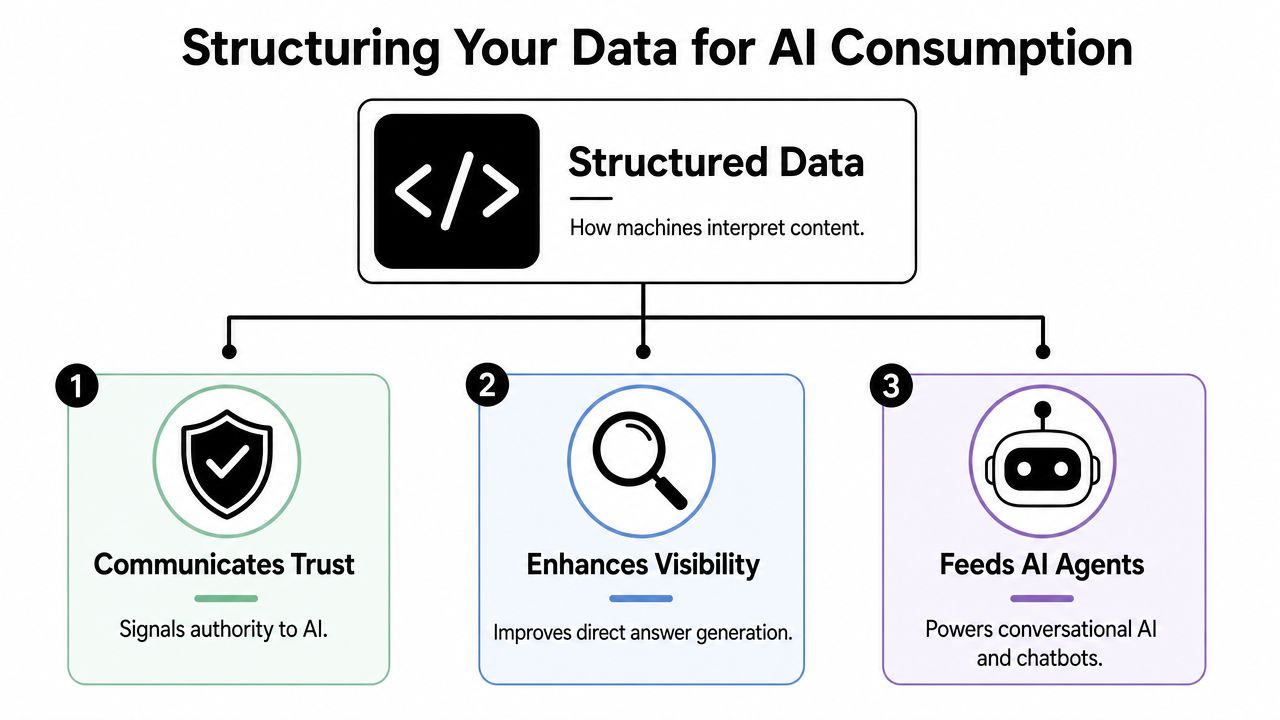
The 99 Cents lesson was technical, not just commercial
The brand's collapse showed why machine-readable data matters. The 99 Cents Only Stores chain began in 1982 and had grown into a major discount retailer. FundingUniverse reported 2,189 employees and $230.9 million in sales in 1997, yet the company's digital footprint couldn't be updated fast enough during the closure of all 371 stores in 2024, as described in FundingUniverse's company history.
That's the problem in plain language. A business can be prominent, well-known, and historically successful, but still fail the machine-readability test when reality changes.
What structured data actually does
Think of Schema.org markup as a digital name tag attached to your content. It tells systems what a page element means.
Not just “here's text,” but:
- This is a local business
- These are the operating hours
- This location is part of this brand
- This product is in stock
- This page answers a defined question
- This person is the author
- This review belongs to this service
Without that layer, your website is readable. It's just not efficiently interpretable.
The minimum data most businesses should structure
You don't need to mark up everything at once. You do need to mark up the facts customers ask about most.
| Business need | Useful structured element |
|---|---|
| Open or closed status | Local business details and hours |
| Service availability | Service markup and clear service areas |
| Who runs the business | Organization and person entities |
| Product or offer details | Product, offer, and availability data |
| Common customer questions | FAQ-style question and answer structure when appropriate |
Machines don't reward prose alone. They reward labeled meaning.
For a practical reference on implementation, Raven SEO's schema markup guide is a solid starting point. The broader point is strategic, not just technical. If your website doesn't clearly label its own truth, AI systems will assemble that truth from somewhere else.
A Practical Roadmap to AI-Ready Visibility
Most businesses don't need an abstract lecture about AI search. They need a sequence.
If you want your brand to show up accurately in AI answers, local discovery, and direct response search, use a four-part workflow and treat it like an operations project, not a content experiment.
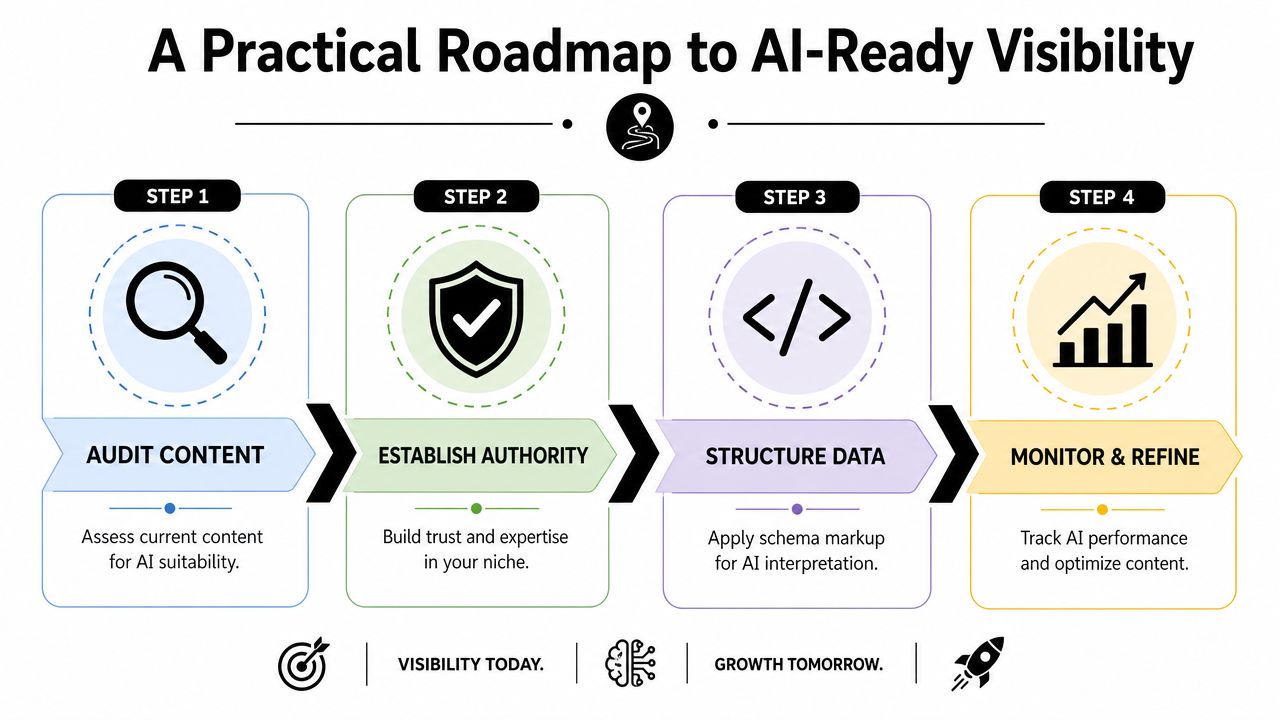
Start with an audit, not a rewrite
Most companies are tempted to produce fresh content first. That's backwards.
A proper AEO audit should review:
- Entity consistency across website, Google Business Profile, maps, and directories
- Location accuracy including active locations, temporary closures, and duplicate profiles
- Citable content gaps around hours, services, returns, pricing logic, and contact paths
- Structured data coverage on core business pages
- AI answer quality by testing what major search and chat systems currently say about the brand
This is also the point where many teams discover that their website copy isn't the main issue. The actual issue is fragmented truth.
Build authority and structure in parallel
After the audit, move on two tracks at once.
One track is authority cleanup. Fix listings, strengthen business identity, improve location pages, and publish credible expert-led content.
The second track is technical structure. Add schema, clarify page relationships, tighten internal linking, and remove ambiguity around services and locations. If your business runs ecommerce, this gets even more important because product, offer, and availability signals need clean formatting. For broader digital planning, Next Point Digital's growth strategies offer useful context on how ecommerce brands connect visibility with revenue decisions.
Then create answer-first content
This content should be specific and operational. Not fluffy.
Good AEO content often includes:
Decision pages
Clear service or product pages that answer what you do, who it's for, and what happens next.Operational FAQs
Practical answers about availability, timing, policies, and service boundaries.Comparison pages
Helpful content that explains differences between options without sounding evasive.Location truth pages
Pages that confirm active status, contacts, service areas, and updates.
A platform or partner can help operationalize this. For example, Raven SEO's guide to ranking in AI Overviews outlines the mechanics behind answer visibility, especially where structure and authority overlap.
Monitor what the machines say
Don't assume implementation is the finish line. Ask the systems what they think your business is.
- Search your brand plus hours
- Search your brand plus reviews
- Ask AI tools to summarize your services
- Check whether locations appear active, closed, or uncertain
- Review whether citations point back to your actual pages
If the answer is vague, your signals still need work.
Future-Proof Your Business with Raven SEO
The lesson from the collapse of the 99 Cents search experience is simple. Search visibility now depends on whether machines can verify your business, not just whether your page contains the right phrase.
If your listings are inconsistent, your location pages are thin, or your site lacks structured data, you're leaving the interpretation of your business to third parties. That's a bad strategy. AI systems fill gaps with whatever signals they can find. Sometimes they get it right. Sometimes they don't.
What an AI visibility review should uncover
A serious review should answer questions like these:
- Are your hours and location signals consistent across the web?
- Can AI clearly identify your services and service areas?
- Do your pages support citation-level trust, or just keyword matching?
- Are your business facts structured in a machine-readable way?
Those are practical business questions. They affect calls, appointments, foot traffic, and lead quality.
If you want a clearer look at how this shift is changing search behavior and what AI-ready visibility looks like in practice, this short video is a useful next step.
A focused audit helps. Raven SEO provides AI-ready website, technical SEO, and structured visibility work designed to make brand data easier for search engines and language models to interpret. If your business depends on being found, cited, and trusted online, waiting is expensive.
Frequently Asked Questions About AEO
Is AEO replacing SEO
No. AEO and SEO work together.
SEO still helps your pages get discovered, crawled, indexed, and ranked. AEO improves the odds that AI systems can extract, trust, and cite your information directly. If you ignore SEO, your visibility weakens. If you ignore AEO, your data becomes harder for AI to use confidently.
Is AEO only for large national brands
Not even close. Local businesses may need it more.
A local service provider, retailer, clinic, or multi-location company often has frequent changes in hours, coverage, staff, or availability. Those are exactly the situations where AI needs clean business signals. If your customers ask operational questions before they call, AEO matters.
How long does it take to become AI-ready
It depends on how messy your current footprint is.
Some businesses need basic cleanup. Others need location consolidation, schema implementation, content restructuring, and authority repair. The right way to think about it isn't speed. It's sequence. Fix identity first, then structure, then answer coverage, then monitoring.
What content should be prioritized first
Start with pages tied to revenue and trust:
- Core service pages
- Location pages
- Hours and availability details
- Contact and appointment paths
- Questions customers ask before buying
If a customer asks it often, AI systems will eventually need a clean answer for it.
If you want a practical next step, schedule a no-obligation consultation with Raven SEO. We'll review your current AI visibility, identify authority and data gaps, and give you a clear action plan for becoming more citable in search.