
Digital marketing for coaches is the strategic use of online channels to attract, engage, and convert your ideal clients. This guide provides an educational roadmap, combining a clear online presence with valuable content to establish you as a go-to expert. Mastering this process is key to differentiating your practice and building a sustainable coaching business.
Defining Your Niche and Ideal Client Profile

Before investing in marketing, the most critical first step is answering a simple question: Who, specifically, do you help? A vague answer like, “I help people achieve their goals,” is a fast track to getting lost in the noise. The foundation of any successful marketing plan is having unshakeable clarity on your niche and ideal client.
Trying to be a coach for everyone means you are effectively a coach for no one. This initial step will shape every piece of content you create, every social media post you share, and every service you offer. It’s the difference between shouting into an empty room and having a meaningful conversation with someone actively looking for your expertise.
Pinpointing Your Profitable Niche
A strong niche isn’t just a label; it’s a specific problem you solve for a specific group of people. It’s important to think beyond broad categories like “life coach” or “business coach.” The real value emerges when you drill down to find where your unique expertise meets a specific market need.
Here are a few ways to start narrowing your focus:
- By Industry: A business coach for startup founders in the tech space.
- By Demographics: A wellness coach for new mothers over 30.
- By Problem: A career coach for professionals experiencing burnout in the corporate world.
- By Aspiration: A leadership coach for first-time managers aiming for a C-suite position.
The goal is to become the undeniable expert for a particular kind of transformation. This level of specificity makes your marketing instantly more relevant because it speaks directly to a person’s unique situation.
Your marketing becomes exponentially easier when your ideal client reads your message and thinks, “That’s me. They understand my exact problem.”
Crafting Your Ideal Client Avatar
Once you’ve defined your niche, the next step is to create a detailed portrait of your ideal client, often called a buyer persona or avatar. This process goes far beyond demographics; it’s about understanding their mindset. What keeps them up at night? What are their biggest fears and deepest desires related to the problem you solve?
To gain this clarity, ask yourself these questions:
- What specific struggles are they facing right now?
- What other solutions have they already tried that didn’t work?
- What does their “dream” outcome look like in detail?
- What words and phrases do they use to describe their challenges?
Documenting these details provides an invaluable compass for all your marketing efforts. For a deeper look at this, you can learn how to create buyer personas with our detailed guide. This foundational work ensures your messaging connects on an emotional level, turning passive followers into engaged prospects eager to work with you.
Building a Website That Wins You Clients

Your website is more than an online business card. It is your hardest-working employee, your digital handshake, and the engine that converts curious visitors into paying clients, operating 24/7.
If your marketing efforts feel stalled, your website is often the reason. Many coaches invest in ads only to send traffic to a site that fails to convert. A common mistake is prioritizing slick design over strategic function. While aesthetics are important, the primary goal is to guide a potential client on a clear, compelling journey that ends with them booking a call.
The Anatomy of a High-Converting Coaching Website
To build a website that generates leads, you need a few core pages that work together seamlessly. Each page has a specific job, moving a prospect from “Who is this?” to “I need to work with them.”
These are the non-negotiable pages every coaching website needs:
- Homepage: This is your first impression. It has about three seconds to answer: Who are you, who do you help, and what problem do you solve?
- Services / Work With Me Page: Be specific. Clearly outline your coaching packages, what the process involves, and who will benefit most from each offer.
- About Page: This is where you build a connection. Share your story, but frame it around your ideal client’s journey. This isn’t a resume; it’s where you establish trust and show them you understand their challenges.
- Contact Page: Make it simple for someone to take the next step. A clean form and links to your professional social media profiles are sufficient.
Assembling these elements correctly is both an art and a science. For a comprehensive look at the mechanics, review our guide on website design best practices.
Designing for Trust and Action
A website that converts is built on trust and makes it incredibly easy for someone to say “yes.” Your layout, copy, and calls-to-action must work in harmony to make a potential client feel seen and understood.
Your website’s primary job is to make a prospective client feel seen, heard, and understood. When you achieve that, the decision to book a call becomes the natural next step, not a hard sell.
For example, a large, clear “Schedule Your Free Discovery Call” button should be prominent on your homepage and services page. Use strong, action-oriented language like “Start Your Transformation” instead of passive phrases like “Learn More.”
Social proof is another powerful trust-builder. Nothing sells your coaching better than demonstrating its effectiveness for others. Integrating authentic testimonials and case studies shows visitors you deliver real results. In fact, adding this kind of social proof can increase conversions by over 22%.
Finally, remove all friction from the booking process. Integrate a scheduling tool like Calendly or Acuity Scheduling directly onto your site. This simple step eliminates frustrating email exchanges and allows a prospect to book a session the moment they feel inspired. That immediate action can make all the difference.
Using SEO and Content to Attract Ready-To-Buy Clients
When someone has a problem, they don’t search for your name—they search for a solution. They go to Google and type in their questions, frustrations, and goals. This moment is where a smart digital marketing strategy, powered by SEO and valuable content, becomes your most powerful tool for attracting clients who are ready to invest.
Think of SEO (Search Engine Optimization) as the technical work of making your website understandable to Google. Content marketing is what you communicate. When you combine them, you create a system that consistently brings in qualified leads who are already searching for the transformation you offer.
Uncovering What Your Clients Are Searching For
Everything starts with keyword research. This isn’t about stuffing technical jargon onto your pages; it’s about understanding your ideal client’s mindset. What specific phrases would that person—the one we defined earlier—type into the search bar when they need help?
A career coach for burnt-out tech managers isn’t just trying to rank for “career coach.” That term is too broad. Their ideal clients are searching with more specific, long-tail keywords that reveal their exact needs.
- “Signs of burnout at work”
- “How to ask for a promotion in tech”
- “Career change after 10 years in IT”
These phrases are signals of intent. Someone searching for them is actively looking for answers, making them a much warmer lead than someone who randomly encounters an ad. Tools like Google Keyword Planner or Ubersuggest are excellent for discovering these valuable terms.
Your goal is to find the intersection between what you offer and what your clients are actively asking Google. Mastering this is the key to creating content that attracts not just traffic, but the right traffic.
Creating Content That Establishes Your Authority
Once you have your list of keywords, it’s time to create genuinely helpful content around them. This is how you transition from being a salesperson to an expert. Your content must answer your ideal client’s most urgent questions, offer unique insights, and provide real value long before they consider hiring you.
This is your opportunity to demonstrate your expertise. For example, a wellness coach specializing in new mothers could create a blog post titled, “5 Simple Nutrition Tips for Postpartum Energy.” It’s direct, it solves a real problem for her specific audience, and it immediately builds credibility.
Publishing high-quality, optimized content on a regular basis is essential for this strategy to succeed. Our in-depth guide on how to write SEO-friendly blog posts breaks down the entire process from start to finish.
Of course, not all content is created equal, and different formats are better suited for different goals. Below is a quick breakdown of essential channels and their best uses.
Essential Content Marketing Channels For Coaches
| Channel | Primary Goal | Key Metric to Track |
|---|---|---|
| Blog Posts | Drive organic search traffic and establish deep expertise on specific topics. | Organic Traffic & Keyword Rankings |
| Downloadable Guides (PDFs) | Capture email leads by offering a high-value resource in exchange for contact info. | Conversion Rate & Email Sign-ups |
| Video Tutorials (YouTube) | Build a personal connection and explain complex concepts in an engaging way. | Watch Time & Audience Retention |
| Client Case Studies | Provide social proof and showcase the tangible results you deliver for clients. | Time on Page & Lead Inquiries |
Using a mix of these formats allows you to meet potential clients where they are, whether they’re looking for a quick answer on Google, a detailed guide, or a personal connection through video. Each piece of content you create becomes another magnet, pulling the right people into your sphere of influence.
Nurturing Leads With Social Media and Email Marketing
Getting traffic to your website is a significant achievement, but it’s only half the journey. The real art lies in what happens next: building genuine relationships. This is where social media and email marketing become your most powerful tools.
Consider them a perfect team. Social media is your public forum for starting conversations and building a community. Email, in contrast, is your private space for deepening those relationships in a more personal, one-to-one manner. You need both to create a reliable system that keeps your coaching pipeline full.
This process follows a logical flow: you identify what your clients are searching for, create content that answers their questions, and drive them to your website.
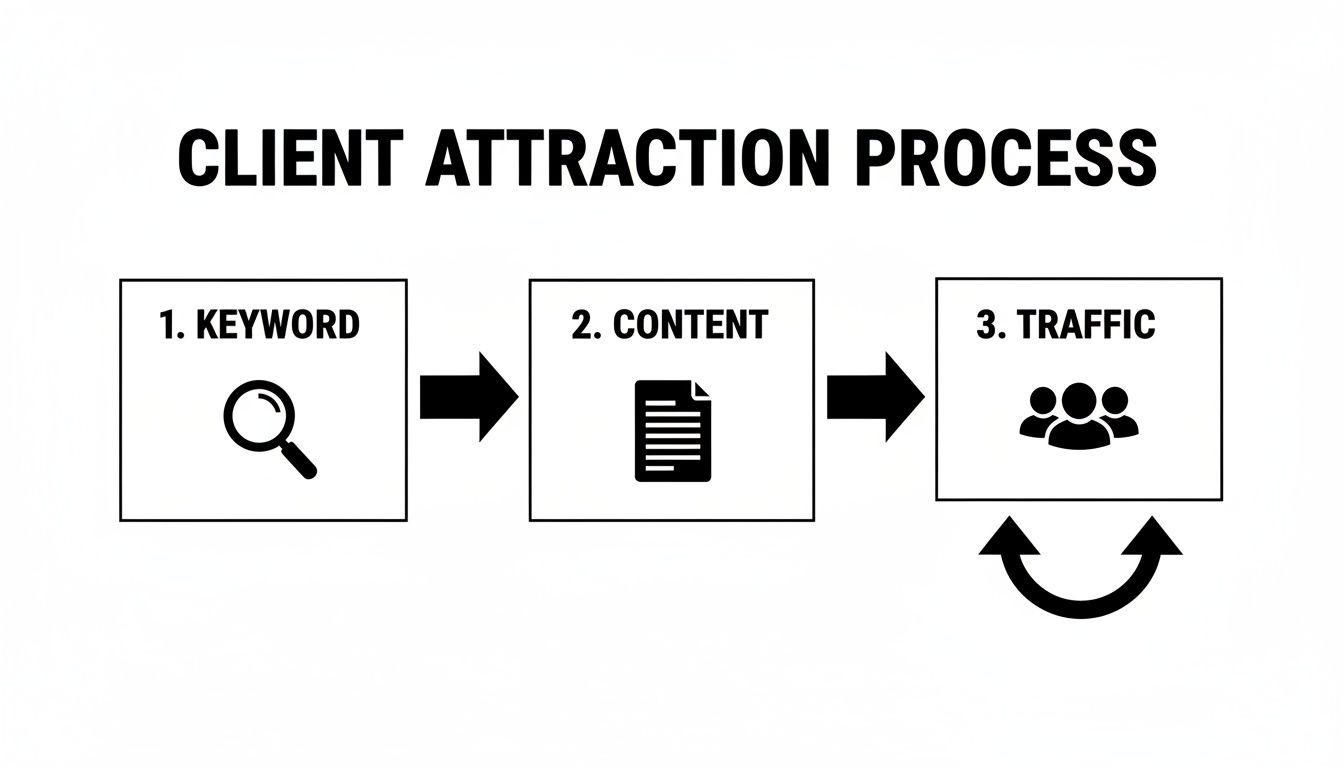
It all begins with understanding your audience’s language, which informs the content you create to ultimately attract the right people.
Choosing the Right Social Media Playground
The biggest mistake coaches make is trying to be everywhere at once. The secret isn’t more platforms; it’s the right platforms. Your mission is to find the digital space where your ideal clients already spend their time.
A business coach targeting C-suite executives will find their audience on LinkedIn, not TikTok. In contrast, a wellness coach for new mothers will connect with a more engaged community on Instagram or in dedicated Facebook groups.
Forget chasing trends. Pick one platform, go deep, and master it.
- For B2B or Career Coaches: LinkedIn is non-negotiable. It’s where you build professional authority and network with decision-makers.
- For B2C, Wellness, or Life Coaches: Instagram and Facebook are fantastic for visual storytelling and fostering a real sense of community.
- For Coaches with a Younger Audience: Do not overlook TikTok. It offers massive potential for organic reach with short, snappy, and engaging video content.
The goal is not to broadcast your services but to spark genuine conversations. Share valuable tips, ask thought-provoking questions, and use live video to connect with your audience in real-time. This consistent, authentic engagement builds the “know, like, and trust” factor essential for a high-ticket service like coaching.
The Power of the Inbox: Your Secret Weapon
While social media is great for initial engagement, your email list is your most valuable business asset. It is a direct, unfiltered line to your warmest leads—people who have explicitly opted in to hear from you.
To make this work, you first need to learn effective strategies to build a robust email list. This typically starts with a great lead magnet—a high-value freebie offered in exchange for an email address. This could be a checklist, a short e-book, a webinar recording, or an insightful quiz.
Your email list is the only marketing channel you truly own. Algorithms change, but your email list gives you a direct, unfiltered connection to your most interested prospects.
Once someone joins your list, they should receive an automated welcome email sequence. This “welcome series” is your chance to make a strong first impression, share your story, and provide immediate value. From there, you can nurture the relationship with weekly newsletters filled with insights, client success stories, and gentle reminders of how you can help. If you want to dive deeper, we explain more about cultivating connections and driving growth with your email list in our guide.
The data supports this approach. Coaches who personalize their content see email marketing funnels convert leads at rates 3x higher than those who don’t. Meanwhile, platforms like Instagram Reels and TikTok have helped coaches boost client acquisition by 25-30%. A combined social and email strategy is a powerful engine for growth.
Accelerating Growth With Strategic Paid Ads
While organic methods like SEO and content marketing are the foundation of long-term, sustainable growth, sometimes you need to get in front of your ideal clients now. This is where paid advertising becomes a powerful lever in your digital marketing playbook.
Think of it as the most direct and scalable way to amplify your message and fill your calendar with a predictability that organic channels cannot always match.
Running ads on platforms like Meta (Facebook and Instagram) and Google is about making smart, strategic investments to acquire clients at a profitable rate. You can bypass the slower build of organic reach and place your offers directly in front of a hand-picked audience.
Choosing Your Paid Advertising Channel
First, you must decide where to invest your ad budget. As with social media, you do not need to be everywhere at once. For most coaches, the decision comes down to two major players: Google Ads and Meta Ads.
They serve very different, yet complementary, purposes.
- Google Ads: This platform is all about intent. You’re targeting people who are actively searching for a solution to their problem. The power here is immense because you meet potential clients at the exact moment they are seeking help.
- Meta Ads (Facebook & Instagram): This platform is built on discovery. You target users based on their interests, behaviors, and demographics. This is perfect for reaching potential clients who fit your ideal profile but may not yet be aware that a solution like yours exists.
To truly accelerate and scale your client base, coaches need robust and scalable PPC advertising strategies that deliver consistent results. A common path to success is starting with Meta ads to build brand awareness and then using Google Ads to capture high-intent leads who are ready to invest.
Paid advertising gives you control. You decide who sees your message, how much you spend, and what action you want them to take. It’s the fastest way to test your offers and get real-time data on what resonates with your market.
Key Metrics That Actually Matter
Running a successful ad campaign is not about getting clicks or likes; it’s about acquiring clients. To ensure your ad spend generates a positive return, you must ignore vanity metrics and focus on the numbers that impact your bottom line.
For a deeper dive into managing your campaigns effectively, check out these Google Ads best practices.
Here’s what you should be laser-focused on:
- Cost Per Lead (CPL): How much does it cost you to get one person to sign up for your webinar, download your lead magnet, or book a discovery call?
- Cost Per Acquisition (CPA): On a broader scale, what is the total ad spend required to secure one new paying client? This is a crucial metric.
- Return on Ad Spend (ROAS): This is the ultimate measure of profitability. For every $1 you invest in ads, how many dollars in revenue do you generate?
Tracking these numbers diligently is what separates guessing from growing. It tells you precisely how your campaigns are performing and provides the hard data needed to make smart decisions to scale your coaching business.
Common Questions About Digital Marketing For Coaches
Embarking on online marketing often brings up numerous questions. Getting clear, straightforward answers is key to building momentum and avoiding common early mistakes.
Let’s address some of the most frequent questions from coaches who are just starting out. Consider this your quick-reference guide to help you move forward.
How Much Should I Budget For Digital Marketing As a New Coach?
As a new coach, a strategic approach is more important than a specific budget number. Your most valuable asset is likely your time, not a large bank account. Therefore, you should focus on low-cost, high-impact strategies first.
A great starting point is to commit to creating one high-quality, SEO-optimized blog post per week and engaging consistently on one social media platform. If you are ready to explore paid ads, start small. A test budget of $15 to $25 per day on a platform like Meta is sufficient to gauge if your message is resonating before you consider scaling up.
Which Social Media Platform Is Best For Coaches?
The best platform is simply where your ideal clients already spend their time. Avoid the trap of spreading yourself thin by trying to be everywhere. Master one platform before considering a second.
- Executive, career, or business coaches: LinkedIn is your non-negotiable. It’s built for establishing professional authority.
- Life, wellness, or relationship coaches: You will likely find more success on visual and community-driven platforms like Instagram or in targeted Facebook Groups.
The goal is to find the digital “watering hole” where your audience gathers. This focus allows you to maximize your effort for the greatest impact.
How Long Does It Take For SEO To Start Working?
This is a common question, and the honest answer is that SEO is a long-term strategy, not a quick fix. While every situation is different, you can generally expect to see initial results within four to six months of consistent, focused effort.
This timeline depends on the competitiveness of your niche and the consistency with which you publish valuable, optimized content.
SEO is like planting a tree. It takes a while to grow, but once it matures, it provides value for years to come. While your SEO roots are taking hold, use faster tactics like paid ads to generate leads in the short term.
Do I Really Need a Blog For My Coaching Business?
Yes. A blog is one of the most powerful marketing assets you can build. It is much more than just writing articles—it’s about creating a library of evergreen resources that directly answer your ideal clients’ biggest questions.
Every post you publish acts like a digital salesperson, working 24/7 to attract organic traffic from search engines. This process builds immense trust, showcases your expertise without you having to say a word, and provides the fuel for a long-term SEO strategy that brings in qualified leads month after month.
Ready to build a digital marketing strategy that consistently attracts the right clients? The team at Raven SEO specializes in creating practical roadmaps for coaches that increase visibility, traffic, and conversions. Start with a no-obligation consultation today!