

A winning marketing strategy for an executive search firm starts with two things: specialization and a deep understanding of your audience. This educational guide will show you how to define a precise market niche, get inside the heads of both clients and candidates, and build a value proposition that hits on their exact pain points. When you nail this focus, every marketing dollar works harder, and every effort gets you closer to the right people.
Building Your Foundational Market Position
In the executive search world, being a generalist is a fast path to becoming invisible. The firms that truly dominate don’t try to be everything to everyone. They build an unshakable reputation by becoming the undisputed expert in a specific industry or role. This is the bedrock of your entire marketing plan, and this guide makes it easy to understand how to build it.

This kind of specialization lets you ditch generic messaging and speak directly to the unique challenges of a very select group. When a Series B FinTech company needs a new CFO, they aren’t just looking for any recruiter; they’re looking for a firm that gets the nuances of their world.
Pinpoint Your Profitable Niche
Your niche is your competitive edge. It’s the sweet spot where your firm’s expertise, passion, and market demand all come together. Stop thinking “C-suite executives” and start getting laser-focused. A clear, educational approach to defining your niche will make all your marketing efforts more effective.
Consider how powerful these specific niches are:
- Industry Vertical: Focusing exclusively on placing leaders in the renewable energy sector.
- Functional Role: Becoming the go-to firm for Chief Revenue Officers in the SaaS industry.
- Company Stage: Specializing in leadership roles for private equity-backed portfolio companies.
- Geographic Focus: Owning the executive search market for biotech firms within a specific research triangle.
This clarity doesn’t just attract the right clients; it makes your marketing ten times more powerful. Your content becomes more relevant, your outreach more precise, and your brand authority skyrockets.
Develop Dual-Sided Buyer Personas
Once you’ve defined your niche, you need to understand the people in it. Executive search is unique because you’re marketing to two distinct audiences: the corporate clients who hire you and the top-tier candidates you place. You need detailed buyer personas for both. These aren’t just simple demographic profiles; they’re deep dives into what makes these people tick, presented in an easy-to-read format.
For a great walkthrough on this, check out this guide on how to create buyer personas to really flesh out these profiles.
A persona isn’t just a job title. It’s understanding that your ‘ideal client’ is a VP of HR under immense pressure to fill a critical leadership gap. They fear making a bad hire and get their information from industry newsletters and peer groups on LinkedIn.
When you’re building these personas, ask the tough questions:
- For Clients: What are their biggest business frustrations? What does a home-run placement look like to them? Where do they hang out online for industry news?
- For Candidates: What are their long-term career goals? What would actually make them consider leaving their current role? What kind of company culture are they looking for?
This dual-sided insight informs everything—from your website copy to your LinkedIn content—ensuring your message connects with both sides of the deal. With the executive search market projected to hit USD 94.73 billion by 2030, and retained search making up over 63% of that, this focused approach is more critical than ever. Clients are looking for proven, specialist partners, not generalists. Your targeted marketing message is what will make you their first call.
Turning Your Website Into a Client Magnet
Your website isn’t just a digital brochure. It’s your firm’s virtual headquarters and, more often than not, the very first impression you make on a discerning client or a high-caliber candidate. In the world of executive search, where credibility is everything, your site must immediately project expertise, professionalism, and trust.
Think about it: a clunky, outdated website can kill a potential deal faster than a bad pitch. To turn your site into a client-acquisition engine, you have to see it through your ideal client’s eyes. When a hiring manager lands on your homepage, they need to feel understood. They need to see their specific industry, their unique challenges, reflected right back at them. This isn’t about flashy design—it’s about strategic messaging and a user experience that smoothly guides them toward starting a conversation with you. This educational approach makes your value clear from the first click.
Uncovering Client Intent with Keyword Research
The entire foundation of a high-performing website is built on understanding what your potential clients are actually searching for online. This is where solid keyword research comes in. You have to get inside the head of a CHRO or a CEO who has a critical leadership gap and a serious problem to solve.
They aren’t just typing “recruiter” into Google. Their searches are far more specific, signaling a clear and urgent need. I’ve seen it time and time again; they’re looking for things like:
- “retained executive search for fintech”
- “cfo search firm healthcare”
- “top executive recruiters for private equity”
- “biotech leadership recruitment agency”
Once you identify these “long-tail” keywords, you can meticulously optimize your service pages to capture this high-intent traffic. Each page should be built around a primary keyword, clearly explaining your process, showcasing relevant case studies, and speaking directly to the pain points of that specific niche. This focused approach is a core pillar of any successful marketing strategy for executive search firms.
Building Trust Through Strategic Content and SEO
Knowing what clients search for is step one. Step two is creating educational content that answers their questions and cements your firm’s authority. A content hub or blog isn’t just a “nice-to-have” anymore; it’s an essential tool for demonstrating deep industry knowledge while simultaneously boosting your search engine rankings.
Your website shouldn’t just state that you are an expert; it must prove it. Every piece of content, from a service page to a case study, is an opportunity to build the trust necessary for a high-stakes partnership.
This content can take many forms. You could publish insightful articles on leadership trends, craft detailed case studies of successful placements, or create easy-to-read guides on hiring best practices. The key is that each piece should be optimized for relevant keywords, which further strengthens your site’s visibility. Ultimately, the goal is to create a resource that not only attracts but also educates and converts visitors. Our guide offers deeper insights on how to increase website conversions by turning that hard-earned traffic into tangible leads.
Ensuring a Flawless Technical Foundation
All your brilliant messaging and expert content will be for nothing if your website is technically flawed. A slow-loading, insecure, or mobile-unfriendly site creates an instantly negative impression and gets penalized by search engines. A comprehensive technical SEO audit is non-negotiable—it ensures your digital headquarters is built on solid ground.
Pay close attention to these key technical elements:
- Mobile Responsiveness: A huge portion of your audience—both clients and candidates—will visit your site on a phone. The experience must be flawless.
- Page Speed: Websites that take longer than 3 seconds to load lose 40% of their visitors. Your site has to be fast, period.
- Security (HTTPS): A secure website is an absolute must-have for building trust, especially when clients will be sharing sensitive information.
- Clean Navigation: The structure of your site needs to be logical and intuitive. This helps both users and search engines find what they’re looking for without any friction.
When you combine targeted keyword research, authoritative content, and a flawless technical setup, you transform your website from a passive online placeholder into an active, powerful magnet for your ideal clients.
Building Authority with Content and LinkedIn
In executive search, clients aren’t just buying a service; they’re investing in your judgment, your network, and your credibility. Your website and positioning can get their foot in the door, but it’s unshakable authority that actually closes high-value retained searches.
This is where a smart content strategy and a masterful LinkedIn presence become your most powerful assets.
A well-executed plan proves your expertise long before you ever speak with a potential client. It completely flips the script—instead of you chasing leads, your ideal clients start seeking you out for your specialized knowledge.
This visual breaks down how to turn your website into a client-generating machine through a simple, three-part process.
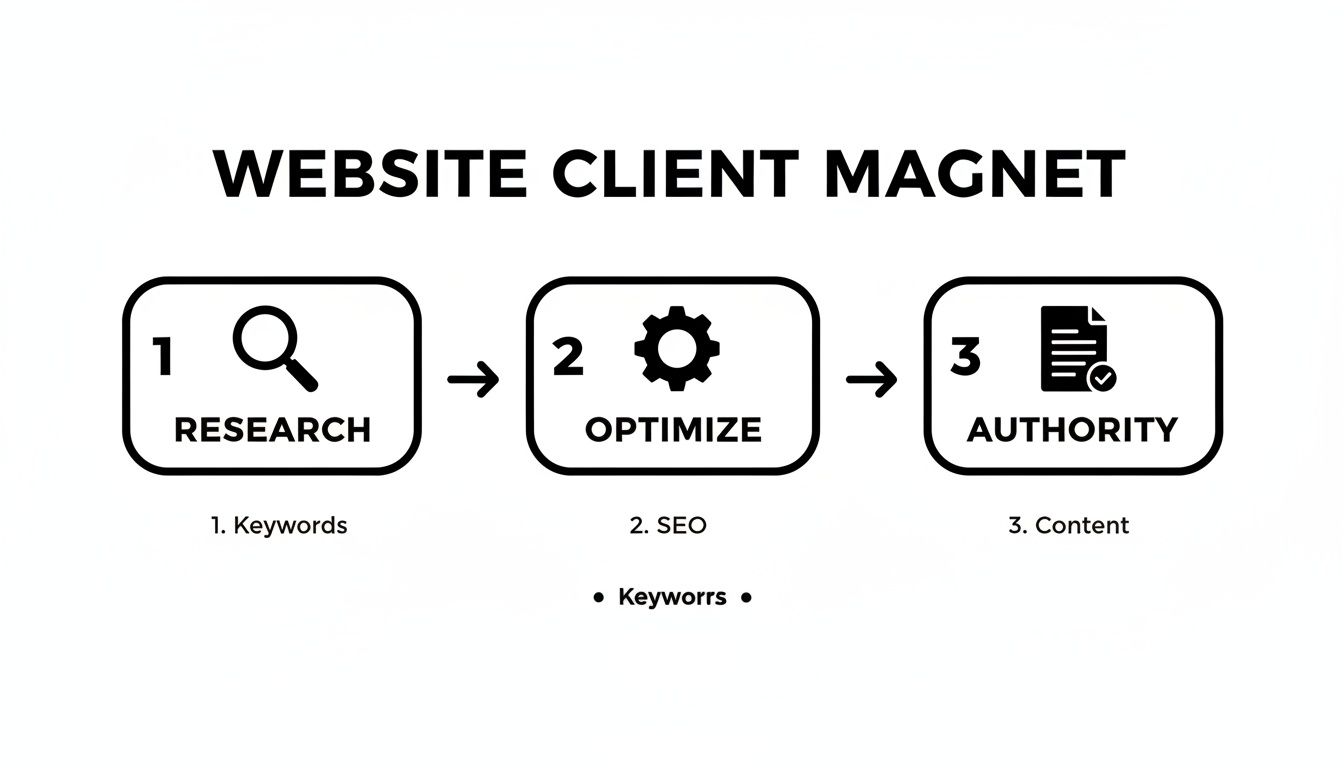
Becoming a go-to firm isn’t a one-off task. It starts with deep research, gets amplified by technical optimization, and is sustained by consistently proving your authority. It’s a continuous, educational cycle.
Crafting Content That Builds Unshakable Credibility
Let’s be blunt: generic blog posts about “leadership tips” are a waste of time. Your content needs to be substantial, insightful, and laser-focused on the high-stakes challenges your niche audience is wrestling with. Forget quantity. Think definitive, high-value, educational assets.
Your goal is to become a trusted advisor through your content. Here are the formats that actually move the needle:
- In-Depth Industry Reports: Publish an annual “State of Leadership” report for your niche. Fill it with original data, survey results, and bold predictions.
- Detailed Case Studies: Go way beyond a simple logo and testimonial. Detail the client’s challenge, your unique search process, and the transformative business impact of the placement you made.
- Insightful White Papers: Tackle a complex, meaty topic like “Navigating C-Suite Compensation in a Post-Pandemic World” or “Building a Diverse Leadership Team in Biotech.”
The best content doesn’t just attract; it qualifies. When a potential client reads your in-depth analysis of their industry’s talent challenges, they are pre-sold on your firm’s expertise before the first call even happens.
Creating this level of content is how you establish true expertise, experience, authoritativeness, and trustworthiness (what Google calls E-E-A-T). This approach not only resonates with potential clients but also signals serious quality to search engines, which is always a plus. For a deeper dive, check out this excellent guide on the power of E-E-A-T in crafting high-quality content for SEO and audience trust.
The following table breaks down how to map specific content types to each stage of your client’s decision-making process in an easy-to-read way.
High-Impact Content Funnel for Executive Search
| Funnel Stage | Content Type | Goal | Example |
|---|---|---|---|
| Awareness (Top) | Industry Reports, Trend Analyses, Blog Posts | Attract a broad audience facing industry-specific challenges. | A downloadable report titled “The Future of CTO Leadership in FinTech.” |
| Consideration (Middle) | Case Studies, White Papers, Webinars | Showcase your specific process and expertise in solving problems. | A detailed case study on “How We Placed a Chief Revenue Officer Who Tripled Revenue in 18 Months.” |
| Decision (Bottom) | Client Testimonials, Firm Differentiator Guides, Process Overviews | Build final trust and demonstrate why your firm is the best choice. | A one-page PDF outlining “The 5 Key Differentiators of Our Retained Search Process.” |
This structured, educational approach ensures you have the right asset to guide a potential client from simply being aware of a problem to confidently choosing your firm to solve it.
Dominating the Conversation on LinkedIn
For executive search pros, LinkedIn isn’t just another social media site. It’s the digital town square, the boardroom, and the networking event all rolled into one. A passive or sloppy presence is a massive missed opportunity. Your firm’s leaders and consultants must be active, visible, and valuable contributors.
This means you have to move beyond just posting open roles.
Your LinkedIn strategy should be a direct extension of your content marketing, focused squarely on personal branding and relationship building. Every single consultant at your firm should have a fully optimized profile that positions them as a thought leader in their niche—not just a recruiter.
If you really want to dial this in, you need to Master Prospecting on LinkedIn with strategies that actually build valuable, long-term relationships.
A Dual-Pronged LinkedIn Approach
An effective LinkedIn strategy isn’t just one thing; it requires a coordinated effort at both the company and individual levels.
1. Your Company Page as a Content Hub
Use your firm’s LinkedIn page as the official home for your high-value content. This is where you share your industry reports, case studies, and insightful white papers. It’s also the place to celebrate successful placements (with permission, of course) and share curated industry news. Think of it as the official voice and content library for your brand.
2. Consultant Profiles as Expert Voices
This is where the real magic happens. Encourage your consultants to share their unique perspectives on the content your firm produces. They should be actively engaging in relevant industry groups, commenting thoughtfully on posts from clients and prospects, and building genuine connections with the key players in your niche.
This two-pronged approach ensures your firm has a consistent, professional brand message while also showcasing the individual expertise and personality of your team. It’s this powerful combination of corporate authority and personal connection that builds the deep trust required to win and retain executive search clients.
Driving Growth with Targeted Outreach and Partnerships
Once you’ve built a solid brand position and a high-authority website, it’s time to switch gears from passive attraction to proactive growth. Inbound leads from your content and SEO are fantastic long-term assets, but targeted outreach is what accelerates your pipeline. This is how you get your firm directly in front of ideal clients who need your expertise right now.
This phase isn’t about casting a wide net and hoping for the best. It’s about surgical precision—targeting the right companies, building valuable alliances, and turning your happiest clients into your most effective sales team. This easy-to-read section will show you how.

Precision Targeting with Paid Advertising
Paid advertising gives you a shortcut, letting you bypass the slow build of organic reach to put your message right in front of key decision-makers. For executive search, the two heavy hitters are LinkedIn Ads and Google Ads, and they each play a very different role in your strategy.
LinkedIn Ads for Audience Building
When it comes to targeting professionals, nothing beats LinkedIn. You can build campaigns aimed at hyper-specific job titles (like “Chief Human Resources Officer”), niche industries (“SaaS”), and exact company sizes (“50-200 employees”). You can even target members of specific professional groups.
This makes LinkedIn the perfect platform for promoting high-value, educational content, like a new white paper or an industry report, to a hand-picked audience of potential clients. For example, you could run an ad for your “State of FinTech Leadership” report that’s shown only to VPs of Talent and C-suite execs at FinTech companies in your target city.
Google Ads for Capturing Intent
While LinkedIn is brilliant for reaching a specific who, Google Ads is all about capturing a specific what. It lets you target people who are actively looking for a solution. When a board member types “retained search firm for biotech CEO” into Google, your ad can show up at the very top of the page.
These are high-intent, bottom-of-the-funnel leads. You simply can’t afford to miss them.
Creating a Powerful Referral Engine
Let’s be honest: your most valuable source of new business will always be referrals from delighted clients. But you can’t just sit back and hope they happen. A structured referral program actively encourages and rewards past clients for sending new business your way.
A strong referral doesn’t just send a lead; it sends a pre-qualified, high-trust prospect who is already convinced of your value before the first conversation. This drastically shortens the sales cycle.
Your referral program needs to be simple and transparent. A few ideas:
- Financial Incentive: Offer a percentage of the first placement fee or a flat finder’s fee for any referred client that signs a retained search agreement.
- Service Credit: Provide a discount on a future search for clients who refer new business. This is a great way to encourage repeat business, too.
- Reciprocal Agreement: For partners who aren’t clients (like industry advisors), set up a clear “you send us business, we send you business” relationship.
The key is to make it official. Document the program, communicate it clearly to your network, and make it incredibly easy for people to make that introduction. For a deeper dive into lead generation, you can explore proven B2B digital marketing strategies that work beautifully alongside these outreach efforts.
Developing Mutually Beneficial Strategic Partnerships
No search firm operates in a vacuum. Your clients rely on a network of trusted advisors, and you can become part of that inner circle by building partnerships with complementary, non-competing service providers.
Think about who else serves your ideal client. Prime partners often include:
- Leadership coaching and development firms
- M&A advisory and investment banking firms
- HR consulting and benefits providers
- Specialized law firms (e.g., labor and employment)
The goal here is a symbiotic relationship. When your partner’s client mentions needing a new executive, they recommend you. When one of your placements mentions needing M&A advice, you recommend them. This creates a powerful, mutually beneficial ecosystem for high-quality leads built on a foundation of shared trust and credibility.
Measuring What Matters for Sustainable Growth
A sophisticated marketing plan is worthless if you can’t prove it’s working. Without clear measurement, you’re just flying blind, pouring money and time into activities that feel productive but might not be moving the needle on your bottom line. It’s time to ditch the vanity metrics like social media likes and zero in on the key performance indicators (KPIs) that actually signal real, sustainable growth. This educational video provides a clear overview.
This data-driven mindset is what separates the pros from the amateurs. It lets you see exactly what’s working, what’s a waste of resources, and where to double down for the biggest impact. Ultimately, this transforms marketing from a mysterious cost center into a predictable, revenue-generating engine for your firm.
Defining Your Core Marketing KPIs
In the world of executive search, not all metrics are created equal. Chasing a huge spike in website traffic is pointless if those visitors aren’t the right C-suite executives or HR leaders who can actually hire you. Instead, you need to be laser-focused on a handful of KPIs that draw a straight line from your marketing efforts to new business.
Here are the essentials every search firm should have on their dashboard, presented in an easy-to-read list:
- Website Lead Conversions: This is the percentage of your website visitors who take a meaningful action—like filling out your “Contact Us” form or downloading a high-value industry report. It’s the single best measure of your website’s ability to generate new client opportunities.
- Cost Per Lead (CPL): This metric tells you exactly how much you’re spending to get one new, qualified lead in the door. You calculate it by dividing your total marketing spend by the number of new leads you generated in a specific period.
- Marketing-Influenced Pipeline: This tracks the total dollar value of all active client opportunities that were touched by a marketing activity. It’s how you prove marketing’s direct contribution to your firm’s sales pipeline.
Tracking these core KPIs gives you a clear, unfiltered view of your marketing performance. It shifts the conversation from “Are we busy?” to “Are we profitable?”—which is the only question that really matters.
Calculating Your Client Acquisition Cost
One of the most powerful metrics you can track is your Client Acquisition Cost (CAC). This number tells you, on average, exactly how much it costs to win one new retained search client.
The formula is refreshingly simple: Total Sales & Marketing Costs / Number of New Clients Won = CAC.
Knowing your CAC is a game-changer because it empowers you to make smart, strategic decisions about your budget. For example, if your average placement fee is $75,000 and your CAC is $8,000, you’ve got a healthy, scalable business model. But if your CAC starts creeping up toward $30,000, you know it’s time to take a hard look at your strategy and find some efficiencies.
Understanding your CAC is the cornerstone of truly measuring marketing ROI. For a much deeper, educational dive, our guide on measuring return on marketing investment provides a complete framework.
The Essential Tools for Effective Tracking
The good news? You don’t need a ridiculously complex or expensive tech stack to track what matters. A couple of fundamental tools will give you all the data you need to make intelligent decisions.
To truly get a handle on your marketing’s impact, you need a solid grasp of analytics and measurement fundamentals. These tools are your starting point:
- Google Analytics 4 (GA4): This is the undisputed industry standard for tracking your website’s performance. You can set up specific conversion goals to see how many people are filling out your contact forms, where they came from, and which of your thought leadership articles are resonating most.
- Your CRM (Customer Relationship Management) System: Whether you’re using a specialized platform for search firms or something like HubSpot, your CRM is your single source of truth for client data. It’s where you’ll track the entire journey from an initial lead to an active client, which is essential for calculating your marketing-influenced pipeline and CAC.
By connecting the data from these two sources, you create a powerful “closed-loop” reporting system. This allows you to draw a direct line from a specific LinkedIn campaign all the way to a new signed client contract, giving you undeniable proof of your marketing’s value and guiding your strategy for future growth.
Essential Marketing KPIs for Executive Search Firms
Tracking the right metrics is crucial for understanding the health and effectiveness of your marketing. This easy-to-read table breaks down the most important KPIs, what they measure, and why they should be on your firm’s dashboard.
| KPI | What It Measures | Why It’s Important | Tracking Tool |
|---|---|---|---|
| Website Lead Conversions | The percentage of website visitors who complete a key action (e.g., contact form). | Measures your website’s ability to turn anonymous visitors into actual business opportunities. | Google Analytics 4 |
| Cost Per Lead (CPL) | The average cost to generate one new lead from your marketing activities. | Helps you understand the efficiency of your marketing spend and optimize your budget. | CRM / Spreadsheets |
| Client Acquisition Cost (CAC) | The total cost to acquire one new paying client, including all sales and marketing expenses. | The ultimate measure of profitability. It tells you if your business model is sustainable. | CRM / Spreadsheets |
| Marketing-Influenced Pipeline | The total value of sales opportunities that have been touched by a marketing campaign. | Demonstrates marketing’s direct contribution to revenue generation. | CRM |
| Website Traffic by Source | Breaks down where your website visitors are coming from (e.g., Organic Search, LinkedIn). | Reveals which channels are most effective at driving relevant traffic to your site. | Google Analytics 4 |
| Keyword Rankings | Your website’s position in search results for your target keywords (e.g., “life sciences executive search”). | A leading indicator of your SEO performance and brand visibility in your niche. | SEO Tools (Ahrefs, Semrush) |
By consistently monitoring these metrics, you move from making assumptions to making informed, strategic decisions that will fuel your firm’s growth for years to come.
Of course. Here is the rewritten section, crafted to sound like it was written by an experienced human expert, following all the provided guidelines and examples.
Common Questions (And Our Straight-Up Answers)
When you’re mapping out a modern marketing plan for an executive search firm, a few key questions always come up. Let’s tackle them head-on with these easy-to-read, educational answers, so you can move forward with a clear, confident strategy.
How Much Should We Actually Budget for Marketing?
There’s no magic number here, but a solid benchmark for B2B professional services firms is anywhere from 5% to 10% of your annual revenue. Where your firm lands in that range really depends on your goals and your current momentum.
If you’re a newer firm trying to make a name for yourself, you’ll want to lean toward the higher end—maybe even 10-12%—to build brand recognition and grab market share. On the flip side, an established firm with a powerful referral network might do just fine closer to 5%.
The key is to start with a number you’re comfortable with and pour it into high-ROI activities first, like dialing in your website and running targeted LinkedIn outreach. Once you see what’s working, you can reinvest those returns and scale your budget based on real data, not guesswork.
What’s the Single Most Effective Channel for Finding New Clients?
For almost every executive search firm we’ve worked with, the winning combination is a powerful LinkedIn presence backed by strategic, educational content marketing. Why? Because that’s exactly where your target clients—hiring managers, C-suite leaders, and board members—spend their time professionally.
LinkedIn lets you target with surgical precision, build up the personal brands of your consultants, and open doors for direct conversations. When you fuel that activity with genuinely valuable content, like a deep-dive industry report or a detailed case study, you’re not just showing up—you’re proving your expertise and giving people a real reason to connect with you.
LinkedIn isn’t just a job board; it’s the stage where you prove you’re an authority in your field. It builds the kind of credibility that traditional advertising simply can’t touch in a high-trust industry like executive search.
This two-pronged approach makes your firm both highly visible and incredibly valuable to the exact people you want as clients.
How Long Until We See Real Results from SEO and Content?
Let’s be clear: SEO and content marketing are a long game, not a quick fix. You should start seeing the early signs of life—like a bump in organic traffic and climbing keyword rankings—within 3 to 6 months of consistent effort. These are the green shoots that tell you the strategy is taking root.
But generating a steady, predictable flow of high-quality inbound leads? That typically takes 6 to 12 months. The timeline can shift based on a few key factors:
- How competitive is your niche? Targeting “CFO search firm” is a tougher battle than “biotech R&D leaders in Boston.”
- Is your content truly valuable? In-depth, original research will always beat generic, forgettable articles.
- Is your website technically sound? Search engines reward sites that are fast, secure, and work flawlessly on mobile.
The most important ingredient is consistency. The value of your SEO and content compounds over time, building a durable, lead-generating asset that will pay you back for years to come.
Should We Bother with Paid Ads on Google or LinkedIn?
Both platforms can be absolute game-changers, but they play very different roles in your marketing strategy. The right one for you really depends on your immediate goal.
LinkedIn Ads are brilliant for getting your thought leadership in front of specific job titles, companies, and industries. It’s the perfect place to promote a new white paper or a webinar to a hand-picked professional audience, building your firm’s authority.
Google Ads, on the other hand, are all about capturing active intent. When a potential client is literally typing “retained search for chief marketing officer” into the search bar, your ad can show up at that exact moment of need.
A smart strategy often uses both: LinkedIn to build awareness and establish expertise, and Google to capture those high-intent leads who are ready to hire right now.
Ready to build a marketing strategy that drives predictable growth for your executive search firm? The team at Raven SEO specializes in creating data-driven digital marketing roadmaps that increase visibility, attract qualified leads, and deliver measurable ROI. Schedule your no-obligation consultation today to get started.