
The surprising part of Google Business Profile AI isn't that Google added generative features. It's that your profile is no longer just a listing humans read. Google's own help documentation says businesses can use “Suggest description” to generate an AI-powered version from existing Business Profile information and other sources, which means Google is actively treating profile data as machine-readable input for AI workflows.
That changes the job of SEO.
For years, local and national brands could separate ranking work from business data hygiene. One team handled pages, another updated listings, and everyone hoped clicks would follow. That model is fading. If Google's AI is summarizing your brand, comparing your profile to your website, and deciding whether your facts are trustworthy enough to reuse, then visibility depends on whether your business exists online as one consistent entity.
Most articles about Google Business Profile AI stop at profile optimization. That's necessary, but it overlooks the core issue. A polished profile won't carry much weight if your service pages, schema, hours, and third-party citations tell a different story.
The New SEO Imperative AI Visibility
AI has changed what local SEO is for. The job is no longer limited to winning a click. The job is to publish business facts that search systems can verify, reconcile, and reuse without hesitation.
That raises the standard for Google Business Profile. Your profile still matters, but it no longer works as a standalone asset. If the profile says one thing, your website says another, and directory citations introduce a third version, AI systems do not see a strong brand. They see an identity problem.
Google has already signaled this direction by building generative features into Business Profile workflows, including AI-assisted description creation from existing profile information and other sources, as noted earlier. That matters because your listing is being treated as structured input for machine-generated summaries, not just copy for a human reader.
Why this matters more than rankings alone
A search result used to send the user somewhere else. Now the platform often assembles the answer first, then decides whether your business deserves to be included in that answer.
The practical consequence is simple. Visibility depends on whether your business can be verified as a consistent entity across every source AI is likely to compare.
That changes SEO priorities:
- Entity consistency: Your business name, primary category, hours, services, locations, and service areas need to match across your profile, website, and major citations.
- Evidence over copywriting: Clear service pages, schema, contact details, and policy pages carry more weight than vague brand language.
- Citation eligibility: The target is not only traffic. The target is becoming a source an AI system trusts enough to reference.
I see the same failure pattern in audits. A company invests time polishing its profile, then leaves outdated hours on the website, inconsistent categories in directories, and service claims that appear nowhere in crawlable page content. The profile looks polished. The entity does not look reliable.
Practical rule: If a third party cannot confirm your core business facts across your profile, website, and citations in a few minutes, an AI system is unlikely to treat your brand as a dependable source.
Teams that want the broader context should read this generative engine optimization guide. For the operating model behind this approach, Raven SEO lays it out in this AI visibility strategy framework. The underlying shift is the same in both cases. Strong AI visibility starts with a verifiable entity, not an isolated profile.
Understanding the Shift from Clicks to AI Citations
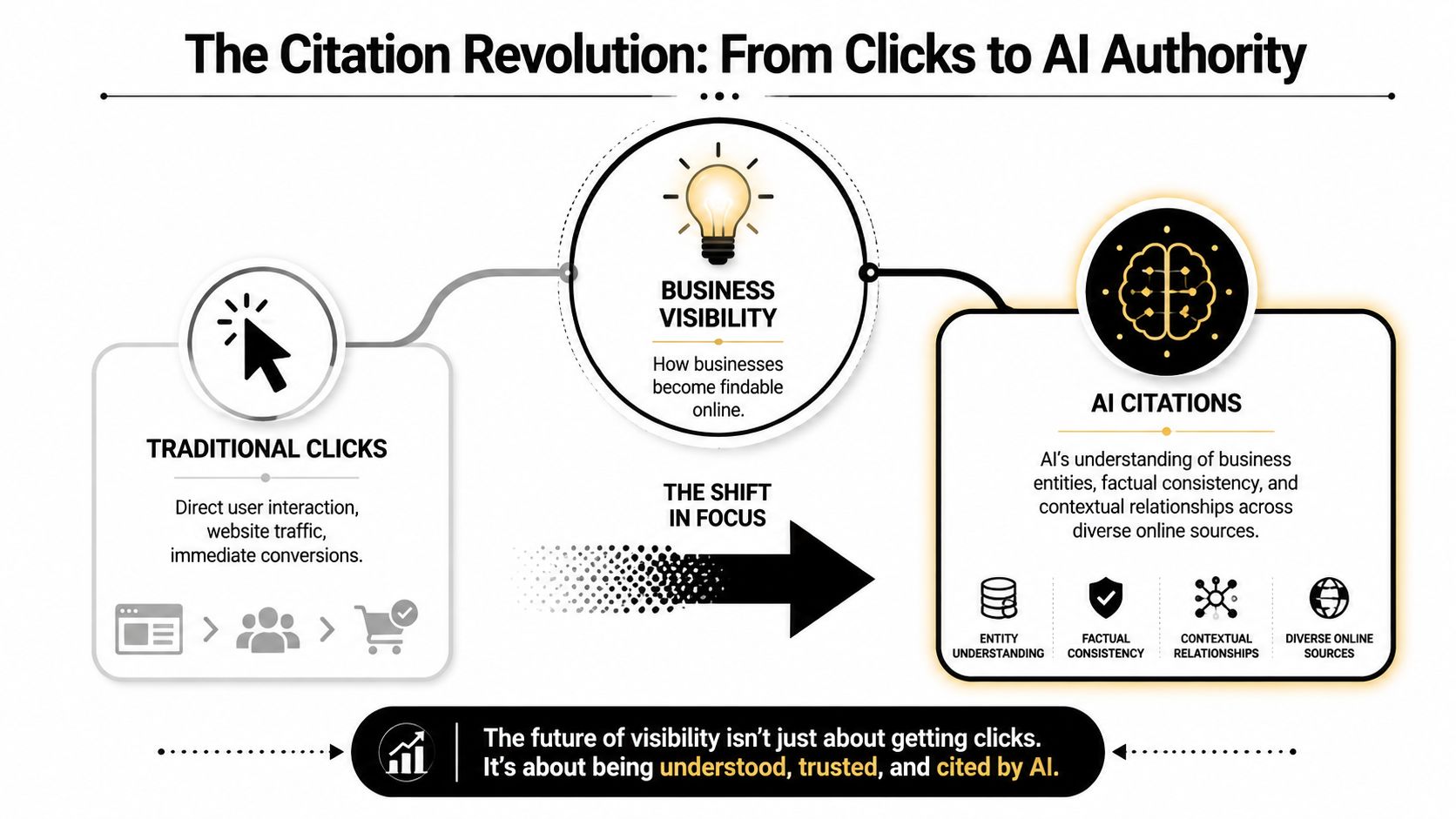
Search used to work like a librarian. You asked a question, and Google handed you a list of sources. Your job was to choose one.
AI search behaves more like a research assistant. It reads the sources first, extracts what it thinks is relevant, and returns a synthesized answer. Your brand wins when that assistant trusts your information enough to use it.
The real asset is trustable business data
This is why older SEO habits don't map cleanly to AI visibility. Ranking signals still matter, but AI systems need something more basic first. They need confidence that your business facts are coherent.
The most useful contrarian takeaway comes from Cheers Tech's analysis of whether Google Business Profile is enough for AI visibility: AI visibility is now an entity-consistency problem, not a profile-only problem, and the audit should include whether services, coverage areas, hours, and brand descriptors match across the website and external directories.
That point matters because many businesses are optimizing one node of the entity and ignoring the rest.
What AI citations actually look like
An AI citation doesn't always look like a footnote. In practice, it can be:
- A summarized business description built from profile and web signals
- A recommendation in conversational search when a user asks for a provider with specific capabilities
- A comparative answer that includes your hours, services, or service area
- A branded mention in an AI overview where the engine pulls facts without requiring a click
Here's the trade-off. Broad, keyword-heavy optimization can help you look relevant in a traditional SERP. But contradictory details make you look unreliable to AI. In the old model, you could sometimes outrank your data problems. In the new model, those problems poison the source material.
| Search model | Primary goal | Winning signal |
|---|---|---|
| Traditional search | Earn the click | Ranking strength and page relevance |
| AI-driven search | Earn reuse in answers | Consistent, verifiable entity data |
A business can still appear in search while failing the deeper trust test required for AI-generated answers.
The practical implication is simple. If your profile says one thing, your location page says another, and a directory says a third, the system has to choose which version to believe. Often, it chooses caution instead. That means weaker presence in AI summaries, thinner brand mentions, or no mention at all.
Decoding How AI Uses Your Business Profile Data
Google Business Profile has shifted from local listing management to entity training data.
That change matters because AI systems do not read your profile in isolation. They compare it against your website, reviews, directory citations, and other public references to decide whether your business is a stable entity or a messy one. A polished profile helps. A profile that conflicts with the rest of your footprint creates doubt.

Which fields matter most
Some fields carry more weight because they help AI answer three practical questions: who you are, what you offer, and whether the information can be trusted.
- Business categories: These set the primary classification. If the category is too broad or wrong, every downstream interpretation gets weaker.
- Services and attributes: These add specificity. They help systems match the business to detailed prompts instead of vague commercial intent.
- Hours and availability details: These support operational trust. In local and service-driven queries, stale hours can disqualify an otherwise relevant business.
- Reviews and Q&A content: These contribute real-world language about your offerings, outcomes, and common customer questions.
- Photos and descriptive fields: These improve completeness and can reinforce what the business does at a specific location.
The trade-off is simple. Marketers often spend too much time polishing the description field and too little time tightening the facts that AI can verify across sources.
Why specificity beats filler
AI does not need slogans. It needs usable facts.
A weak profile says a company offers “high-quality solutions” and “excellent service.” That copy sounds acceptable to a human reviewer and does almost nothing for machine interpretation. A stronger profile names the service categories, defines service areas, reflects real availability, and matches the wording used on the website.
That same principle shows up in other AI workflows. Teams that automate Shopify with AI agents get better results when product, inventory, and operations data are explicit and structured. Local business data works the same way. The systems perform better when the inputs are explicit.
Field-level insight: Categories set the identity. Services narrow the match. Reviews supply supporting language that can confirm relevance.
A basic Google Business Profile overview is still useful, but the profile should now be managed as part of a wider entity system. If the category says one thing, the location page says another, and review language points in a third direction, AI has to reconcile the conflict. That is where visibility starts to erode.
What weakens AI trust
Three patterns show up again and again in audits:
- Keyword-stuffed service names that do not reflect real offerings.
- Generic descriptions that sound polished but add no verifiable detail.
- Outdated operational data such as old hours, old phone numbers, or stale service areas.
The fix is less about copywriting and more about governance. Strong brands treat the profile as one node in a shared source-of-truth system. That is the standard AI visibility now rewards.
Your Practical Roadmap for AI Visibility
A complete profile is not the finish line. It's the starting point.
Google's guidance for AI features says pages must be indexed, technically crawlable, and have structured data that matches the visible text, while businesses should also keep Business Profile information up to date in Google Search documentation for AI features. When categories, hours, service areas, or schema don't line up, eligibility for AI surfaces can weaken because the system favors consistency.
Start with the audit. Not the redesign. Not the content sprint. The audit.

The entity consistency audit
The point of this audit is to establish a single source of truth. Every public signal about your business should trace back to that source.
Define your canonical facts
Lock down the business name, address format, phone number, categories, hours, service list, service areas, and core brand description. If you operate multiple locations, define these at the location level too.Compare your profile to your website
Check the homepage, location pages, contact page, footer, and service pages. Many businesses keep the profile current but leave old hours, retired services, or mixed naming conventions on-site.Review structured data against visible text
If schema says one thing and the page says another, you've created an avoidable trust problem. This includes hours, organization details, and service information.
A lot of teams need a process document to manage this work across web, content, and local operations. A practical framework like this 6-step design process is useful because it turns cleanup into repeatable operations rather than ad hoc fixes.
Here is a useful walkthrough before you formalize the audit in your own workflow:
Where conflicts usually hide
The most damaging inconsistencies are rarely dramatic. They're usually small and scattered.
- Hours drift: Holiday changes get updated in one place and ignored elsewhere.
- Service drift: The profile lists services that no longer have a matching page on the site.
- Location ambiguity: The website uses one city or region phrasing while directories use another.
- Category mismatch: The profile frames the business one way, while page titles and headings frame it differently.
- Brand descriptor inconsistency: One source calls the company a contractor, another a consultant, another a service provider.
Clean data wins because it reduces the amount of interpretation the AI has to do.
How to prioritize corrections
Fix high-impact items first.
| Priority | What to fix first | Why it matters |
|---|---|---|
| High | NAP, hours, core services, primary category | These shape identity and trust |
| Medium | Secondary categories, attributes, FAQs, review responses | These improve fit and specificity |
| Ongoing | Photos, supporting citations, social bios | These reinforce consistency over time |
For implementation, teams usually use a mix of spreadsheets, CMS controls, schema validators, listing management tools, and agency workflows. Raven SEO is one option when a business wants the audit, remediation planning, and rollout handled as a connected AI-readiness project.
Structuring Your Data and Content for AI Discovery
Once the entity is clean, the next job is to make it easy for AI systems to understand. At this point, many businesses stall. They update the profile, maybe refresh a service page, then stop short of structuring the site in a way that machines can reliably interpret.
That gap matters because Google's AI uses the profile's categories, attributes, listed services, hours, and reviews to decide whether a business fits a query, and current guidance emphasizes specificity and consistency over broad keyword stuffing in PowerChord's analysis of Google Maps AI and Business Profile signals.

Schema is now operational, not optional
Schema markup used to be treated like technical garnish. That view doesn't hold up anymore. If you want AI systems to connect your business identity, services, and local relevance, structured data needs to mirror the facts users can see on the page.
The most useful schema types for this work usually include:
- Organization: For core brand identity, official name, website, and brand-level properties
- LocalBusiness: For location-based details such as address, hours, and contact information
- Service: For service-specific pages that define what the business offers
A strong setup doesn't stuff every possible property into JSON-LD. It focuses on accuracy and alignment.
What high-utility pages look like
The best pages for AI discovery answer realistic buyer questions with verifiable details. They don't rely on vague marketing claims.
Compare the two approaches below:
| Weak page | Strong page |
|---|---|
| Generic overview with broad claims | Clear service definition tied to actual delivery |
| No matching service schema | Service schema aligned with on-page text |
| Mentions locations vaguely | States actual coverage areas consistently |
| Uses category terms loosely | Uses the same service language as GBP and citations |
Content patterns that help AI reuse your data
Use content that resolves ambiguity.
- Build service pages that map to GBP services: If the profile lists a service, the site should explain it clearly.
- Write FAQs around real intent: Address operational questions, service fit, timing, coverage areas, and constraints.
- Keep location signals grounded: If a branch can't perform a service, don't imply that it can.
- Encourage review specificity: Reviews that naturally mention the service performed or the context of the job help reinforce fit.
- Use consistent descriptors: Choose the business terms you want associated with the brand and use them steadily.
For teams implementing this at scale, a focused structured data guide helps connect schema choices to actual search behavior rather than treating markup as a separate technical task.
Specificity creates retrieval value. Consistency creates trust.
What doesn't work is publishing one thin location page for every market, copying service blurbs across all branches, and hoping AI will infer the differences. It usually won't. It will either generalize poorly or avoid citing the business with confidence.
Monitoring Your AI Footprint and Future-Proofing Your Brand
AI visibility decays faster than teams expect. A Google Business Profile can be accurate today and misleading a month from now if the website, citations, reviews, and location data start drifting apart.
That is the core risk to monitor. AI systems do not judge your profile in isolation. They assemble a business entity from many inputs, then decide whether your brand is consistent enough to cite with confidence. If your GBP says one thing, your service pages imply another, and directory listings still show old details, the model has no clean version of the truth to reuse.
A useful monitoring process checks how the business is being interpreted, not just whether the profile fields are filled in.
What to monitor regularly
Review how your brand appears across AI-assisted search experiences and conversational answers.
- Brand queries: Search your business name and review how summaries describe the company, categories, and locations.
- Service-intent prompts: Test the questions buyers ask when comparing providers and note whether AI connects your brand to the right services.
- Location-plus-service combinations: Check how the business is represented in regional searches, especially if you have multiple branches or service areas.
- Review language trends: Watch for recurring phrases that strengthen your positioning or create confusion about what you do.
Google has also started connecting Business Profile data to Gemini for small businesses. Google says Gemini can access contextual information such as customer reviews, customer questions, and performance data from the profile after connection in Google's Gemini features for businesses announcement. That increases the value of profile accuracy because the profile now influences more than traditional local search surfaces.
Build a maintenance loop
Strong teams treat this as an operating rhythm.
A practical review cycle usually includes:
- Monthly data checks: Hours, services, categories, and location details
- Quarterly schema review: Confirm markup still matches visible content on the site
- Citation cleanup: Fix drift in major directories and partner listings
- AI snapshot testing: Record how the brand is summarized over time and compare changes
If you want a more structured way to track these patterns, an AI visibility analytics approach for search optimization helps turn scattered checks into a repeatable reporting process.
The brands that gain citations in AI search usually are not the ones publishing the most content. They are the ones maintaining the clearest, most consistent digital identity across every source AI can reference.
That consistency does not happen by accident. It comes from regular audits, clear ownership, and fast correction when profile data, on-site content, and citations stop matching.
If your business needs a practical audit of profile data, schema alignment, service-page consistency, and AI citation readiness, Raven SEO can help map the gaps and turn them into an actionable plan.