

To truly manage your brand across the web, you need one single, undisputed source of truth for your business’s core data. This educational guide will walk you through the non-negotiable steps.
This data is your official Name, Address, and Phone number (NAP), plus your website URL. Think of it as your brand's digital passport. Any variation, no matter how tiny—like using "St." in one place and "Street" in another—creates confusion for search engines and, more importantly, for your customers.
Why Your Digital Entity Is Your Most Valuable Asset
Your digital entity is so much more than just a business name on a website. It's the complete, interconnected profile that search engines like Google assemble to figure out who you are, what you do, and whether you’re a legitimate, trustworthy operation.
Google pieces this profile together from dozens of signals scattered across the internet—everything from your Google Business Profile and local directories to your social media accounts. When all these signals tell the exact same story, Google sees you as a reliable business worth showing to its users.
But when they conflict? A slightly different business name here, an old phone number there? It chips away at that trust. For a local business, the damage can be devastating. An incorrect address on a map or a disconnected phone number on a directory isn't just a small error; it's a lost customer and a hit to your reputation. Grasping how to build an online presence that lasts starts with treating your digital entity as your most valuable asset.
The Real Cost of Inconsistency
Inconsistency isn't just a minor headache; it's a direct threat to your visibility and credibility. Search engines are obsessed with showing users accurate, reliable information. If they can't figure out which version of your business data is the right one, they'll often just show a competitor's listing instead. Simple as that.
This is where having a unified, consistent entity becomes absolutely critical. The benefits aren't theoretical—they directly impact your bottom line.
- Improved Local SEO Rankings: Consistent NAP data is a heavyweight ranking factor for local search. Businesses with a clean digital footprint are far more likely to land in the coveted "local pack" map results.
- Enhanced Customer Trust: When customers find the same correct information everywhere they look, it builds confidence. That seamless experience is what turns a casual searcher into a paying customer.
- Stronger Brand Authority: A consistent entity strengthens your brand’s authority signals, a key ingredient in building Experience, Expertise, Authoritativeness, and Trustworthiness (E-E-A-T). You can learn more about the power of E-E-A-T in our guide.
Before we move on, let's break down the core components that absolutely must be kept consistent. These data points form the bedrock of your digital entity.
Table: Core Components of Your Digital Entity
| Entity Component | Description | Why It Matters for SEO |
|---|---|---|
| Official Business Name | The exact, legal name of your business, including suffixes like "LLC" or "Inc." | Inconsistencies confuse search engines, splitting your authority across multiple perceived entities. |
| Physical Address | The full, verifiable street address, including suite or unit numbers and the proper ZIP code. | This is the primary signal for local search, directly impacting your visibility in map packs and "near me" queries. |
| Primary Phone Number | The main local phone number for your business, consistently formatted. | A correct phone number is a key trust signal and is essential for click-to-call conversions from mobile search. |
| Website URL | The canonical version of your homepage URL (e.g., https://www.yourdomain.com). |
A consistent URL ensures all backlinks and authority signals point to a single, authoritative source. |
Having these four elements locked down and identical everywhere is the first and most important step in controlling your online presence.
The stakes are higher than ever. Companies maintaining a presence on three or more channels see 250% higher engagement and an 89% customer retention rate, compared to just 33% retention for single-channel efforts. This multi-channel success hinges on the consistent entity data that ties them all together.
Conducting Your Digital Footprint Audit
Before you can build a unified brand presence, you first have to understand the messy reality of what's already out there. The critical first step in managing your business entity online is a deep-dive audit of your digital footprint. This is all about uncovering every single place your business is mentioned online so you can spot and document the inconsistencies that are holding you back.
Think of yourself as a digital detective. Your prime targets are your Name, Address, and Phone number (NAP). Even tiny variations—like "Suite 200" versus "Ste. 200" or "(555) 123-4567" vs. "555.123.4567"—can dilute your authority and confuse the heck out of search algorithms.
Uncovering Every Online Mention
Your first move is to use advanced search queries to find listings hiding beyond the obvious places like Google and Yelp. Don't just search for your brand name. You need to get creative to cast a wider net and find every citation, whether it's right or wrong.
Here are a few search strings I use all the time:
"Your Business Name" + "Your City""Your Business Name" + "Your Phone Number""Your Old Business Name" + "Your Address"(This is crucial if you've ever rebranded or moved)."Your Phone Number" -site:yourwebsite.com(This clever one finds mentions of your phone number anywhere except your own website).
As you find these, document everything in a simple spreadsheet. I recommend columns for the URL of the listing, the NAP information it displays, and a status column to tag each one: Correct, Incorrect, or Duplicate. This simple system is how you turn a chaotic list of links into an actionable cleanup plan.
For a more detailed walkthrough, our comprehensive web audit checklist provides a step-by-step framework you can follow. It's the perfect companion to this guide, ensuring you don’t miss any critical steps during your audit.
A Real-World Scenario
I once worked with a local plumbing company that was baffled by a sudden drop in lead calls. Their audit quickly unearthed the culprit: a popular local directory had scraped an old, disconnected phone number from a forgotten Facebook page they had created years ago. Potential customers were calling a dead line, assuming the business had shut down.
This isn't a rare occurrence; it's a common and costly mistake. For that plumber, one incorrect phone number was directly costing them paying customers every single week. The impact was immediate and measurable, proving that a thorough audit isn't just an "SEO task"—it's an essential business health check.
This whole process—from establishing your identity to making it consistent—is what builds trust with both search engines and customers.
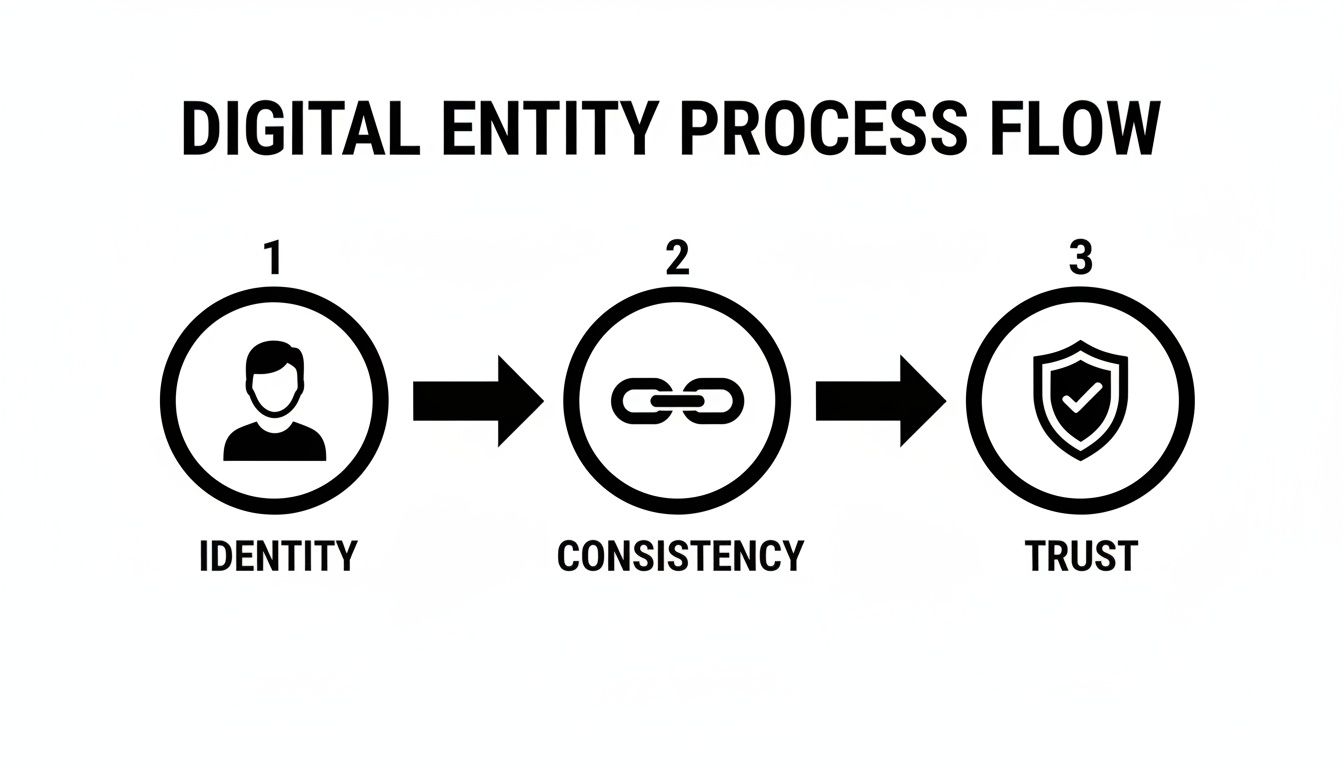
This flow is the core of a healthy digital presence. Your audit is the diagnostic tool that makes it all possible, showing you exactly where the problems are so you can start fixing them.
Establishing Your Authoritative Brand Identity
Once you've finished auditing your digital footprint, the next job is to build a single, authoritative source of truth for your business information. This isn't just about being consistent; it's about taking control. You have to define your brand's official identity before you can expect search engines and directories to get it right.
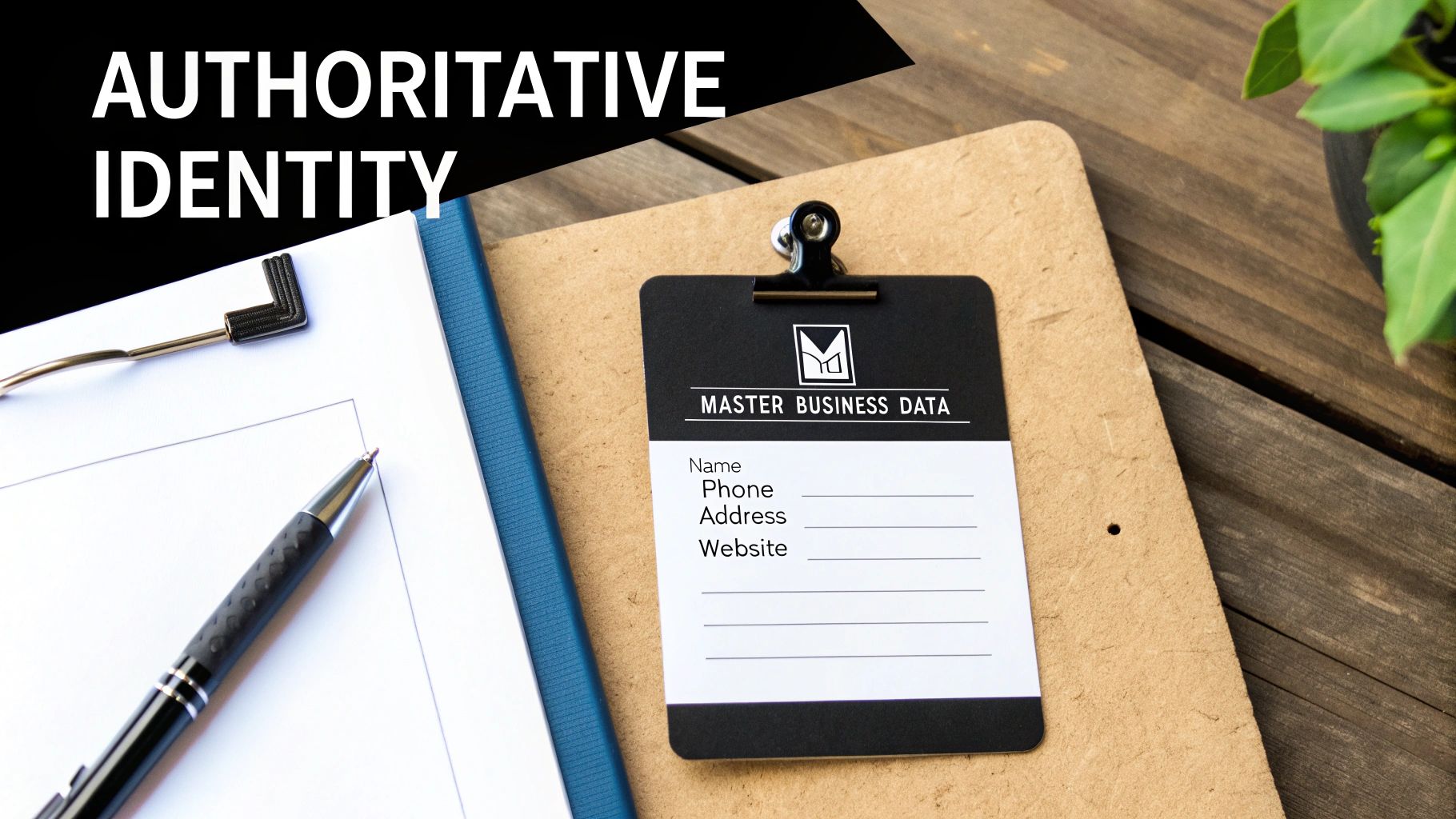
This process kicks off with what we call a "master file." It can be a simple document or spreadsheet, but its role is monumental. This file will house the canonical, non-negotiable details of your business, serving as the ultimate reference point for every online profile you create or claim down the road.
Defining Your Canonical Data
Your master file needs to contain the definitive version of your core business information. This data should be locked down and used without any variation, ever.
- Canonical Business Name: Settle on the exact legal name, including suffixes like "LLC" or "Inc.," and stick with it. Don't flip-flop between "Smith Plumbing Co." and "Smith Plumbing Company."
- Primary Physical Address: Document the full, correct address just as a mail carrier would recognize it. Use consistent abbreviations for street types (e.g., always "St." or always "Street") and include suite or unit numbers precisely.
- Main Local Phone Number: Choose one primary, local phone number. Make sure the formatting is identical everywhere, whether it's
(555) 123-4567or555-123-4567. - Definitive Website URL: Decide on the canonical version of your URL. For most businesses, this means using
https://www.yourdomain.com, including the "www."
This master file is the bedrock of your entity management strategy. Any time you or your team need to update a profile or create a new one, you will refer back to this document. This simple step eliminates the guesswork that leads to costly inconsistencies.
Prioritizing Key Platforms
With your master file ready to go, the next move is to secure and optimize the most critical platforms first. These are the heavy hitters that search engines trust the most for business information. Getting these right provides a strong foundation for your wider syndication efforts.
Your top priorities should always be:
- Google Business Profile (GBP): This is the single most important online profile for any local business. It directly dictates how you show up in Google Search and Maps.
- Bing Places for Business: As the second-largest search engine, Bing's business directory is a crucial asset that shouldn't be ignored.
- Core Social Profiles: Secure profiles on platforms like Facebook and LinkedIn, as they are powerful signals that help confirm your business identity.
When you're filling out these profiles, the goal is 100% completion. This means filling out every single relevant field using the data straight from your master file. Select the most accurate business categories, write compelling descriptions that reflect who you serve, and upload high-quality photos and videos. If you need help understanding your target audience, check out our guide on how to create buyer personas for deeper insights.
A fully optimized GBP profile that perfectly matches your master file sends an incredibly strong signal to Google that your entity data is accurate and trustworthy. This initial effort pays huge dividends in the long run.
Getting Your Business Listed Everywhere That Matters
Once you’ve locked in your official brand identity, the real work begins. It’s time to start pushing that information out across the web in a process we call syndication. This is all about building a vast network of consistent signals that tells search engines like Google that you are a legitimate, established business at a specific location.
Think of every consistent listing as another vote of confidence in your favor.
This is where you'll hear the term citations thrown around a lot. A citation is simply any online mention of your business's Name, Address, and Phone number (your NAP). It doesn't even need a link back to your website to count. Having consistent citations across high-quality online directories is a foundational piece of local SEO and directly impacts how well you show up in local search.

Doing It By Hand vs. Using a Service
When it comes to building out these citations, you have two main routes you can take: the manual, hands-on approach or using automated data aggregator services. Each has its pros and cons, and the right choice really depends on your resources and goals.
Manual Citation Building: This means you or your team will be creating or claiming listings one by one. You'll hit the big ones like Yelp and Yellow Pages, plus any directories that are super relevant to your specific industry.
- The upside? You get total control over every single listing, guaranteeing 100% accuracy. You can also make sure you’re listed on the niche sites that your competitors might overlook.
- The downside? It’s a ton of work. Seriously, it's incredibly time-consuming and needs constant monitoring to keep everything up to date.
Data Aggregator Services: These services are the big guns. You give your business info to a few major data providers, and they, in turn, feed that data to hundreds of other online directories, mobile apps, and GPS services.
- The upside? The scale and efficiency are massive. Your NAP data gets spread far and wide with very little manual effort.
- The downside? You give up direct control. If there’s a mistake, it can take months for a correction to trickle down through the entire network.
For most small and medium-sized businesses, the best strategy is a mix of both. Manually claim and perfect your most important profiles, especially your Google Business Profile. Then, use an aggregator to handle the broad-strokes distribution. To really nail this, you should know that optimizing your Google Business Profile is a local SEO powerhouse—we have a whole guide on it.
Don't Forget Social Media and Schema Markup
Citations aren’t just about business directories. Other platforms are just as important for backing up your business identity. Think about social media profiles on places like Facebook, LinkedIn, and X. They are surprisingly powerful trust signals for search engines.
Even if you have no plans to post regularly, go claim your profiles. Fill them out completely with your official, canonical NAP data. This not only secures your brand name but also adds another layer of verification that Google can see and trust.
But the most powerful signal of all comes directly from your own turf: your website. This is where structured data, often called Schema markup, comes into play. It’s a way to explicitly tell search engines exactly what your business is all about.
Schema markup is a special code vocabulary you add to your website's backend. It gives search engines a perfectly organized fact sheet about your business—removing any and all guesswork about your name, address, services, and hours.
This direct line of communication is priceless. It helps Google connect the dots between your website and all those other citations you've built across the web, cementing your entity's authority and boosting your chances of getting those eye-catching rich results in search.
Connecting Entity Management with Reputation
Your online business entity isn't just a static collection of data points; it's a living, breathing profile shaped by what your customers say about you. Getting your name, address, and phone number consistent across the web is the critical first step—it builds the foundation. But it's your reputation that builds the trust that actually wins you business.
Any solid plan to manage your 'entity' across the web has to include a strategy for nurturing and protecting your brand's public perception.
This means getting serious about managing your reviews. They are powerful social proof that both search engines and potential customers rely on heavily. A steady stream of positive feedback on platforms like Google signals a healthy, thriving business. On the flip side, a few unanswered negative reviews can quickly poison the well and undermine all your other hard work. To really nail this, it's worth understanding What Is Online Reputation Management and how it actively shapes the way people see your business.
Cultivating Positive Reviews Proactively
Just waiting for reviews to trickle in is a passive strategy that leaves your reputation completely to chance. The businesses that win at this have a simple, repeatable process for asking their happiest customers for feedback.
The absolute best time to ask is right after a successful sale or a great customer interaction when their positive feelings are at their peak. You can do this with a simple, automated follow-up email or even a text message that includes a direct link to your Google Business Profile. The less friction you create, the more likely they are to share their fantastic experience with the world.
A Framework for Responding to All Feedback
How you handle the reviews you get is just as important as generating them in the first place. A thoughtful response strategy shows that you're an engaged business owner who genuinely cares about customer feedback, which builds a ton of trust with anyone reading them.
- For the Good Stuff: Always, always say thank you. Take it a step further by personalizing your response and mentioning something specific from their review. It shows you're actually reading what they wrote and reinforces their positive experience.
- For the Not-So-Good Stuff: You need to be prompt, professional, and public. Acknowledge the issue, apologize that they had a bad experience (without necessarily admitting fault if it's not warranted), and offer to take the conversation offline to make things right. This shows accountability to both the unhappy customer and every future prospect who sees it.
Real-World Win: A local contracting firm got hit with a one-star review over a scheduling mix-up. Instead of getting defensive or ignoring it, the owner responded within an hour. He apologized for the miscommunication and offered a discount on their next service. The customer later updated the review to four stars, specifically praising the incredible customer service. That public response turned a negative into a powerful testament to their commitment.
This kind of active engagement sends crucial signals to customers and search engines alike. An omnichannel approach wins big, with companies seeing a 250% higher engagement rate when using multiple channels. When you consider that daily social media use is over 2 hours globally and that 77% of companies get higher engagement from email, it's clear these platforms are essential for reputation management.
Ultimately, managing your reputation across your social channels is a critical piece of a complete entity management strategy. You might find our guide on reputation management on social media helpful for diving deeper.
Common Questions on Managing Your Business Entity
Navigating the complexities of how your business shows up online can bring up a lot of questions. We get it. Below, we tackle some of the most common queries we hear from business owners, offering clear, direct answers from our years of experience.
What’s the single most important part of managing my business entity?
Without a doubt, it’s NAP (Name, Address, Phone number) consistency. Every single mention of your business online—from your website to the smallest local directory—must use the exact same information. No exceptions.
Even tiny variations like "St." versus "Street" or including a suite number on some profiles but not others can create massive confusion for search engines. This dilutes your local authority and chips away at the trust Google has in your business. The best practice is to define one canonical version of your NAP in a master file and treat it like gospel. It's the bedrock of a strong digital presence.
How often should I audit my online presence?
For a deep, comprehensive entity audit, a yearly check-up is a great starting point. This helps you benchmark your digital footprint and catch any long-standing errors.
However, a more proactive approach is even better. We recommend quarterly mini-audits to spot new, incorrect listings before they cause problems. Setting up free tools like Google Alerts for your brand name can also help you stay on top of new mentions. If your business moves, rebrands, or changes its phone number, an immediate and thorough audit is non-negotiable. This proactive maintenance is a health check for your brand's digital identity.
How does social media affect my business entity?
Think of your social media profiles as powerful confirmation signals for search engines. Platforms like Facebook, LinkedIn, and even industry-specific sites all work to reinforce your business's name, website, and location. Each one adds another layer of verification to your entity.
It's crucial to make sure this profile information is complete and perfectly matches your canonical NAP data. Even if you aren't active on a platform, just claiming and completing these profiles prevents others from squatting on your brand name and strengthens the authority of your digital identity. They are essentially high-authority citations that add weight and legitimacy to your business in the eyes of search algorithms.
What is structured data and why is it important for my entity?
Structured data, also known as Schema markup, is a specialized code you add to your website. It acts like a clear, organized fact sheet for search engines, explicitly telling them your official business name, address, phone number, hours, and services.
This removes all guesswork for search engines like Google. It helps them connect your website (the source of truth) to all the other listings and citations across the web, strengthening your entity's authority. Implementing it correctly is a technical but powerful step in managing your entity and can help you earn prominent, eye-catching results in search.
At Raven SEO, we specialize in taking the complexity out of entity management. Our team builds a consistent, authoritative digital presence for your business so you can focus on what you do best. Schedule a no-obligation consultation today and let's create a practical roadmap to increase your visibility, traffic, and conversions.