

In Maryland's fast-paced market, hiring a professional web designing company is one of the smartest investments you can make for your business. A great website isn't just a digital brochure; it's an educational resource, your 24/7 salesperson, your virtual storefront, and the first handshake you have with potential customers. It builds trust long before they ever pick up the phone.
Why a Great Website Matters in Maryland
From the bustling Baltimore-Washington corridor to local hubs like Fells Point and Towson, a professional website is no longer a "nice-to-have." It’s a core part of your business's survival and growth. It's your single most powerful tool for credibility and sales, working around the clock to bring customers to your door and educate them on your value.
Standing Out in a Competitive Market
Most business battles today are won or lost online. The proof is in the numbers. The web design services industry has exploded, with the number of firms growing to over 203,000 in the U.S. and seeing a 4.9% annual growth rate in recent years.
With roughly 72% of businesses now having a website, that other 27% are at a massive disadvantage. This is especially true in hyper-competitive areas influenced by the D.C. metro, where customers have endless choices.
A great website has to deliver a flawless, educational experience on every device. This is where solid mobile optimization becomes non-negotiable. For any Maryland business, your site needs to work perfectly whether a customer is browsing on their desktop in Towson or on their phone while walking through Canton.
The Real Cost of Being Invisible
Deciding to put your online presence on the back burner isn't just a missed opportunity—it's a significant risk. An outdated or nonexistent website creates serious problems:
- Loss of Credibility: Customers are savvy. They often see a poor website as a reflection of the business itself, making you seem less professional or trustworthy.
- Missed Opportunities: You're effectively invisible to the thousands of local customers actively searching online for the exact services you offer.
- Competitive Disadvantage: While you're offline, your competitors with strong websites are capturing the customers and market share you’re leaving on the table.
Investing in a professional web designing company is a direct investment in your business's future. It's about creating a powerful asset that generates leads, educates visitors, and secures your place in the local market.
Ultimately, a well-built website does more than just look good. It's strategically designed to meet your business goals, connect you with your community, and deliver a real, measurable return on your investment. To see what goes into a site that delivers, check out our guide on website design best practices that truly drive results.
Defining Your Website Goals Before You Hire
Before you even start Googling for a web designer, the most critical work actually starts in-house, with you. Too many businesses jump straight into the design phase and end up with a website that, while it might look good, does absolutely nothing for their bottom line.
A successful website project is built on a rock-solid foundation of clarity. Without it, you're just throwing money at a problem you haven't defined yet. An educational approach starts with clear goals.
Think of it this way: you wouldn't hire a home builder without a detailed blueprint. Your website is no different. Every decision, from the layout to the technology used, has to be driven by specific, measurable business goals.
What's the Number One Job of Your Website?
First things first: what is the single most important thing you need your website to do? Every other decision flows from this answer. Are you trying to get the phone to ring, sell products from an online storefront, or position yourself as the leading authority in your field?
A plumber in Towson, for instance, needs a site that’s a lead-generating machine, funneling visitors directly to a phone number or a contact form. On the other hand, a retail boutique in Fells Point needs to showcase its inventory and make the online checkout process dead simple.
Getting this primary objective nailed down from the start helps a potential web designing company like us at Raven SEO understand what success looks like for you. It's the only way we can propose a solution that actually moves the needle.
Who Are You Actually Talking To?
Your website isn’t for you. It’s for your customer. A site designed to attract tech-savvy startups in Baltimore will look and feel completely different from one targeting families in suburban Maryland. You have to get inside your ideal customer's head.
Every single design choice—from the color palette to the navigation menu—should be made with your ideal client in mind. The goal is to create an online experience that feels like it was built just for them, providing educational content they value.
To get a clearer picture, start asking some key questions:
- Who are they? Think about their age, where they live, and their general income level.
- How do they behave online? Are they scrolling on a phone during their commute or researching on a desktop at the office?
- What's their problem? What specific issue are they trying to solve that you can help with?
Building out these customer profiles ensures the final design and messaging will actually connect with the right people. If you want to go deeper on this, we've got a guide that walks you through how to create buyer personas.
What Are Your Non-Negotiable Features?
Finally, it's time to make a practical list of the features your website absolutely must have to function. We're moving beyond the standard "About" and "Contact" pages here. Think about the tools that will make your business run smoother and make life easier for your customers.
Common "Must-Have" Functionalities:
- An integrated appointment booking system that's easy for customers to use.
- A secure portal for clients to log in and access shared documents.
- A portfolio or gallery of your work that can be filtered by project type.
- eCommerce functionality with secure payment processing.
- A blog or news section to share updates and build your expertise through educational content.
Walking into a meeting with a list like this shows you've done your homework. It allows a web designing company to give you a much more accurate quote and sets the stage for a smooth, efficient project right from day one.
How to Evaluate a Company's Portfolio
A portfolio isn't just a pretty gallery of past projects; it's a web designing company's resume. And the first place you should always look? Their own website. If it’s clunky, confusing, or just plain broken, that’s your biggest red flag. Move on.
The portfolio itself is where you'll find the proof. It’s a direct look into their design style, technical chops, and—most importantly—the actual results they've gotten for businesses like yours.
This is also where you check for a vibe match. Look past the slick visuals and ask yourself: is their work functional? Is it intuitive? Is it built to actually achieve a business goal, or is it just art? A great website educates the user on why they should choose that business.
Look for More Than Just a Pretty Picture
A beautiful design is a great start, but it's only one piece of the puzzle. An effective website has to deliver a fantastic user experience (UX). Your customers simply won't stick around on a site that's a pain to navigate, no matter how good it looks.
The numbers don't lie. A staggering 75% of users admit to judging a company's credibility based entirely on its website design, and they form that first impression in less than a second. This is especially true for businesses in busy Maryland spots like Fells Point and Towson.
With mobile devices now driving up to 63% of all web traffic, a site that isn't built for a phone is dead on arrival. In fact, 53% of mobile users will bounce if a site takes longer than 3 seconds to load. The stakes are incredibly high.
A great portfolio doesn't just show off pretty designs. It showcases websites that are fast, intuitive, and built to convert visitors into customers.
A Practical Checklist for Portfolio Reviews
To help you tell a top-tier portfolio from a mediocre one, use this simple gut-check process. It breaks down the essential things to look for in any potential web designing company's work.
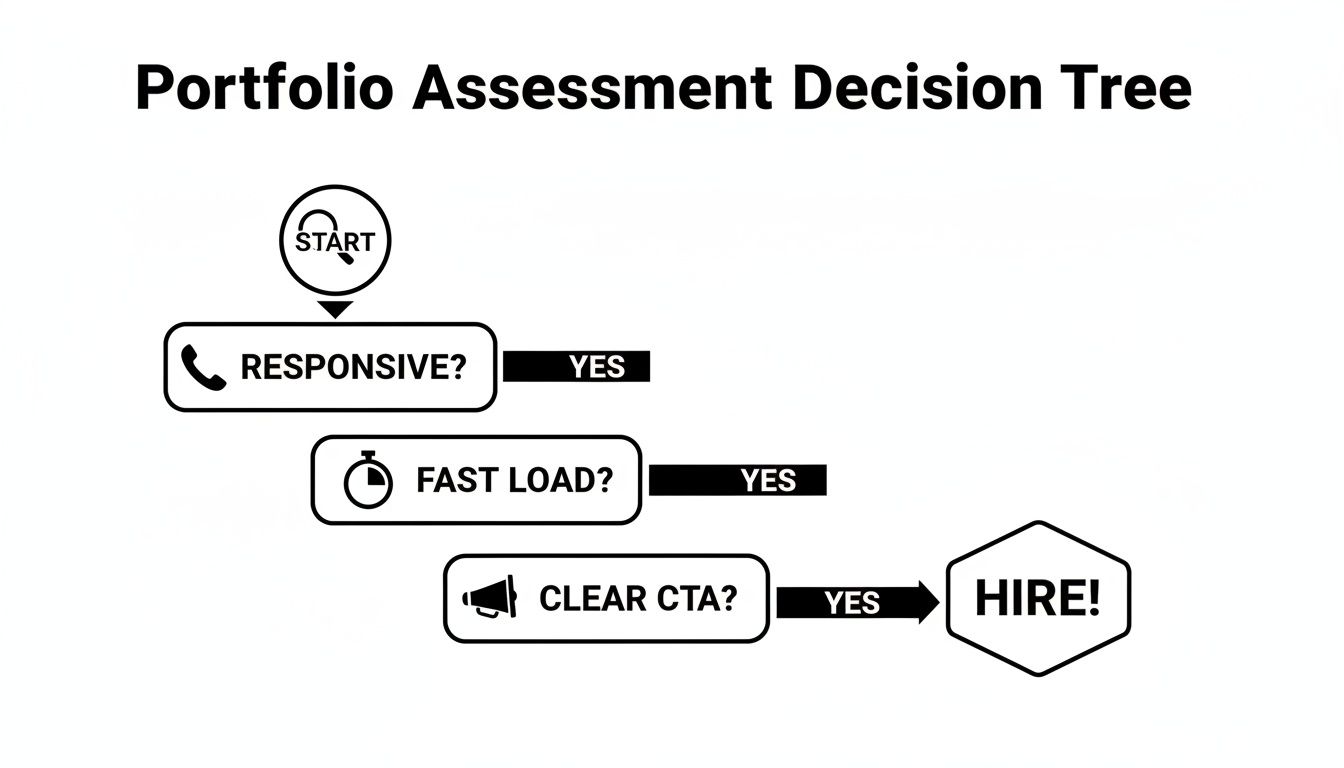
This flowchart just reinforces the point: great design is a mix of aesthetics, speed, and clear direction. These are the cornerstones of an agency you actually want to hire.
The Fells Point Cafe Scenario
Let's make this real. Imagine you own a cafe in Fells Point, and you’re looking at two different agencies.
- Agency A's Portfolio: It’s full of stunning, artistic websites for high-fashion brands in New York. The sites are visually striking but loaded with animations that make them painfully slow on a phone.
- Agency B's Portfolio: This one features several Baltimore-area restaurants and cafes. The designs are clean, the menus are a breeze to find, and a clear "Order Online" button is impossible to miss.
For the cafe owner, Agency B is the clear winner. Their portfolio proves they get the local market and know how to build a website that drives real results for a food business—like online orders and reservations. To see a great business website example that nails this balance, our team at Raven SEO has put together some helpful breakdowns.
Look for a web designing company that has experience not just in your industry but, ideally, in your geographic area. Their work should show you they understand your customers and your business goals.
Understanding the Technology Behind the Design
A gorgeous website is great, but if it’s slow, clunky, or insecure, it’s just an expensive online brochure. The technology powering your site is what turns it from a pretty picture into a high-performance business asset. For most business owners, this is where the conversation can get a little technical, but you don't need to be a coder to make a smart decision.
Getting a handle on the basics will help you ask the right questions and choose a web designing company that builds for performance, not just looks.

Think of your website's platform, or Content Management System (CMS), as its engine. You wouldn't put a lawnmower engine in a race car, and the same logic applies here. The right engine is critical for your site's speed, security, and future growth.
Comparing Website Platforms
When you start talking to agencies, you’ll likely run into two main options: a massively popular open-source system or a more specialized, managed solution.
-
WordPress: This is the giant in the room, powering over 43% of all websites on the internet. Its main draw is its incredible flexibility. With a universe of themes and plugins, you can make a WordPress site do almost anything. That power, however, comes with responsibility. It demands consistent maintenance, security monitoring, and updates to keep it running smoothly and safely.
-
Swyft Sites: This is our specialized platform at Raven SEO, built specifically for Maryland businesses that need peak performance without the technical overhead. Swyft Sites are engineered for speed, security, and local SEO right out of the box. They're an ideal fit for service-based companies who want a site that just works, letting them focus on their customers instead of plugin updates.
When you’re vetting a web designing company, ask about their technical bench strength. Do they have skilled full-stack developers on the team? This is a great sign they can handle complex back-end challenges, not just the front-end design.
Core Technicals You Cannot Ignore
Beyond the CMS, several technical fundamentals directly impact how your customers and Google perceive your site. A top-tier agency won’t treat these as add-ons; they'll be part of the foundation.
The web design market is exploding, projected to hit $142 billion by 2033. This matters for Maryland businesses because your customers are online—50% of mobile shoppers use websites over apps. Yet a surprising 27% of SMBs still don't have a website at all. With 88% of consumers saying they’ll bail on a site after one bad experience, getting the tech right is non-negotiable.
A fast, secure, and mobile-friendly experience is not a luxury feature—it's a baseline requirement for any modern website. Google prioritizes sites that deliver this, and so do your customers.
Here are the absolute must-haves to discuss with any agency you're considering:
- Core Web Vitals: These are Google’s official metrics for user experience. They measure loading speed, how quickly a user can interact with your page, and whether the layout shifts unexpectedly. A poor score here can seriously hurt your search rankings.
- Mobile-First Design: Google now ranks your site based on its mobile version. Your website must be designed for a phone screen first and then adapted for desktops, not the other way around.
- Site Security (SSL): An SSL certificate is what puts the "s" in "https://". It encrypts the connection between your site and your visitors. Without it, browsers will warn users that your site is "Not Secure," destroying trust in an instant.
Understanding these key pieces ensures you’re equipped to partner with a company that will build a site that’s not just beautiful, but fast, secure, and ready to grow with your business. To see how all these pieces come together, you can explore the stages of web development in our complete guide.
Integrating Local SEO From Day One
For any business serving Baltimore, Dundalk, or the wider DMV area, a website has to do more than just look good. It needs to be a magnet for local customers. You can have the most beautiful design in the world, but if people in your own neighborhood can’t find you on Google, what's the point?
This is why local SEO can't be an afterthought tacked on after launch. It has to be baked into the design process from the very beginning. A smart web designing company isn't just building you a website; they're building a local lead-generation engine from the ground up.

The entire process is about weaving your location into the very fabric of your website. It’s about optimizing for the exact phrases your customers are typing into their phones, like “plumber in Towson” or “best crab cakes in Fells Point.” When Google sees these local signals built right into your site's structure, it starts to see you as the most relevant, authoritative answer for nearby searchers.
Building for Your Neighborhood
A huge piece of this puzzle is your Google Business Profile (GBP). Your website and your GBP need to be in perfect sync. A skilled web designer ensures that every critical detail—your address, phone number, and hours—is 100% consistent across both. This consistency is a massive trust signal for search engines.
It also means creating educational content that speaks directly to the communities you serve. This isn't generic stuff; it's targeted and specific.
- Neighborhood-Specific Pages: Think dedicated pages for Canton, Federal Hill, or Dundalk, each filled with localized content, customer photos, and testimonials from that area.
- Geotagged Images: Every photo of your work should be optimized with location data, signaling exactly where you operate.
- Local Schema Markup: This is a bit of code that works behind the scenes, explicitly telling Google you're a local business, what you do, and where you're located.
This level of detail is what separates a generic, invisible website from one that dominates local search. For a much deeper dive, our team at Raven SEO put together a complete guide on local SEO best practices that will give you a serious competitive edge.
Local SEO Success in Action
Let's talk about a real-world example. We worked with a home improvement contractor based in Canton who was struggling to get leads beyond word-of-mouth. Their old website was completely generic, with no local focus. They were invisible online, even to homeowners just a few blocks away.
They came to Raven SEO for a website redesign that put local search at the very center of the strategy. We built out individual service pages targeting specific Baltimore neighborhoods, fully optimized their Google Business Profile, and created content centered on their local projects.
The results were immediate. Within three months of launching the new site, they started ranking on the first page of Google for their most important local search terms. This led directly to a 45% increase in qualified leads from their core service area.
This is the power of getting local SEO right from day one. When you hire a web designing company that truly understands your market, you’re not just buying a new website. You’re investing in a strategic tool designed to connect you with the customers right in your own backyard.
Frequently Asked Questions About Web Design
Choosing a web design partner is a huge decision for any Maryland business owner. It’s an investment of time, trust, and money. Over the years, we’ve found that most local business owners have the same handful of crucial questions.
Let's cut through the noise and give you the straightforward, educational answers you need to make the right choice.
How much does a new business website cost?
This is usually the first question on everyone's mind, and the honest answer is: it depends. A website isn't a commodity; it's a custom-built asset. The price can range from a few thousand dollars for a streamlined, professional site to tens of thousands for a large-scale, completely custom project.
The final cost really boils down to the scope of the work. For instance:
- Custom vs. Template Design: A unique design built from the ground up to reflect your brand's identity will naturally require a larger investment than a site built from a pre-made template.
- Platform and Technology: The engine running your site matters. A fully flexible WordPress site has different cost implications than a managed, high-performance solution like our Swyft Sites.
- Advanced Features: Need to sell products online? Require a private client portal or a sophisticated booking system? These specialized features add development time and will be reflected in the quote.
We believe in total transparency. That’s why Raven SEO offers no-obligation consultations to provide a precise quote based on your specific goals.
What is the difference between web design and web development?
Think of web design as the architect and interior designer of a house. They focus on the look and feel—the layout, color scheme, typography, and overall user experience (UX). It’s about making the website visually appealing, intuitive, and easy for visitors to navigate.
Web development is the construction crew. They take the design plans and use code to build a functional, working website. This includes the back-end (server, database) and the front-end (what users interact with). A top web designing company excels at both, ensuring your site is both beautiful and technically sound.
How long does it take to build a new website?
There’s no magic number here—the timeline is tied directly to the project's complexity.
As a general rule, a straightforward informational website for a local business can often be designed, built, and launched in about 4-6 weeks. A more complex project with custom features or a large e-commerce store could take 3-4 months or longer.
A typical project moves through stages: discovery, design, development, content population, and revisions. Your role is crucial; providing timely feedback and content is what keeps the project moving forward smoothly without cutting corners on quality. We set a clear, realistic timeline from day one.
Does my website need ongoing maintenance after launch?
Absolutely. Your website's launch is the starting line, not the finish line. A website is a living asset. Just like your company vehicle, it needs regular tune-ups to perform at its best and stay secure. If you ignore it, you risk slow load times, broken features, and, worst of all, major security breaches.
Any solid maintenance plan from a web designing company should, at a minimum, include:
- Core & Plugin Updates: Keeping all software current to patch security holes and ensure everything works together.
- Proactive Security Scans: Regularly scanning for malware or hacking attempts before they become a problem.
- Frequent Backups: Creating daily or weekly copies of your entire site, so if the worst happens, it can be restored in minutes.
Raven SEO offers comprehensive care plans to protect your investment and ensure your site remains a powerful, high-performing tool for your Maryland business long after it goes live.
Ready to build a website that becomes your business's most powerful growth engine? The team at Raven SEO specializes in creating high-performance websites built on a foundation of expert local SEO. Visit us at https://raven-seo.com to schedule your no-obligation consultation today.