
Why Your Maryland Business Needs a CRO Partner
Many Maryland businesses are stuck in a cycle of pouring money into ads and SEO just to get more people to their website. But traffic is only half the story. The real, sustainable growth kicks in when you stop focusing on just getting visitors and start converting the ones you already have. This educational guide will walk you through the process.
This is where a conversion optimization consultant changes the game. They shift the focus from traffic acquisition to user experience, figuring out why visitors aren't taking that next step—whether that's buying a product, booking a consultation, or filling out a form.
Think of it this way: a contractor in Dundalk can spend thousands on local ads to get website visits, but that money is wasted if the "Request a Quote" form is confusing and drives people away. A tiny improvement to that form can have a massive impact on the bottom line, turning existing visitors into paying jobs without spending another dime on ads.
The Hidden Cost of Ignoring Conversion
Most marketing budgets have a massive blind spot. The data is shocking: for every $92 spent on acquiring customers, only $1 is spent on converting them.
This 92-to-1 imbalance explains why a staggering 22% of businesses are satisfied with their conversion rates. For local service providers and entrepreneurs in the Baltimore area, this is a critical leak in the bucket, as nearly 68% of small businesses admit they don't have a documented conversion rate optimization (CRO) strategy.
The upside, however, is huge. CRO tools and strategies can deliver an average ROI of 223%, making it one of the most efficient ways to spend your marketing budget.
Take a Towson law firm, for example. They might get hundreds of website visits a month from their marketing efforts. But if only a few of those visitors actually schedule a consultation, the marketing spend is a sunk cost. A CRO partner digs into the data to find out why people are dropping off and makes targeted changes to turn that traffic into tangible leads.
This isn't just about a one-time sales boost; it's about building a more efficient and profitable business. Instead of constantly chasing new leads, you create a system that reliably turns your hard-earned website visitors into customers.
By optimizing the assets you already own, you can see a much higher return on your marketing dollars. It’s a core part of truly measuring return on marketing investment and building a healthier business.
How Your Website Stacks Up in the Maryland Market
Before you can even think about improving your website's performance, you have to know your starting point. It’s easy to get fixated on your conversion rate, but that number is pretty useless without context. For a Maryland business, that means sizing yourself up against both local competitors and industry-wide benchmarks.
This is exactly why any worthwhile engagement with a conversion optimization consultant starts with a CRO audit. This deep dive into your analytics establishes your baseline and, more importantly, uncovers the low-hanging fruit and hidden opportunities. It's how an expert partner takes the guesswork out of the equation and sets realistic goals that will actually move the needle for your business.
Sure, you can find a basic conversion rate in Google Analytics. But what does a 1.5% rate really mean for a Baltimore-based IT firm? Is that cause for alarm or just par for the course? Without the right context, you’re flying blind.
Benchmarking Against Industry Averages
Knowing the typical numbers for your sector is the first step in adding that crucial context. While you might hear that the average website conversion rate is somewhere between 2.9% and 3.68% globally, that’s a pretty broad stroke. The best-in-class sites often hit 11% or more.
But here’s where it gets interesting: these numbers vary wildly by industry.
To get a clearer picture for Maryland businesses, it's helpful to see how different sectors perform. This table gives you a sense of where you might stand and what's possible.
Maryland Industry Conversion Rate Benchmarks
| Industry (Maryland Focus) | Average Conversion Rate | Top Performers Achieve |
|---|---|---|
| Professional & Financial Services | 4.6% | 10%+ |
| Legal Services (e.g., Baltimore, Bethesda) | 7.4% | 15%+ |
| Home Services (HVAC, Plumbing, etc.) | 3.3% | 8%+ |
| Local eCommerce (Retail & Boutiques) | 1.9% | 4.5%+ |
| Restaurants & Food Service | 7.9% | 18%+ |
| B2B Technology & SaaS | 2.2% | 5%+ |
These benchmarks help you and your consultant turn raw data into an actual strategy. They tell you whether your performance is a five-alarm fire or simply an area with room for solid, achievable growth.
For example, a restaurant owner in Fells Point might be thrilled with a 5% conversion rate on their online ordering system. But when they see the industry average is closer to 7.9%, it reframes the conversation. Suddenly, there's a clear business case for optimizing that checkout flow.
This is a massive, and all-too-common, blind spot. Businesses pour money into getting people to their website but completely neglect the experience once they arrive.
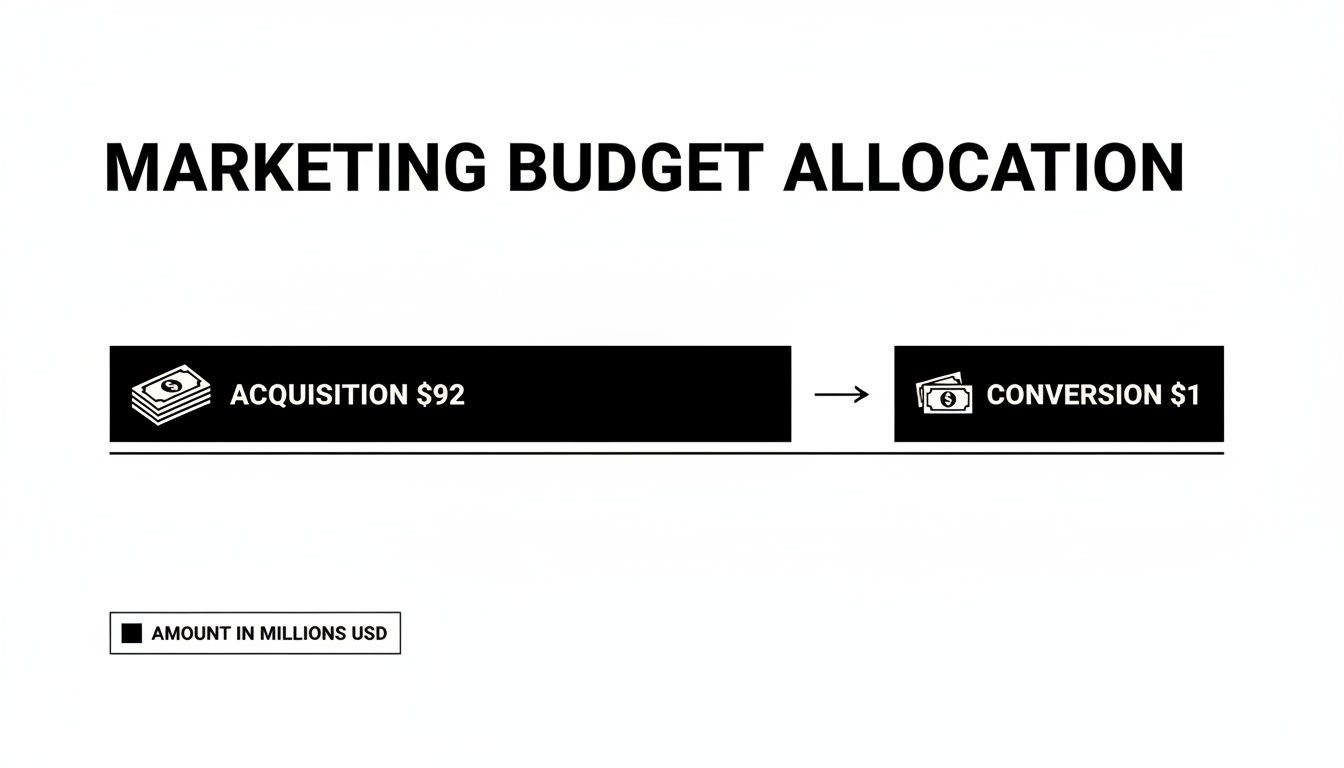
The graphic above says it all. This huge imbalance shows just how much opportunity is left on the table by failing to invest in optimizing the traffic you already paid for.
The Role of a CRO Audit
A real audit goes so much deeper than just that top-line conversion number. A consultant will slice and dice your data to answer the critical questions that tell the full story of your website's health.
A proper CRO audit will always dig into areas like:
- Performance by Traffic Source: Are visitors from your Google Ads campaigns converting better than those from organic search or Facebook? Knowing this helps you double down on what’s working and fix what isn’t.
- User Behavior on Key Pages: Where are people abandoning your checkout process or lead form? Using tools like heatmaps and session recordings, a consultant can pinpoint the exact points of friction.
- Device-Specific Conversion Rates: Is your mobile conversion rate tanking compared to desktop? This is often a dead giveaway of major usability problems on smaller screens.
By getting into these granular details, conversion optimization consultants can identify the most promising targets for improvement. It’s this data-first approach that ensures every tweak is strategic and aimed squarely at delivering measurable results.
If you want a head start on understanding your site's current state before bringing in an expert, our web audit checklist is a great place to begin.
The Collaborative CRO Process From Start to Finish
So you’ve decided to bring in a conversion optimization consultant. What does that partnership actually look like? Many business owners think it’s a hands-off deal where you just hand over the keys to your website and wait for magic. The reality is quite different.
Real, effective CRO is a deeply collaborative process. It's built on a foundation of open communication, shared business goals, and, most importantly, hard data.
To get a feel for how it works, let's imagine a popular Fells Point restaurant. They get solid website traffic and have a great local reputation, but their online reservation system is a mess. Bookings are stagnant. They bring in a CRO consultant to find out what’s broken.

From Discovery to Data-Backed Hypothesis
It all starts with a discovery call. This is where the consultant sits down with the Fells Point restaurant owner. We're not just talking conversion rates here; we're talking about the business itself. What are the busiest nights? What’s the average party size? The whole point is to connect the website's performance to real-world business objectives.
From there, we move into the site audit. Using tools like heatmaps and analytics, the consultant watches how actual users try to navigate the reservation page. A problem surfaces almost immediately: people are bailing when the form asks for too much information upfront. It's just too long and clunky for someone trying to book on their phone.
This observation isn't just a hunch; it's the raw material for a clear, testable hypothesis.
Hypothesis: "By simplifying the reservation form to only ask for name, party size, and phone number, and moving other questions to a post-booking confirmation, we can reduce form abandonment by 30% and increase completed reservations."
Notice how specific that is. It’s not a vague goal—it’s a measurable prediction that transforms ambiguity into a concrete action plan.
Implementing Tests and Iterating on Results
With a solid hypothesis, it's time for A/B testing. The consultant develops a new, simplified version of the reservation page (we'll call it Variant B). Using specialized software, 50% of website visitors are shown the original page (Variant A), while the other 50% get the new, streamlined version.
After running the test for a few weeks to ensure the data is statistically significant, the results are undeniable. The simplified form, Variant B, is converting at a 40% higher rate.
That's a huge win, but the work doesn't stop. A good CRO process is never one-and-done. The insights from this first successful test feed directly into the next hypothesis. Maybe the next experiment will focus on simplifying the menu page or adding a "Call to Book" button for large parties. During this phase, consultants often identify and implement direct conversion tools, such as features designed for driving instant conversions.
This is the very core of professional CRO: an iterative cycle of Audit > Hypothesize > Test > Analyze > Iterate. It’s a continuous loop of improvement where every decision is guided by user data, ensuring your website is constantly evolving to better serve your customers and crush your business goals.
Hyperlocal CRO Tactics for Baltimore Businesses
That generic advice you read on national marketing blogs? It just doesn't work in a place as unique as Baltimore. What connects with a customer in Silicon Valley is going to fall completely flat with someone who prides themselves on local community and character. Real success with conversion optimization consultants comes from digging into the specific nuances of each neighborhood and building a website experience to match.
This is where a true local partner shines. It’s about much more than just slapping "Maryland" on your contact page; it’s about weaving your business into the digital DNA of the communities you serve. That’s how you build real trust and show customers you’re part of their world.
After all, a boutique on the historic cobblestone streets of Fells Point has a completely different customer—and a different set of opportunities—than a law firm near Towson University. Your website needs to reflect that reality.
Fells Point: Drive Foot Traffic from Clicks
Let's say you run a small, independent shop in Fells Point. Your customers aren't just looking for a product; they're looking for an experience, for unique items, and for a personal connection. Your website's main job isn't just to make a sale—it's to be a magnet that pulls people into your physical store.
- Make "In-Store Pickup" a star player. Feature it prominently as a primary delivery option. This is perfect for locals already in the area who want the instant gratification of grabbing their purchase today.
- Lean into "Shop Local" messaging. Weave this pride point across your entire site. Banners, product descriptions, and your "About Us" story should all highlight your deep roots in the Fells Point community.
- Use authentic local imagery. Show off high-quality photos of your actual storefront, the surrounding neighborhood, and your team. This builds a powerful sense of place and proves you're the real deal.
This isn't just about keywords; it's about context. Showing you're part of the neighborhood fabric is a conversion tactic in itself.

This visual context tells a story, positioning your business as an integral part of the community, not just another faceless e-commerce site.
Towson and Canton: Convert on Credibility
Now, let's shift gears. A law firm in Towson or a home services contractor in Canton has entirely different goals. For them, conversion hinges on two things: trust and authority.
A professional services firm in Towson isn't selling a product off a shelf; they're selling expertise and reliability. Their website must immediately answer the question: "Why should I, a Maryland resident, trust you over anyone else?"
To build that immediate credibility, your website absolutely must:
- Showcase testimonials from local clients. A glowing review from someone in Baltimore, Towson, or Columbia is 10x more powerful than generic praise from a stranger in another state.
- Display your local credentials. Are you a member of the Maryland Chamber of Commerce? Did you win a "Best of Baltimore" award? Put those trust signals front and center.
- Feature hyper-local case studies. Show potential clients exactly how you've solved problems for other businesses or homeowners right here in their own community.
This deep, street-level understanding of the local market is a core part of what we do. If you're interested in going deeper on this strategy, you can see exactly how we handle hyper-local content for our clients. It's that relentless focus on Maryland-specific solutions that makes all the difference.
Choosing Your Maryland Conversion Optimization Consultant
Picking the right conversion optimization consultant is, without a doubt, the most important decision you'll make in this process. Get it right, and you'll uncover revenue streams you never knew existed. Get it wrong, and you're looking at a wasted budget and months of frustratingly flat results. This is especially true here in Maryland, where a deep understanding of the local market can make or break a campaign.
A true CRO partner does more than run a few A/B tests. They become an extension of your team, digging into your business model, understanding your specific customers, and tying every single action back to your bottom line. You're not just hiring a technician; you're looking for a strategic ally who gets the unique economic pulse of the Baltimore-Washington corridor.
Vetting Potential Partners
Before you even think about signing a contract, you need to ask some tough questions. The answers you get will tell you everything you need to know about a consultant's process, their experience, and whether they're the right fit for your Maryland business. Vague, hand-wavy responses are a huge red flag. A confident expert will have a clear, data-backed process and won't hesitate to share it.
Here are the non-negotiables you should be asking:
- Walk me through your testing process, from hypothesis to analysis. A pro should be able to outline a structured methodology for finding opportunities, building a testable hypothesis, running the experiment, and making sense of the results.
- Can you show me case studies from Baltimore-area clients in my industry? This is huge. A consultant who has already helped a Towson-based firm or a Canton retailer has a valuable head start in understanding your audience.
- How do you define and measure success? The answer needs to go beyond just "a higher conversion rate." Look for someone who talks about business metrics that actually matter, like lead quality, average order value, and—most importantly—revenue.
- What's in your toolbox for analytics, heatmapping, and testing? While the specific tools (like Hotjar or VWO) are less important than the strategy behind them, this question reveals their technical depth and the sophistication of their approach.
Choosing the right partner has never been more critical. The CRO software market alone was valued at $771.2 million in 2018 and is projected to explode to $1.932 billion by 2026. This rapid growth means more powerful tools are available to savvy local agencies, but it also means the market is flooded with unqualified players. Your job is to tell them apart.
To help you vet and choose the best conversion optimization consultant for your business, we've put together a simple checklist. Use these questions to guide your conversations and compare potential partners side-by-side.
Vendor Selection Checklist For Maryland Businesses
| Question to Ask | Why It Matters | Ideal Answer |
|---|---|---|
| Can you show me relevant case studies, especially from local Maryland businesses? | Local experience shows they understand the unique market dynamics, from Fells Point foot traffic to Towson student behavior. | They provide 1-2 specific examples from similar industries or locations, complete with anonymized data on the uplift in key metrics. |
| What is your process for creating a test hypothesis? | This reveals if they use data or just guesswork. A solid process is built on analytics, user research, and heatmaps—not just "best practices." | They describe a research-driven process involving data analysis, user behavior review, and qualitative feedback to identify real problems. |
| How do you define success and which KPIs do you focus on? | It ensures they're focused on your business goals (like revenue or lead quality), not just vanity metrics (like button clicks). | They ask about your most important business metrics and explain how they will tie CRO efforts directly to improving them, focusing on ROI. |
| What kind of reporting and communication can I expect? | You need transparency and a clear understanding of what’s happening. You should never be in the dark about your own project. | They promise regular, easy-to-understand reports, a dedicated point of contact, and a clear schedule for check-in calls. |
| Are your contracts based on long-term commitments or performance? | This shows their confidence. While long-term contracts aren't always bad, a consultant willing to prove their value over a shorter initial term is a good sign. | They offer flexible terms, perhaps a 3-month initial project or a pilot program, showing they are confident in their ability to deliver results. |
A thorough vetting process isn't about being difficult; it's about being diligent. Taking the time to ask these questions upfront will save you a world of headaches and financial loss down the road.
Red Flags to Watch Out For
Just as important as knowing what to look for is knowing what to run away from. Certain promises and behaviors should set off immediate alarm bells.
Be extremely wary of any conversion optimization consultant who guarantees specific results, like "We guarantee we'll double your conversion rate." True CRO is an experimental process; outcomes can be predicted based on data, but they can never be guaranteed.
Other major red flags to keep an eye on include:
- A fuzzy or non-existent methodology. If they can't explain their process, they don't have one.
- An obsession with a single tactic (e.g., "We just change button colors and headlines").
- Any hesitation to provide transparent reporting or give you access to the data.
- A complete lack of questions about your business goals, customers, or profit margins.
Choosing an agency is a major business decision. For an even more comprehensive list, check out our guide on the 10 questions you absolutely must ask before signing with a digital marketing agency. Armed with the right knowledge, you can confidently select a Maryland-based partner, like Raven SEO, who is ready to deliver real, measurable growth for your business.
Frequently Asked Questions About CRO
When we sit down with Maryland business owners, a few questions always come up about conversion optimization. It’s a field that can seem technical and full of jargon, so it's smart to get clarity before you commit.
Here are the straightforward answers to the questions we hear most often from local companies just like yours.
How Long Does It Take to See CRO Results?
This is the big one, and the honest answer is: it depends.
For simple, high-impact tests—like changing a button color, tweaking a headline, or rewriting a call-to-action—we can sometimes see statistically significant results in just a few weeks. The key ingredient is having enough website traffic to get reliable data quickly.
On the other hand, bigger projects take more time. A complete overhaul of your checkout process or a redesign of your main service pages might take a couple of months to properly implement, test, and measure. A good consultant knows how to balance this, prioritizing quick wins to build momentum while mapping out those larger, more strategic improvements.
Is My Maryland Business Too Small for Conversion Optimization?
Absolutely not. In fact, CRO can have a more dramatic and immediate impact on a smaller business.
Think about it this way: if your website gets a steady 1,000 visitors a month and you manage to lift your conversion rate from 1% to 2%, you’ve just doubled your leads without spending a single extra dollar on ads. That’s a game-changer.
The only real prerequisite is having enough traffic to run a valid test. If your visitor numbers are still very low, a trustworthy consultant will be upfront about it. They'll likely suggest focusing on SEO or paid ads first to build that initial audience. We work with Maryland businesses of all sizes, and the first step is always creating a roadmap that makes sense for where you are right now. For more ideas, you can explore some of our favorite conversion rate optimization tips.
What Is the Difference Between SEO and CRO?
This is a fantastic question, and the distinction is critical. We like to explain it with a party analogy.
SEO (Search Engine Optimization) is the art of sending out great invitations and directions so more guests show up to your party.
CRO (Conversion Rate Optimization) is the art of being a great host—making sure guests have a fantastic time, know where everything is, and do what you hoped they’d do (like sign the guestbook or take a party favor).
In short, SEO is about increasing the quantity of visitors coming from search engines. CRO is about improving the quality of their experience to get more of them to become customers. We see them as two sides of the same coin; they are most powerful when they work together to maximize your return on investment.
Ready to stop leaving money on the table and start turning more of your Maryland website visitors into loyal customers? The team at Raven SEO specializes in creating data-driven CRO strategies that deliver measurable results for local businesses.