

Your website's backlink profile is the sum of every single link pointing to your site from anywhere else on the web. Think of it as your digital reputation. Each link is like a vote of confidence, telling search engines that your site is a credible resource worth paying attention to.
A strong, healthy backlink profile is non-negotiable if you want to climb the search rankings. It’s the foundation of online authority.
Your Website's Digital Reputation
Imagine you just opened a new shop in town. If the most respected local business owners start telling their customers to check you out, people will trust you almost instantly. That’s exactly how a backlink profile works for your website.
Every time another site links to you, it’s a recommendation. It’s a signal to Google that your content is valuable, trustworthy, and authoritative. This profile isn't just a simple list of links; it’s a living record of who is vouching for you online, and it’s one of the most powerful factors search engines use to determine who deserves the top spot.
The Foundation of Online Authority
Every part of your backlink profile tells a piece of your story. A link from a major industry publication like Forbes carries a lot more weight than one from a brand-new, unknown blog. Why? Because search engines know that earning a mention from a highly respected source is tough and signals real expertise.
The context of that link matters, too. If an article about the best marketing agencies in Baltimore links to a local firm like Raven SEO, that’s a direct, powerful, and relevant endorsement. These votes of confidence add up, building your digital reputation piece by piece and directly influencing how easily new customers find you. To put it simply, your backlink profile is the total collection of all external links directed at your website. You can find more insights about link building statistics on presswhizz.com.
"Think of backlinks as votes of confidence that build a strong reputation with Google (and users) when coupled with other credibility-boosting elements, like excellent content and user experience."
To help you get a handle on what a backlink profile is made of, here’s a quick breakdown of the core elements that matter most.
Key Components of a Backlink Profile at a Glance
This table sums up the essential building blocks of your site's digital reputation, giving you a quick reference for what to look for when analyzing your own profile.
| Component | What It Means | Why It Matters for SEO |
|---|---|---|
| Link Quality | The authority and trustworthiness of the website linking to you. | High-quality links from reputable sites pass more authority and have a bigger impact on rankings. |
| Link Quantity | The total number of backlinks pointing to your website. | While less important than quality, a healthy number of links shows popularity and credibility. |
| Referring Domains | The number of unique websites linking to your site. | Diversity is key; 10 links from 10 different sites are more valuable than 10 links from one site. |
| Anchor Text | The clickable text used in a hyperlink. | It provides context to search engines about the linked page's content. A natural mix is vital. |
| Topical Relevance | How closely the linking site's topic relates to your own. | Links from industry-relevant sites are more powerful than links from unrelated ones. |
Understanding these components is the first step toward building a backlink profile that not only boosts your rankings but also establishes your website as a trusted authority in your field.
Deconstructing the Key Components of a Backlink Profile
To really get a handle on what a backlink profile is, you have to look past the total link count and start inspecting the individual parts. It’s a lot like baking a cake—having all the ingredients is a start, but it’s the quality and proportion of each that determines if you end up with something delicious or a total disaster. A strong, healthy profile is built from several key components all working together.
This infographic is a great way to visualize your backlink profile as your digital reputation. Each quality link you earn acts like a vote of confidence, building your site's authority over time.
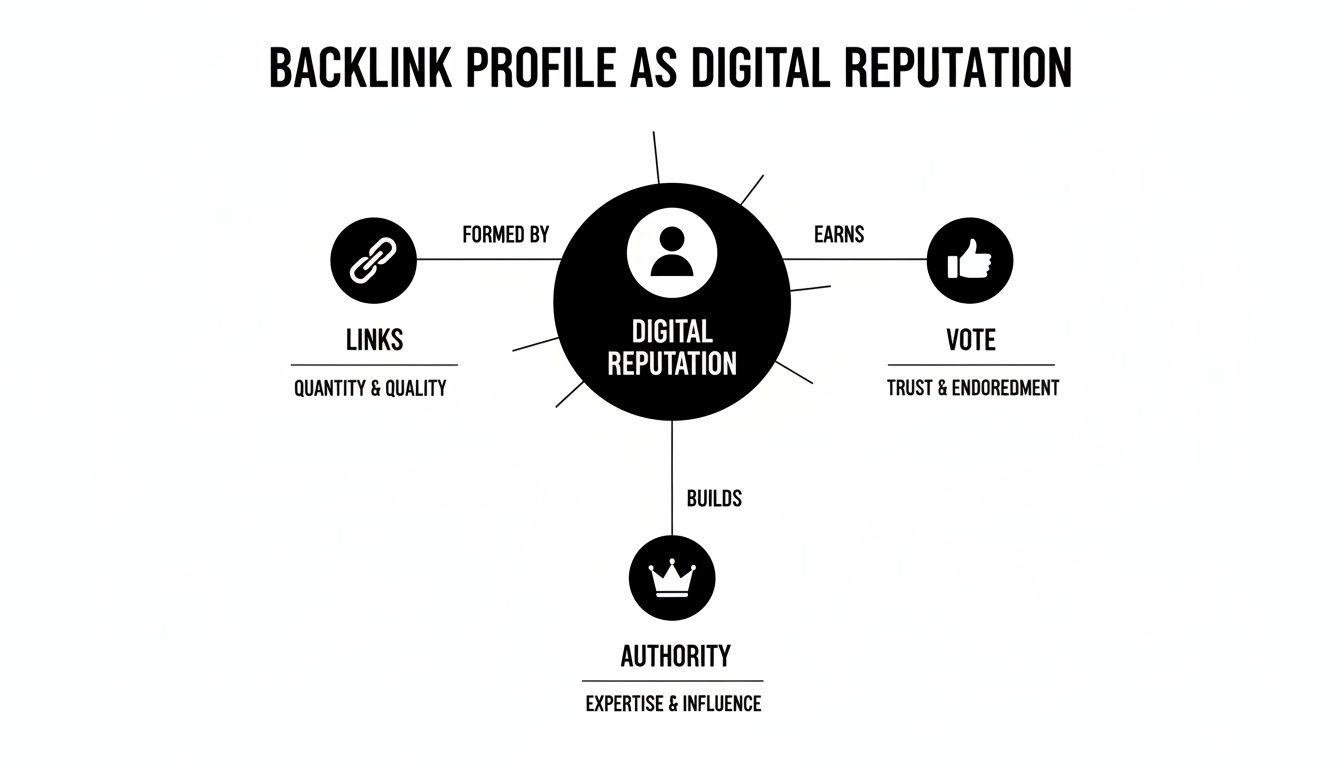
As the image shows, high-quality links are the foundation. Each one casts a "vote" that strengthens your overall authority in the eyes of search engines, making your site more trustworthy.
Quality Over Quantity, Always
One of the biggest myths in SEO is that more backlinks automatically mean better rankings. That’s just not how it works anymore. In reality, a single powerful link from a highly respected industry authority is worth far more than a hundred links from low-quality, unknown blogs.
Think of it this way: which would you rather have? One glowing endorsement from a top expert in your field, or a hundred anonymous, generic comments? Search engines are smart enough to tell the difference. A high-quality link signals genuine trust, while a flood of junk links can actually get you in trouble.
The Power of Referring Domains
Another critical piece of the puzzle is the number of referring domains—that is, the number of unique websites linking to you. Getting ten links from ten different reputable websites is a much stronger signal than getting ten links from the same exact site.
Why does this matter so much? Because a diverse range of referring domains shows search engines that a wide variety of sources find your content valuable. This broad consensus builds a much stronger case for your site's authority than repeated endorsements from a single source ever could.
Even gaining a handful of unique referring domains can put you way ahead of the curve. Shockingly, 55% of all indexed pages have zero referring domains. That means if Raven SEO helps your Baltimore business secure even a modest profile, you're instantly ahead of the vast majority of the web.
Anchor Text and Topical Relevance
Anchor text is the clickable text in a hyperlink, and it gives both search engines and users a big clue about what they'll find on the other side of the link. A healthy backlink profile has a natural, diverse mix of anchor text types. If every single link pointing to your site uses the same keyword-stuffed phrase, it looks manipulative and spammy to Google. You can dive deeper into this by checking out our guide on what anchor text is in SEO.
Just as important is topical relevance. A link from a website in your own industry is a powerful, relevant signal. If you run an eCommerce store selling hiking gear, a link from a popular outdoor adventure blog is a perfect match. A link from a random, unrelated site about pet grooming? Not so much.
Dofollow vs. Nofollow Links
Finally, we need to talk about 'dofollow' and 'nofollow' links. It sounds technical, but the concept is straightforward.
- Dofollow links are the standard type of link. They pass authority (often called "link juice") from one site to another and are the most valuable for directly influencing your search rankings.
- Nofollow links have a special tag added to them that tells search engines not to pass any authority. While they don't give you a direct SEO boost, they're still valuable. They can drive real referral traffic and help your link profile look natural and authentic.
A healthy profile has a good mix of both. In fact, a profile made up only of dofollow links can look unnatural to search engines. Having a balanced ratio is key for long-term success.
How Your Backlink Profile Influences Search Rankings
Think of your website's backlink profile as its online reputation. It’s far more than a simple list of links; it's a direct conversation you're having with search engines like Google. The algorithm constantly listens to this conversation to figure out how authoritative, trustworthy, and relevant your site really is.
Ultimately, what it hears determines where you show up in the search results.
A healthy, natural profile acts like a series of powerful endorsements from across the web. When other respected sites link to you, they're essentially vouching for your credibility, telling Google that your content is a valuable resource. This digital trust is absolutely essential for climbing to the top of the rankings for the keywords that matter to your business.
Each one of those quality backlinks also opens up a new pathway for potential customers to find you, driving valuable referral traffic and building your brand's authority for the long haul.
The Two Sides of Authority and Trust
Let’s use an analogy: your backlink profile is your website's credit score. High-quality links from reputable sources are like on-time payments from major lenders—they build your score and open up bigger opportunities. In the world of SEO, that means earning higher rankings and becoming known as a go-to resource in your industry.
The data backs this up loud and clear. Pages ranking in the top 10 of Google have, on average, 3.8 times more backlinks than the ones struggling on lower pages. It's a stark reminder of just how critical a strong profile is for visibility.
But here’s the catch: it's not just about quantity. It's estimated that around three in ten backlinks can be toxic, potentially poisoning your rankings if you're not paying attention. At Raven SEO, we use specialized tools to sniff out these threats and deal with them before they cause real damage.
On the flip side, a poor or "toxic" backlink profile can completely wreck your credibility. Links from spammy, irrelevant, or low-quality websites are like financial defaults on your credit report. They send a clear signal to Google that your site might be untrustworthy or, worse, trying to game the system.
Navigating the Risks of a Poor Profile
A bad backlink profile doesn't just hold you back from ranking higher; it can actively drag you down. If Google's algorithm spots a pattern of unnatural or manipulative links pointing to your site, it can trigger a penalty.
These penalties are devastating. Your rankings can plummet, and your organic traffic can dry up almost overnight. Clawing your way back from a Google penalty is a slow, painful process, which makes proactive management of your backlink profile non-negotiable.
A big part of building that trust is understanding exactly how search engines measure a page's authority in the first place. You can learn more about how to improve your website's credibility with our guide on what is page authority.
Of course, your backlink profile is just one piece of the larger SEO puzzle. For a more complete picture, it's helpful to explore other elements that influence search results, like the various ChatGPT ranking factors that are shaping online visibility today.
A Practical Guide to Analyzing Your Backlink Profile
Knowing the theory is one thing, but the real progress begins when you roll up your sleeves and actually dig into your own backlink profile. It's time to move from abstract concepts to concrete actions. A basic backlink audit doesn't have to be a super technical affair; it’s really just about asking the right questions to get a clear snapshot of your website's digital reputation.
This process lets you see your website the way search engines see it, helping you spot both your strengths and the hidden risks that might be holding you back. Think of it as a health check-up for your site's authority.
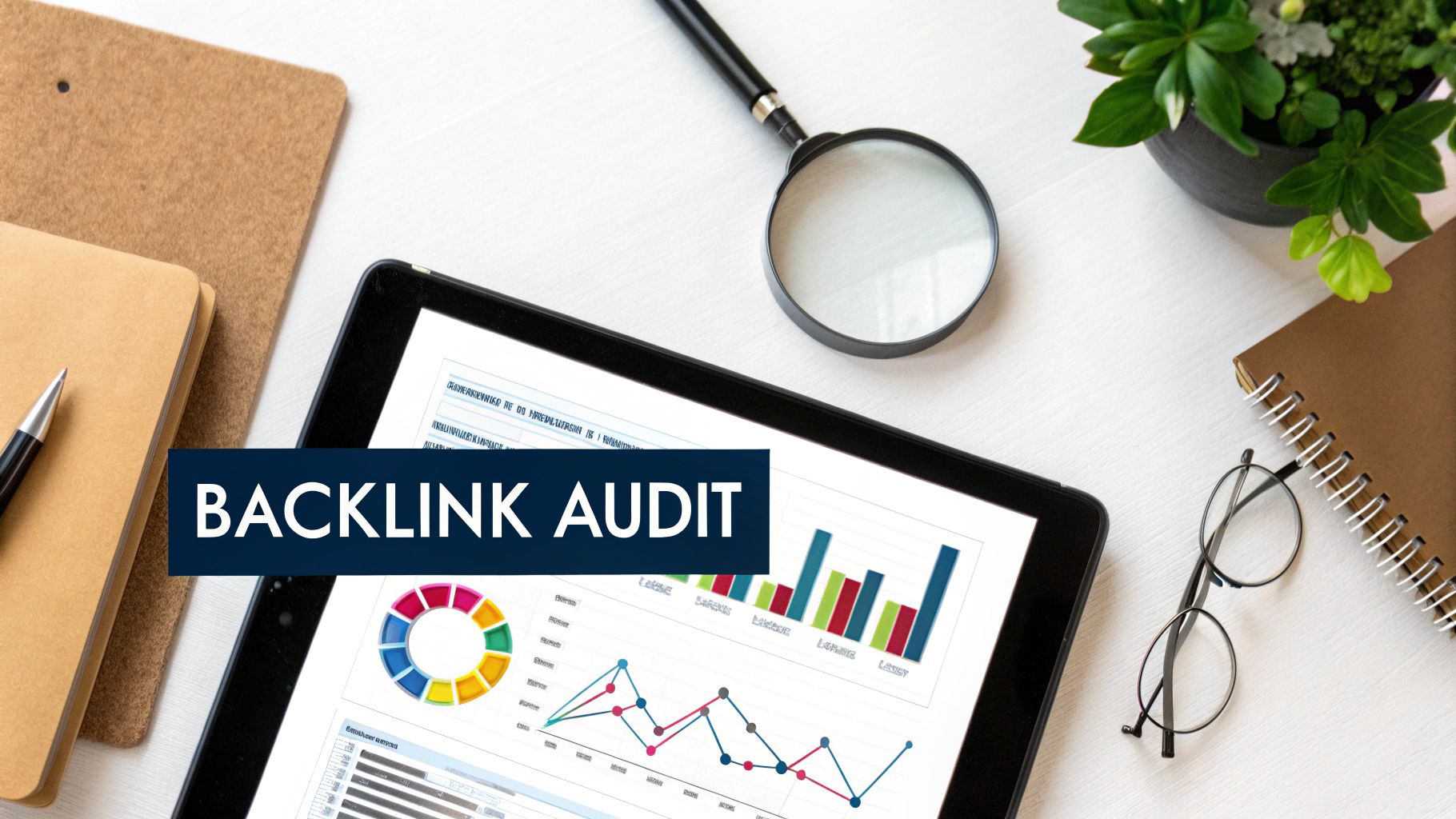
The image above perfectly captures the goal here—using data to get a clear, analytical view of your website's performance. The magnifying glass represents the detailed inspection needed to uncover the valuable insights hiding within the charts and graphs of your profile.
Your Initial Backlink Audit Checklist
For most small business owners and marketing managers, you can kick off a simple audit with just a few fundamental questions. You don't need to be an SEO wizard to get started; you just need to know what to look for.
This basic checklist will guide you through your first analysis. Grab a user-friendly tool, and let's find some answers.
Backlink Profile Audit Checklist for SMBs
For small-to-medium-sized businesses, a backlink audit doesn't need to be overly complex. This checklist breaks down the essential first steps for analyzing your profile to uncover strengths, weaknesses, and opportunities for growth.
| Audit Step | What to Look For | Why It's Important |
|---|---|---|
| 1. Check Referring Domains | The total number of unique websites linking to you. A good starting point is comparing this number to your direct competitors. | More unique, quality domains signal broader authority to Google. It's not just about the total link count; it's about the diversity of sources. |
| 2. Assess Link Quality | The authority and trustworthiness of the sites linking to you. Look for recognizable names, industry blogs, and established local sites. | High-quality links from authoritative websites pass more "link equity" and build trust. Low-quality links can do more harm than good. |
| 3. Analyze Topical Relevance | Are the linking sites in your industry or a related niche? A link from a local business journal is great; a link from a random gambling site is not. | Relevant links tell search engines what your site is about, reinforcing your topical authority and helping you rank for the right keywords. |
| 4. Review Anchor Text | The mix of clickable text used in your backlinks. A natural profile has a blend of branded ("Your Company"), keyword, and generic ("click here") anchors. | An over-optimized anchor text profile filled with exact-match keywords is a major red flag for Google and can lead to penalties. Natural is better. |
| 5. Identify Potential Toxicity | Look for obvious red flags: links from spammy directories, private blog networks (PBNs), foreign-language sites, or sites with thin content. | Toxic backlinks can hurt your rankings or even get your site penalized. Identifying them is the first step toward cleaning up your profile. |
By answering these core questions, you gain a solid, foundational understanding of where your backlink profile stands today. This isn't just an academic exercise; it's the first step in shifting from passively getting links to actively building a profile that drives real growth.
Using Tools to Uncover the Data
To answer the questions on your checklist, you'll need a tool to pull the necessary data. While many advanced platforms come with a monthly subscription, several offer free versions that are perfect for a preliminary audit. Ahrefs' free backlink checker, for example, can give you a quick overview of your top referring domains and most-linked-to pages.
When you pop your domain into a tool like this, it will spit out a report with key metrics like Domain Rating (DR), total number of backlinks, and the number of referring domains. Pay close attention to the actual list of websites linking to you. Do you recognize them? Are they reputable sources in your field?
This initial look provides the context you need to start forming a strategy. If you discover a lot of low-quality links or a lack of relevant referring domains, you know exactly where to focus your efforts first. For those looking to dive deeper, you might be interested in our guide on the 12 best link building tools to scale your SEO in 2025.
Alright, you've done the hard work of auditing your backlink profile. Now comes the fun part: taking what you've learned and actually building a stronger, more authoritative presence.
This isn't about finding quick hacks or loopholes. Lasting authority comes from sustainable, "white-hat" strategies that earn Google's trust. It’s time to move beyond the generic advice and focus on proven tactics that get real, high-quality links.
The goal here is to create a process that’s both achievable and effective, resulting in a profile that search engines and real people will respect. Let's dig into some of the best ways to do just that.
Create High-Value, Link-Worthy Content
This is the absolute bedrock of any good link-building campaign. You can't expect anyone to link to you if you don't give them a compelling reason. Exceptional, high-value content is that reason.
Forget churning out short, surface-level blog posts. Your focus should be on creating in-depth resources that people genuinely want to share and reference. Think ultimate guides, original research studies with new data, or detailed case studies that offer insights no one else has. These assets become natural link magnets because they serve as the go-to source for a topic in your industry.
Distribution is just as important. While data shows 63% of backlinks tend to point to a site's homepage, a smarter strategy diversifies those links across your most important service and product pages. For our clients, we've found that long-form content over 3,000 words is a powerhouse, attracting 3.5 times more backlinks than shorter articles. This makes it perfect for those deep-dive guides on niche topics.
Pursue Strategic Guest Posting
Guest posting on relevant, authoritative blogs in your niche is still one of the most effective ways to build quality backlinks. The key word here is strategic. Don't just blast out generic pitches to any site with a "write for us" page.
Instead, take the time to identify respected publications that your ideal customers actually read and trust. When you contribute a genuinely helpful, well-written article, you're not just getting a link. You're accomplishing several things at once:
- You earn a relevant backlink from a trusted source.
- You expose your brand to a new, targeted audience.
- You establish yourself as an expert in your field.
Remember, the goal is to provide real value to the host blog's readers, not just to drop a link and run. A thoughtful, generous contribution will always outperform a thinly veiled advertisement.
Leverage Digital PR and Industry Partnerships
Think beyond traditional SEO tactics for a minute and embrace the power of digital public relations. This is all about building real relationships with journalists, bloggers, and influencers in your space.
When you have something genuinely newsworthy to share—like an interesting piece of original research or a unique company story—these connections can turn into high-authority media placements and incredibly valuable backlinks.
Building a great backlink profile isn't a one-time project; it's an ongoing process of creating value and building relationships. Every piece of great content you publish and every connection you make is a step toward strengthening your online authority.
Similarly, fostering partnerships with complementary, non-competing businesses can open up a world of link-building opportunities. You could co-host a webinar, co-author an ebook, or simply feature each other in your content. These collaborations are a true win-win, providing value to both of your audiences while generating natural, relevant backlinks in the process. You can find more ideas in our guide on how to build backlinks naturally.
Partnering with Raven SEO for a Stronger Profile
Let's be honest—understanding what a backlink profile is, let alone managing one, can feel like a full-time job. It's a constant cycle of auditing for toxic links, creating content that actually earns good ones, and using specialized tools to make sense of it all.
This isn't an asset you can just hope for the best with. It demands a real strategy. That leaves you with a choice: spend countless hours and resources trying to master this yourself, or bring in a team of experts to protect your investment and get you results faster. The right call really depends on your goals, your budget, and how quickly you want to grow.
Your Path to a Healthier Backlink Profile
At Raven SEO, we specialize in turning our clients' backlink profiles from a source of anxiety into a powerful engine for growth. We ditch the guesswork and implement a proven, data-driven process that works for businesses in Baltimore and beyond.
Our entire approach is built on three core pillars:
- In-Depth Audits: We start with a comprehensive deep-dive into your entire backlink profile. We pinpoint every toxic link that could be dragging you down and identify every high-quality link that's already working for you.
- Strategic Link Removal: Our team gets to work systematically removing or disavowing the harmful backlinks we find. This cleans up your profile and acts as a crucial shield against potential Google penalties.
- Customized Link Building: This is where the growth happens. We develop and execute powerful link-building strategies tailored to your specific business goals. Our focus is always on earning relevant, high-authority links that build lasting trust and drive real, measurable results.
A strong backlink profile doesn’t just happen. It’s the direct result of a deliberate, well-executed strategy that builds authority, drives traffic, and grows your business over the long haul.
We know every business is different. That’s why we kick off every partnership with a no-obligation consultation to really understand your objectives and see where you stand today. This lets us build a practical roadmap designed just for you. If you want to see exactly how we prove our results, you can learn more about our process for showcasing proof of work to search engines.
Ready to take control of your backlink profile? Schedule a consultation today and let's get started.
Frequently Asked Questions About Backlink Profiles
As we wrap up, let's tackle some of the most common questions that come up when business owners start digging into their backlink profiles. This section provides quick answers to help solidify what we've covered.
How do I check my website's backlink profile?
You can check your backlink profile using various SEO tools. Many platforms like Ahrefs, SEMrush, and Moz offer free backlink checkers that provide a high-level overview of your referring domains, top linked pages, and anchor text distribution. For a deeper analysis, you'll typically need a paid subscription, which allows you to export full link lists, track new and lost links, and identify potentially toxic backlinks.
Can a bad backlink profile really hurt my website?
Absolutely. A profile overloaded with spammy, irrelevant, or shady links sends a massive red flag to Google, telling the algorithm your site can't be trusted. This can trigger a manual penalty from a human reviewer or get you suppressed by an algorithm update, causing your rankings and traffic to completely tank. This is why auditing your profile isn't a one-time task; it's essential maintenance.
Your backlink profile is like a digital resume. The quality of your references matters way more than how many you have. One glowing recommendation from a respected leader in your field will always outperform a hundred generic endorsements from strangers.
This isn't just theory, either. The positive impact of strategic, high-quality link building shows up fast. Industry data shows 89.2% of SEOs see ranking improvements within one to six months of getting new links, with many reporting a boost in just a few weeks. You can explore more link building statistics to see how this plays out across the industry.
What’s the difference between a referring domain and a backlink?
It's a simple but important distinction. A referring domain is the unique website linking to you. A backlink is the actual, individual link itself. So, if a local business blog writes about you and links to your site ten different times in one article, you've gained ten backlinks but only one referring domain. A core goal of any solid SEO strategy is to earn links from a wide, diverse group of high-quality referring domains, not just a ton of links from the same one or two sites.
Ready to stop guessing and start building a backlink profile that drives real growth? The experts at Raven SEO create data-driven strategies to clean up harmful links and earn the high-quality backlinks your business deserves. Schedule your no-obligation consultation today.