
At its core, the difference between digital and traditional marketing comes down to two things: the channels you use and how you measure success. Digital marketing lives online—think search engines, social media, and email—letting you run highly targeted and measurable campaigns. On the other hand, traditional marketing sticks to offline media like print, TV, and billboards to cast a much wider net.
Deciding which to use depends entirely on your goals. Are you chasing pinpoint precision and hard data, or are you trying to build broad, general brand awareness? This guide will help you understand the strengths of each, making the digital vs traditional marketing decision clearer for your business.
Defining The Marketing Battleground
Before you can build a winning strategy, you need to understand the fundamental philosophies driving each approach. These aren't just different toolkits; they represent two distinct ways of thinking about how to connect with customers. As technology evolves, even modern takes like AI vs traditional advertising methods highlight this growing divide.
What Is Traditional Marketing?
Traditional marketing covers any promotion that existed before the internet became a household staple. It's the classic, old-school method, often a one-way street where a business broadcasts its message out to a massive audience, hoping it sticks.
Think of it as casting a wide net across the ocean. Its key channels include:
- Print Media: Newspapers, magazines, flyers, and direct mail.
- Broadcast Media: Television and radio commercials.
- Outdoor Advertising: Billboards, bus benches, and transit ads.
- Direct Contact: Telemarketing and event sponsorships.
This approach is fantastic for building general brand recognition in a specific geographic area. A Super Bowl commercial or a full-page ad in The New York Times isn’t about tracking clicks; it's about making a brand a household name by hitting millions of eyeballs at once.
What Is Digital Marketing?
Digital marketing, in contrast, covers every marketing effort that uses an electronic device or the internet. It’s all about creating a two-way conversation, which allows businesses to engage directly with their audience and get instant feedback. Our guide on digital marketing best practices shows just how these dynamic strategies work in the real world.
This approach is built on precision and interaction. The most popular channels are:
- Search Engine Optimization (SEO): Getting found on Google when customers are actively searching.
- Social Media Marketing (SMM): Building a community on platforms like Facebook and Instagram.
- Email Marketing: Nurturing leads and customers with direct, personalized communication.
- Pay-Per-Click (PPC) Advertising: Running laser-targeted ads on search engines and social media.
The real superpower of digital marketing is its measurability. You can track every click, share, and conversion, giving you crystal-clear data on how your campaigns are performing and what your return on investment (ROI) actually is.
To give you a quick, at-a-glance view of how these two worlds stack up, here’s a high-level comparison.
High-Level Comparison: Digital vs. Traditional Channels
| Metric | Digital Marketing | Traditional Marketing |
|---|---|---|
| Primary Channels | SEO, Social Media, PPC, Email | Print, TV, Radio, Billboards |
| Audience Targeting | Highly specific and data-driven | Broad and demographic-based |
| Interaction | Two-way, interactive engagement | One-way, passive broadcast |
| Measurement | Precise, real-time analytics | Estimates, surveys, and recall |
| Cost Structure | Often lower entry cost, pay-per-performance | High upfront investment, fixed costs |
| Flexibility | Campaigns can be adjusted instantly | Difficult to change once launched |
This table lays out the core differences, but the real magic happens when you understand how to blend these approaches. Now, let's dive deeper into what makes each one tick.
A Head-to-Head Channel Comparison
Deciding between digital and traditional marketing isn't about picking an outright winner. It's about knowing which tool to pull from the toolbox for a specific job. To make the right call, you have to go deeper than a simple pros-and-cons list and really compare how these channels stack up against your business goals.
Every digital channel has an old-school counterpart, designed to do a similar job but in a completely different way. Let's break down these matchups to see how they actually perform in the real world. We'll pit the digital titans against their traditional equivalents to highlight the key differences in reach, cost, and overall effectiveness. This is where you'll see when to use modern precision and when to fall back on time-tested reach.
For Local Visibility: SEO vs. Yellow Pages
For decades, if you ran a local business and needed customers, the Yellow Pages was your first and last stop. It was the original search engine, a hefty book that sat by the phone, connecting customers with everyone from plumbers to pizzerias. Its strength was simple: it was everywhere.
But its weaknesses were glaring. Listings were static, surprisingly expensive, and gave you zero data on how they were performing. You paid for your space, crossed your fingers, and hoped the phone would ring, never knowing for sure if your ad was the reason.
Today, Search Engine Optimization (SEO) has completely taken over this role. When someone needs a local service now, their first move is a quick Google search. SEO is the entire process of making sure your business shows up at the top of those results, turning a static print listing into a dynamic, data-rich digital storefront.
Unlike the Yellow Pages, SEO gives you:
- Real-Time Analytics: You can track exactly how many people find your business through search, click to your website, and contact you.
- Targeted Reach: Your business appears at the precise moment a potential customer is actively looking for the services you provide.
- Cost-Effectiveness: While SEO is an investment, it almost always delivers a higher and more measurable ROI over the long term than a static print ad ever could. Our guide on paid vs. organic search breaks down how to balance this strategy even further.
Key Takeaway: For local businesses trying to attract active customers, SEO isn't just a better choice—it's the only choice. It transforms a passive listing into an active, lead-generating machine.
For Direct Response: PPC Ads vs. Print Ads
Direct response marketing is all about getting someone to do something right now—make a call, visit a site, or buy a product. Traditionally, newspapers and magazines were the channels for this. A business would run an ad with a coupon or a special phone number to drive and track responses.
The problem with print ads? The long lead times and total lack of flexibility. Once that ad is printed, you can't change a thing. On top of that, measuring its true impact is mostly guesswork, and you're paying to reach a broad audience, many of whom have zero interest in your offer.
Enter Pay-Per-Click (PPC) advertising, like Google Ads. PPC is the digital evolution of direct response, built for speed, precision, and accountability. You create ads that appear in search results or on websites, and you only pay when someone actually clicks.
This model is a complete game-changer:
- Instant Feedback: You can launch a campaign and see results pouring in within hours, not weeks.
- Hyper-Targeting: Your ads can be aimed at people based on the keywords they search, their location, demographics, and even their past online behavior.
- Budget Control: You have total control. Set your own budget and adjust or pause campaigns at any moment based on how they're performing.
This shift toward measurable, targeted advertising is clear in global spending. In 2023, digital ad spend shot up to $601.8 billion, making up 67% of all media spending. That number is expected to blow past $730 billion by 2025, showing just how much businesses prefer the precision of digital. You can find more of these marketing industry stats on entrepreneurshq.com.
For Brand Awareness: Social Media Marketing vs. TV Commercials
When your goal is building brand awareness and forging an emotional connection, TV commercials have long been the heavyweight champion. A single primetime spot could put your brand in front of millions of people at once, creating massive recognition and making you part of the cultural conversation.
The power of TV is its ability to combine sight, sound, and story. But that power comes with a massive price tag, putting it out of reach for most small and medium-sized businesses. It’s also a one-way street—a monologue with little to no audience interaction.
Social Media Marketing (SMM) provides a much more accessible and interactive way to build a brand. Platforms like Facebook, Instagram, and TikTok let businesses reach huge audiences, but with far more nuance and two-way engagement.
Instead of just broadcasting a message, SMM lets you:
- Build a Community: You can talk directly with your audience through comments, messages, and live videos, building genuine loyalty.
- Target Niche Audiences: You can deliver your message to people based on their specific interests, behaviors, and affiliations, making sure it actually resonates.
- Create Shareable Content: Unlike a TV ad, social content is made to be shared, organically amplifying your reach through digital word-of-mouth.
A TV commercial is a monologue; social media marketing is a conversation. That dialogue forges a stronger, more personal connection between a brand and its customers, often for a tiny fraction of what a traditional broadcast campaign would cost. The choice between digital vs traditional marketing channels always comes down to what you want to achieve and who you need to reach.
Measuring Success With Data and Analytics
One of the sharpest dividing lines in the digital vs. traditional marketing debate is how you measure what’s working. Traditional marketing often feels like shouting into a canyon and waiting for an echo. You can estimate how many people might have seen your billboard or heard your radio ad, but connecting that exposure directly to a sale is notoriously difficult.
Digital marketing, on the other hand, is a world of precision and clarity. Every single action is trackable. Using tools like Google Analytics, you can follow a customer’s entire journey—from their first click on an ad to their final purchase. This gives you a crystal-clear picture of your return on investment (ROI). It’s an approach that removes the guesswork, allowing for constant refinement.
The Granularity of Digital Metrics
Digital marketing provides a level of detail that traditional methods simply can't touch. You’re no longer dealing with broad estimations. Instead, you get specific, actionable metrics that tell a story about your campaign’s performance and your audience's behavior.
Instead of guessing, you know exactly:
- Cost Per Acquisition (CPA): How much it costs to gain one new customer from a specific campaign.
- Click-Through Rate (CTR): The percentage of people who saw your ad and were interested enough to click it.
- Conversion Rate: The percentage of website visitors who complete a key action, like making a purchase or filling out a form.
- Customer Lifetime Value (CLV): How much revenue a single customer is worth to your business over time.
This detail empowers you to make smarter decisions in real-time. If a Facebook ad isn't performing, you can pause it, adjust the targeting, or tweak the copy immediately. You just can't do that with a magazine ad that’s already gone to print. Our guide on how to measure digital marketing success dives deeper into these critical KPIs.
The Ambiguity of Traditional Measurement
Measuring a traditional campaign relies heavily on indirect methods and correlations. It’s more of an art of approximation than a science of exact figures. Marketers often use proxies to gauge impact, which can be helpful but lack the hard certainty of digital analytics.
Common traditional measurement techniques include:
- Brand Recall Surveys: Calling people to ask if they remember seeing your TV commercial.
- Spikes in Sales: Looking for a jump in overall sales after a campaign launch and hoping it wasn't just a coincidence.
- Unique Coupon Codes: Printing a specific code on a flyer to track redemptions—one of the few direct methods available.
- Estimated Reach: Using viewership or readership numbers to estimate how many people were potentially exposed to an ad.
Key Insight: Digital marketing measures actual user actions, while traditional marketing measures potential audience exposure. This fundamental difference is why businesses are increasingly shifting their budgets toward channels that offer undeniable proof of performance.
ROI and Measurement Benchmarks
The difference in measurability directly impacts the ROI you can expect and prove. Here’s a quick look at typical benchmarks and the metrics used to track performance across different channels.
| Channel | Typical ROI Benchmark | Key Measurement Metrics |
|---|---|---|
| Email Marketing | 36:1 | Open Rate, CTR, Conversion Rate, Unsubscribe Rate |
| SEO | Varies (High, Long-Term) | Organic Traffic, Keyword Rankings, Conversion Rate, Backlinks |
| PPC Advertising | 2:1 | CTR, Cost Per Click (CPC), CPA, Conversion Rate |
| TV Advertising | Hard to Isolate | Gross Rating Points (GRPs), Reach, Frequency, Sales Lift |
| Direct Mail | 1.3:1 | Response Rate, Conversion Rate (via codes), Cost Per Lead |
| Print Advertising | Hard to Isolate | Readership, Ad Recall Surveys, Coupon Redemptions |
These benchmarks show a clear pattern: channels with precise tracking tend to deliver a more easily quantifiable—and often higher—return.
Real-World Scenarios in ROI Tracking
Let’s look at how this plays out in the real world. An eCommerce store in Baltimore runs a targeted email campaign. They can track precisely how many people opened the email, clicked the link, added an item to their cart, and completed the purchase. They know their exact ROI, right down to the penny.
Now, imagine a local law firm runs a radio ad across Maryland. They might see an increase in phone calls, but they can't be certain which calls came directly from the ad unless every single new caller is meticulously asked how they heard about the firm. This data is often incomplete, making it tough to justify the ad spend with concrete evidence.
Digital marketing’s ability to deliver a clear ROI is backed by hard numbers. Email campaigns, for example, can generate an average return of $36 for every $1 spent. That’s a figure print or broadcast alternatives struggle to even calculate, let alone match. At Raven SEO, our clients in industries like home services and healthcare see powerful returns because we focus on these data-driven channels, turning marketing from an expense into a predictable driver of growth.
Targeting Your Audience with Precision
One of the most profound differences in the digital vs. traditional marketing debate comes down to a simple question: who are you talking to?
Traditional marketing has always operated like a megaphone. It broadcasts one message to a massive, largely undefined audience. Think of a billboard on a busy highway or a primetime TV spot—it’s a numbers game, built on the hope that if you reach enough people, some of them will be the right people. This is the classic "shotgun" approach. It can build general brand awareness, sure, but a huge chunk of your budget gets spent on people who will never, ever become your customers.
The Surgical Precision of Digital Targeting
Digital marketing, on the other hand, is more like a laser. It gives you the power to go beyond broad demographics like age or gender and find individuals based on their specific online behaviors, interests, and even their past interactions with your brand. This kind of focus was pure science fiction just a couple of decades ago.
With digital tools, you can connect with potential customers in ways that feel personal and directly relevant to their immediate needs. This is done through a few incredibly powerful methods:
- Demographic Targeting: Go deeper than the basics to target users by income level, education, parental status, and even specific life events.
- Behavioral Targeting: Reach people based on their online actions, like the websites they visit, the content they read, or their recent purchase history.
- Retargeting: Re-engage users who visited your website but left without converting. It’s the perfect way to remind them of what they were interested in.
- Lookalike Audiences: Find brand new customers by identifying users who share the same characteristics as your most valuable existing customers.
This ability to slice and dice your audience means your message gets delivered only to those who are most likely to care. It not only makes your campaigns more effective but also dramatically cuts down on wasted ad spend.
Key Insight: Digital marketing’s real power isn’t just in reaching people—it’s in reaching the right people, at the right time, with the right message. It transforms marketing from a monologue into a meaningful conversation.
Real-World Scenario: A Local Law Firm
Let's make this real. Imagine a family law firm based in Baltimore. Their ideal client lives within a 20-mile radius and has recently searched Google for things like "divorce attorney near me" or "child custody lawyer in Maryland."
Using a traditional marketing approach, the firm might buy a full-page ad in a city-wide newspaper. Thousands will see it, but the vast majority—from college students to retirees—have zero need for a family lawyer right now. The firm pays to reach everyone, hoping to catch the tiny fraction who are actually looking for their services.
Now, let's look at the digital approach. The firm can use Local SEO and Google Ads to guarantee their website shows up at the exact moment a potential client in their service area searches those critical keywords. They can also run Facebook ads targeting users who have recently updated their status to "separated." Every single dollar is aimed at a highly qualified lead, which skyrockets the chances of a conversion.
Of course, this level of precision is only possible when you truly understand who your customer is. Check out our guide to learn how to create buyer personas that will fuel these hyper-effective targeting strategies.
Why Precise Targeting Drives a Higher ROI
At the end of the day, marketing is about generating a positive return on investment. The focused, targeted nature of digital marketing directly leads to a much healthier ROI.
Here's why:
- Reduced Wasted Spend: You simply stop paying to show ads to people who have no interest in what you sell. Every dollar works harder.
- Increased Conversion Rates: When your message is highly relevant to the person seeing it, they are far more likely to take the action you want them to take.
- Improved Personalization: Speaking directly to a user's specific needs and problems builds a much stronger connection and fosters real brand loyalty.
For any business watching its budget, this is a complete game-changer. Instead of pouring money into a broad traditional campaign with fuzzy results, you can invest a smaller amount into a targeted digital campaign and get back clear, measurable outcomes. At Raven SEO, we specialize in helping businesses pinpoint their ideal customers, making sure every marketing dollar is an investment in real growth.
Building the Right Marketing Mix for Your Business
The whole digital vs. traditional marketing debate? It's the wrong question. It’s never been about picking a winner. Smart businesses know the real goal is to build a powerful, integrated marketing mix that’s perfectly tuned to their industry, their audience, and what they’re trying to achieve.
A one-size-fits-all strategy just doesn't cut it. The ideal blend for a local coffee shop in Annapolis will—and should—look completely different from the plan for a national e-commerce brand. Crafting the right mix means getting strategic and focusing on measurable outcomes, not just your favorite channels. The key is to pick channels, both old and new school, that work together to guide a customer from "who are you?" to "take my money" and, finally, to "I'll be back." That synergy is what turns your marketing budget from an expense into a growth engine.
A Blueprint for Local Small and Medium Businesses
If you run a local business—a restaurant, a home service company, a retail shop—your world revolves around driving foot traffic and getting the phone to ring within a specific geographic area. Your marketing mix needs to be laser-focused on building a community presence and showing up when locals search for what you offer. Digital is your foundation here, but traditional methods can give you an incredible local boost.
A solid starting point combines hyper-local digital tactics with traditional outreach that screams "we're part of this community."
Digital Core (70% of Budget):
- Local SEO: This is non-negotiable. Your Google Business Profile is your digital storefront. Optimizing it is how you show up in those critical "near me" searches and on Google Maps.
- Geotargeted Social Media Ads: Use Facebook and Instagram to run ads aimed specifically at people within a few miles of your door. Promote a happy hour, a weekend sale, or a special event.
- Email Marketing: Get customers on a list. Send them weekly specials, appointment reminders, and loyalty rewards to keep them coming back.
Traditional Support (30% of Budget):
- Event Sponsorships: Sponsoring the local little league team or the town’s summer festival puts your brand right in front of local families in a way that feels genuine and positive.
- Targeted Direct Mail: A well-designed flyer or postcard sent to specific neighborhoods can be surprisingly effective for announcing a grand opening or a big seasonal sale.
A Blueprint for E-commerce Retailers
E-commerce businesses live and die by their ability to drive qualified traffic and turn visitors into customers. It's a game of clicks and conversions. As you'd expect, their marketing mix is almost entirely digital, built for scalability, precise targeting, and obsessive ROI tracking. The goal is to create a seamless path from discovery to checkout.
Here, the strategy is all about dominating the digital shelf and relentlessly re-engaging anyone who shows interest.
Digital Core (95% of Budget):
- SEO and Content Marketing: You need to create genuinely helpful blog content and optimize every product page for keywords people are actually searching for. This is how you attract free, organic traffic from people actively looking to buy.
- Pay-Per-Click (PPC) Advertising: Google Shopping and search ads are absolutely essential. They put your product in front of high-intent buyers the exact moment they’re ready to pull out their credit card.
- Social Commerce and Retargeting: Use platforms like Instagram and Pinterest for product discovery. Then, run retargeting ads to bring back every single person who abandoned their shopping cart.
Traditional Support (5% of Budget):
- Niche Magazine Ads: If you're selling to a specific hobbyist or luxury market, a targeted ad in a popular print magazine can build serious credibility and reach a die-hard audience.
- Podcast Sponsorships: Sponsoring a podcast that your target demographic loves can be a fantastic way to drive brand awareness and direct traffic.
The best strategies don’t just use a bunch of channels; they create a seamless, integrated experience. To see how the pros pull this off, check out these integrated marketing campaign examples that show how to weave different tactics into a single, powerful story.
A Blueprint for Professional Services
For firms in law, healthcare, or consulting, marketing is all about building trust and establishing authority. The sales cycle is longer, and clients choose you based on your expertise and reputation, not on an impulse buy. That means your strategy has to be centered on education and building relationships. To get this right, it's worth exploring a guide to effective digital marketing strategies to see how you can integrate digital channels with a thoughtful, trust-building approach.
The ideal mix here balances deep, insightful digital content with the kind of traditional networking that builds a rock-solid industry presence.
Digital Core (60% of Budget):
- Content Marketing: Authoritative blog posts, in-depth whitepapers, and detailed case studies that solve client problems are your best tools for proving expertise and driving SEO.
- LinkedIn Marketing: Being active on LinkedIn is crucial. It’s where you build your professional network, share valuable insights, and connect directly with potential B2B clients.
- Email Newsletters: A regular newsletter sharing valuable industry updates keeps your firm top-of-mind with prospects and past clients, reminding them of your expertise.
Traditional Support (40% of Budget):
- Industry Publications: Placing articles or even well-targeted ads in respected trade journals can give your credibility a massive boost.
- Speaking Engagements: Getting on stage at industry conferences is one of the best ways to position yourself as a thought leader and generate powerful networking opportunities.
Ultimately, the right mix is never static. At Raven SEO, we specialize in helping businesses design, implement, and continuously fine-tune a blended marketing strategy, making sure every dollar you invest is working as hard as possible to hit your specific goals.
Answering Your Top Marketing Questions
Choosing between digital and traditional marketing always brings up a ton of practical questions. Where should I put my budget? How long will it take to see results? Is print even still a thing? Business owners want to know where to place their bets for the best possible return.
Let's cut through the noise and give you some straightforward answers to the questions we hear most often.
The decision tree below is a great starting point. It visualizes how different businesses—whether you're a local shop, an e-commerce brand, or a professional service—should think about their marketing mix right from the get-go.
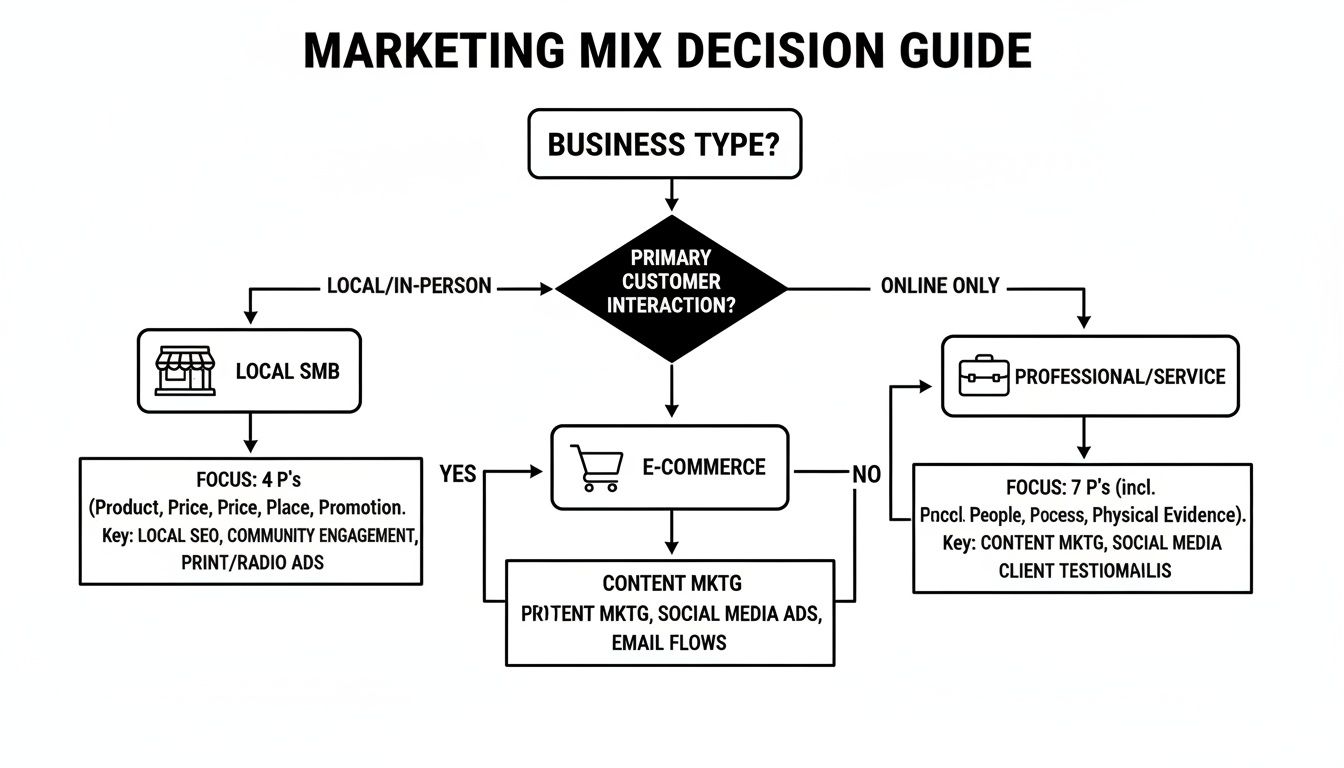
This flowchart helps simplify things by pointing you toward a primary focus based on your business model, ensuring your strategy is lined up with your specific goals.
Is Traditional Marketing Obsolete for a Small Business?
Not at all. While it's true that digital offers incredible tracking and targeting, traditional channels can still be absolute winners for specific goals, especially for businesses with a deep local footprint.
Think about it this way: sponsoring a community event or dropping targeted flyers can generate tangible local buzz and drive immediate foot traffic in a way a digital ad sometimes can't. When a local restaurant's logo is on the back of a youth soccer team's jersey, it creates a level of goodwill that a Facebook ad struggles to match.
The trick is integration, not replacement. A print ad, for example, can feature a QR code that sends people straight to a special online landing page. That simple addition builds a bridge between your offline and online worlds, letting you actually measure the ad's direct impact. The smartest strategies often use traditional channels to amplify and support digital efforts, creating a much richer customer experience.
How Do I Transition My Budget from Traditional to Digital?
Shifting your marketing budget needs to be a gradual, data-driven process—not an overnight flip of a switch. Rushing the transition without a clear plan is a surefire way to waste money and miss opportunities.
Start by auditing your current traditional marketing spend and what you think it's getting you. Pinpoint the channel that seems least effective and reallocate a small slice of that budget—say, 15-20%—to a foundational digital channel, like Local SEO or a targeted Google Ads campaign. This first step minimizes your risk while you start gathering real performance data.
Keep a close eye on the results of that test for at least three to six months. As you start to see a positive, measurable ROI from your new digital channel, you can confidently and progressively shift more of your budget over. An agency can help build a strategic roadmap for this transition, making sure you invest in the right digital channels for your specific goals without ditching what might still be working.
Crucial Takeaway: A successful budget transition is an evolution, not a revolution. Use data from small, controlled tests to guide your larger investment decisions, ensuring every dollar is reallocated for maximum impact.
What Is the First Digital Marketing Step I Should Take?
Before you spend a single dollar on ads, your most critical first step is to establish a professional, mobile-friendly website. Your website is your digital hub—it's the central destination where all your marketing efforts will ultimately point.
This foundation has to clearly communicate what you do, who you serve, and how customers can easily get in touch. Without a functional and persuasive website, any traffic you drive from ads or social media is likely to go to waste.
The second non-negotiable step is setting up Google Analytics and a Google Business Profile. These free tools are absolutely essential. Google Analytics is vital for measuring website traffic and understanding user behavior, while your Google Business Profile is the cornerstone of your entire local search presence. With this solid foundation in place, you can confidently start exploring other strategies like SEO or social media advertising, knowing you have the infrastructure to convert visitors and measure your success.
At Raven SEO, we specialize in building these foundational elements and creating integrated marketing strategies that drive real growth. Whether you're just starting your digital journey or looking to optimize your current mix, we provide the expertise to ensure your marketing efforts deliver measurable results. Get in touch for a no-obligation consultation today.